Facts
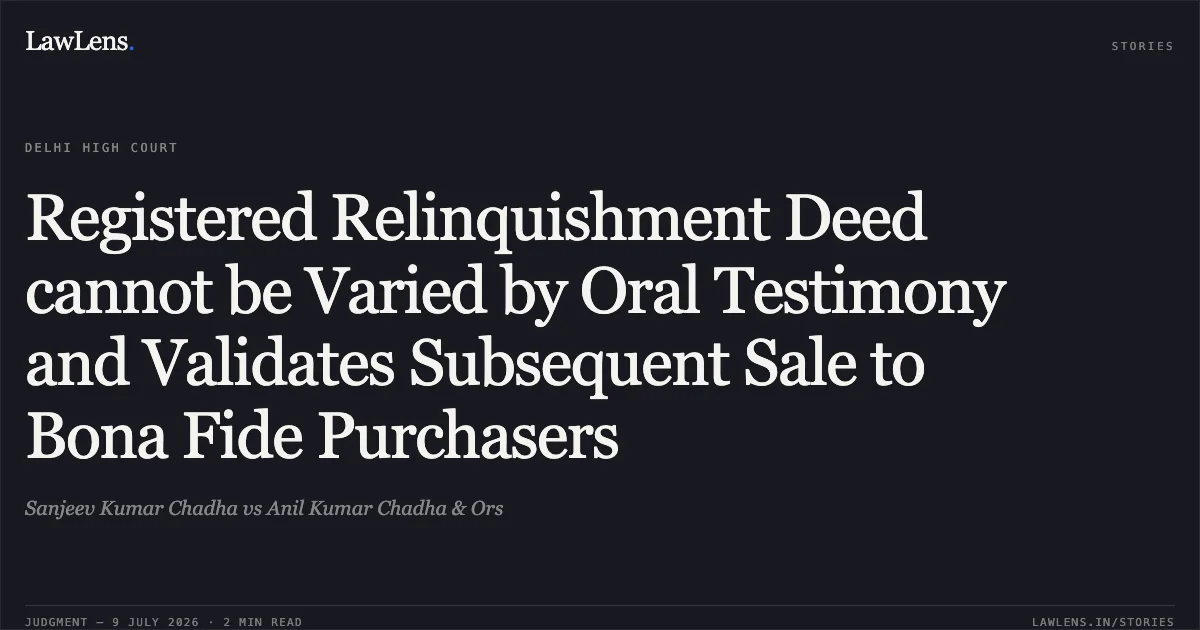
The suit property originally belonged to Late Sh. Pishori Lal Chadha. Following his death, the Appellant (Sanjeev), along with Respondents No. 2 and 3 and the Appellant's sister (Respondent No. 4, Ratna), executed a registered Relinquishment Deed dated 24.04.2003 in favor of their brother, Respondent No. 1 (Anil).
Source reference: p. 3Relying on this deed, Anil executed two registered Sale Deeds on 23.10.2007 in favor of Respondents No. 5 to 8 (purchasers).
Source reference: p. 3-4The Appellant challenged these Sale Deeds, claiming the Relinquishment Deed was conditional upon Anil distributing sale proceeds among all heirs and that the subsequent sales were sham/collusive transactions because the Appellant and Ratna remained in physical possession.
Source reference: p. 4, 13Ratna filed a counter-claim alleging the Relinquishment Deed was obtained by fraud and that she was the owner via a 1993 Will.
Source reference: p. 8The Trial Court dismissed the suit in 2019.
Source reference: p. 2, 12Issues
Whether the Sale Deeds dated 23.10.2007 executed by Respondent No. 1 in favor of Respondents No. 5 to 8 are null and void as sham or collusive transactions?
Source reference: p. 9, para 26 / p. 12, para 33Whether Respondent No. 4 (Ratna) is entitled to a declaration that the Relinquishment Deed dated 24.04.2003 is null and void based on fraud or a prior Will?
Source reference: p. 9, para 26 / p. 20, para 64-65Law Applied
Sections 91 and 92 of the Indian Evidence Act, 1872, which exclude oral evidence to contradict, vary, add to, or subtract from the terms of a written and registered contract.
Source reference: p. 5, 16Section 54 of the Transfer of Property Act, 1882, regarding the validity of Sale Deeds.
Source reference: p. 5Section 115 of the Indian Evidence Act regarding estoppel by conduct.
Source reference: p. 5Principle from Kewal Krishan v. Rajesh Kumar, noting that while a Sale Deed without consideration is void, the burden of proving such lack of consideration rests on the party alleging it.
Source reference: p. 14, 18Reasoning
The Court found that the Appellant, an educated person, admitted to the execution of the registered Relinquishment Deed. Per Sections 91 and 92 of the Evidence Act, the Appellant could not offer oral testimony to claim the deed was "conditional" upon future payment when no such clause existed in the document.
Source reference: p. 16, para 49-51Regarding the Sale Deeds, the Court held that the mere fact that the Appellant and Respondent No. 4 remained in physical possession did not invalidate the transfer of legal title; their status became merely "permissive".
Source reference: p. 17, para 53Though the purchasers were housewives who could not detail the source of funds during cross-examination, the Appellant failed to provide independent evidence to rebut the registered recitals showing payment of consideration (Rs. 16,21,000 and Rs. 16,00,000).
Source reference: p. 18, para 58-59Regarding Respondent No. 4’s claim, the Court noted she failed to produce attesting witnesses to prove the alleged 1993 Will as required by law and did not step into the witness box to substantiate her allegations of fraud or the revocation of the GPA.
Source reference: p. 19-20, para 64, 68Holding
The Court answered both issues in the negative and held that Respondent No. 1 acquired a valid title via the Relinquishment Deed and was competent to sell the property.
The High Court upheld the Trial Court's judgment, dismissed the Regular First Appeal, and disposed of all pending applications.
Source reference: p. 22, para 72-73Acts & Sections Cited
4 provisions across 3 statutes referred to in this judgment. Each provision opens on LawLens.
Code of Civil Procedure, 19082
Transfer of Property Act, 18821
Specific Relief Act, 19631
Original Court PDF
Sanjeev Kumar ChadhavsAnil Kumar Chadha & Ors
Click to open original judgment
Original judgment, available to read, download and summarize on LawLens.in