Facts
The appellant (plaintiff) filed a civil suit for declaration of title and permanent injunction regarding 2.47 acres of land in Village Bakela
Source reference: para. 2-3The plaintiff claimed ownership through a registered sale deed dated 06.02.1968 executed by Nageshwar Sao
Source reference: para. 3However, the plaintiff failed to mutate the land in the revenue records for 33 years, only attempting to do so in 2002
Source reference: para. 3, 11The defendants (respondents) contested the suit, asserting that their father, Siyambar, originally purchased and possessed the land, and that the revenue records were partitioned among them in 1995
Source reference: para. 5(a)-(b)The Trial Court dismissed the suit, finding the sale deed to be a sham and noting the plaintiffs' failure to prove possession
Source reference: para. 6The First Appellate Court affirmed this dismissal
Source reference: para. 8The appellant subsequently filed this second appeal under Section 100 of the CPC
Source reference: para. 1Issues
1. Whether the lower courts erred in law by failing to recognize the appellant’s title based on the registered sale deed (Ex. P/2) despite the absence of a counter-claim for its cancellation.
Source reference: para. 72. Whether the second appeal involves a substantial question of law warranting interference with the concurrent findings of fact regarding possession and title.
Source reference: para. 9, 13Law Applied
The court primarily applied Section 100 of the Code of Civil Procedure (CPC), which restricts the scope of a second appeal to cases involving a "substantial question of law"
Source reference: para. 1, 7, 13It relied on the principle that concurrent findings of fact by lower courts are generally binding unless shown to be perverse or based on no evidence
Source reference: para. 10Furthermore, the court applied the precedent established in State of Rajasthan and others v. Shiv Dayal and another (2019) 8 SCC 637, which holds that interference in a second appeal is only permissible if findings were recorded de hors the pleadings, based on misreading of evidence, or were legally untenable
Source reference: para. 11Reasoning
The Court observed that the lower courts’ findings were based on a proper appreciation of both oral and documentary evidence
Source reference: para. 9Specifically, the testimony of the plaintiffs' own vendor, Nageshwar Sao, revealed that he was never in possession of the suit land and had sold it within three months of his alleged acquisition without the consent of the co-owner, Siyambar
Source reference: para. 10This admission materially undermined the plaintiffs' claim of a valid transfer of title.
Source reference: para. 10The Court further noted that the unexplained 33-year delay in seeking mutation created a serious doubt regarding the genuineness of the plaintiffs' claim
Source reference: para. 11Because the plaintiffs failed to independently prove both title and lawful possession, the Court held that the validity of the sale deed was rightly questioned by the trial court
Source reference: para. 11-12Since the challenges raised by the appellant related essentially to the re-appreciation of evidence and findings of fact, they did not satisfy the "substantial question of law" threshold required under Section 100 of the CPC
Source reference: para. 12-13Holding
The High Court dismissed the appeal at the motion stage, holding that there was no illegality or infirmity in the judgments of the lower courts
The Court answered the issues by affirming that concurrent findings of fact cannot be disturbed in a second appeal unless perversity is shown, which the appellant failed to demonstrate
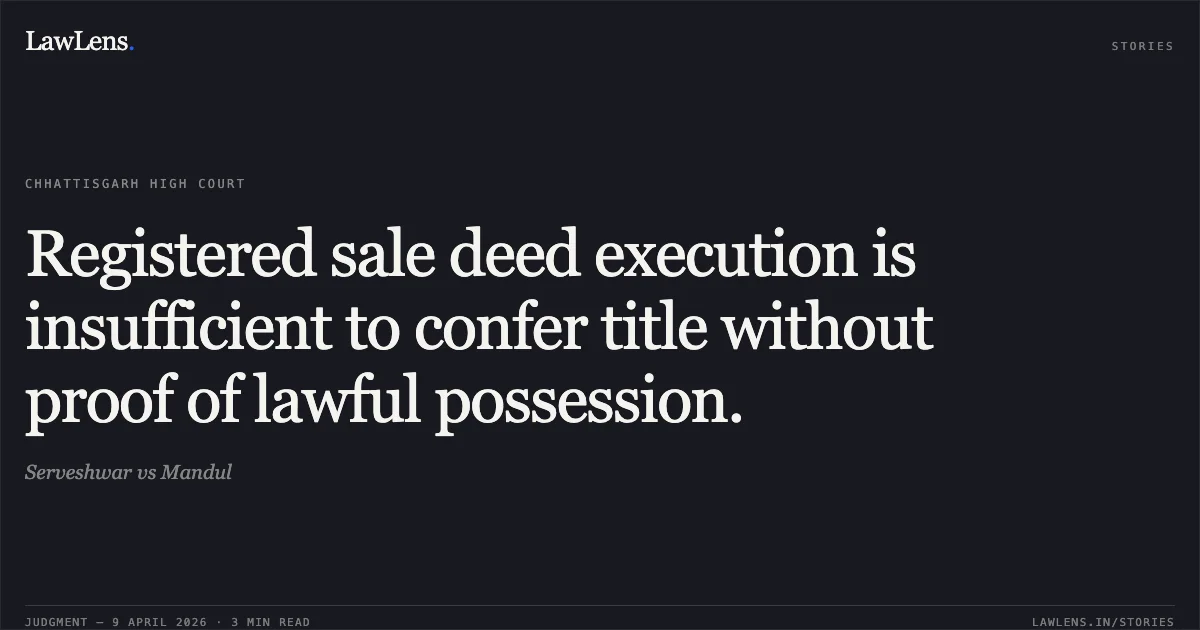
Source reference: para. 12The final holding maintained that mere execution of a sale deed without lawful possession and timely mutation does not automatically confer enforceable title in a suit for declaration
Source reference: para. 9, 11All reliefs were denied
Source reference: para. 13Acts & Sections Cited
1 provisions across 1 statute referred to in this judgment. Each provision opens on LawLens.
Code of Civil Procedure, 19081
Original Court PDF
ServeshwarvsMandul
Click to open original judgment
Original judgment, available to read, download and summarize on LawLens.in