Facts
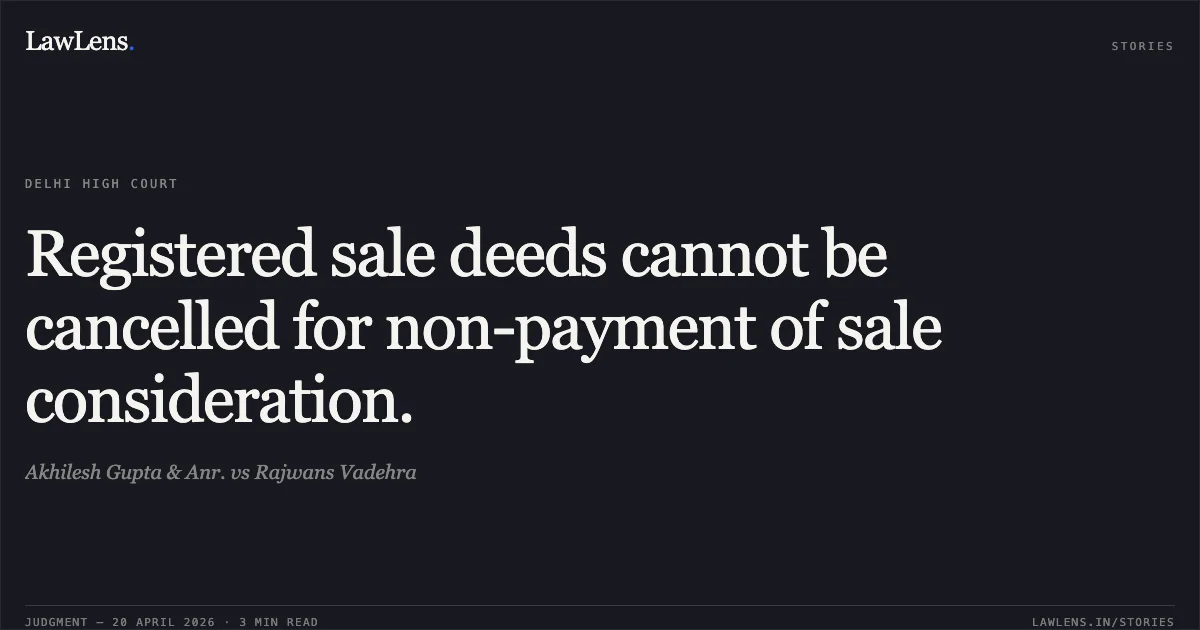
The Respondent (original owner) executed a registered Sale Deed on 07.10.2016 in favor of the Appellants for a shop in Chawri Bazar for a consideration of ₹7,25,000/-
Source reference: p. 2The Respondent filed a suit for declaration and possession, alleging that although the Sale Deed recorded payment via two cheques, the Appellants failed to deliver the cheques and later forcibly took possession of the property
Source reference: p. 2-3The Appellants contended that the cheques were handed over at the time of registration and that they had even sent a reminder letter to the Respondent on 14.12.2016 to encash them
Source reference: p. 4-5The Trial Court (District Judge) declared the Sale Deed null and void under Section 25 of the Indian Contract Act, holding that an agreement without consideration is void
Source reference: p. 6-7The Appellants challenged this decree before the Delhi High Court
Source reference: p. 7Issues
Whether the non-payment or non-receipt of the agreed sale consideration is a legal ground for the cancellation or avoidance of a registered Sale Deed
Source reference: p. 10Law Applied
Section 54 of the Transfer of Property Act, 1882, which defines "sale" as a transfer of ownership in exchange for a price "paid or promised or part-paid and part-promised"
Source reference: p. 10The Court relied on the Supreme Court precedent in Vidyadhar v. Manikrao, (1999) 3 SCC 573, which established that the actual payment of the full price is not a sine qua non for the completion of a sale
Source reference: p. 11The Court further applied the principles from Dahiben v. Arvindbhai Kalyanji Bhanusali, (2020) 16 SCC 366, holding that the appropriate remedy for non-payment of consideration is a suit for recovery of the balance amount, not the cancellation of the registered Sale Deed
Source reference: p. 11Sections 91 and 92 of the Indian Evidence Act, 1872, which preclude oral evidence from contradicting the written terms of a registered document
Source reference: p. 11Reasoning
The High Court found the Trial Court’s reliance on Section 25 of the Indian Contract Act to be erroneous; the transaction was not "without consideration" but rather involved a "promise to pay," which fits the definition of a sale under Section 54 of the TPA
Source reference: p. 11-12The Court reasoned that once a Sale Deed is executed and registered, the title passes to the transferee regardless of whether the price has been paid in full or in part
Source reference: p. 11Because the Sale Deed explicitly recorded that consideration was tendered via cheques and possession was delivered, the Respondent's oral claims to the contrary were held inadmissible under the Indian Evidence Act
Source reference: p. 11The Court emphasized that a seller cannot retain title or seek cancellation of a registered deed due to the non-encashment of cheques; the legal remedy is limited to a suit for the recovery of the unpaid price
Source reference: p. 11-12Holding
The High Court allowed the appeal and set aside the Trial Court's judgment and decree dated 15.05.2024, thereby dismissing the Respondent's suit for declaration and possession
The Court held that the Sale Deed remained valid despite the non-payment of consideration
Source reference: p. 12The Court directed the Appellants to pay the Respondent the sale consideration of ₹7,25,000/- along with interest at 12% per annum from the date of the Sale Deed until the date of actual payment
Source reference: p. 12Acts & Sections Cited
4 provisions across 4 statutes referred to in this judgment. Each provision opens on LawLens.
Code of Civil Procedure, 19081
Indian Contract Act, 18721
Specific Relief Act, 19631
Transfer of Property Act, 18821
Original Court PDF
Akhilesh Gupta & Anr.vsRajwans Vadehra
Click to open original judgment
Original judgment, available to read, download and summarize on LawLens.in