Facts
The appellants' predecessors (then minors) purchased 15 bigha, 11 biswa of land via a registered sale deed dated 04.06.1957
Source reference: p. 1-2Mutation was granted in 1984
Source reference: p. 2When consolidation proceedings commenced in 1991, the appellants filed objections under Section 9A of the U.P. Consolidation of Holdings Act, 1953, seeking record of their names
Source reference: p. 2The Consolidation Officer, Settlement Officer, and Revisional Authority concurrently rejected the claim, holding that the sale deed was void for violating the ceiling limits under Section 154 of the U.P. Zamindari Abolition and Land Reforms Act, 1950 ("Abolition Act"), and that its execution was unproven due to discrepancies in the testimony of the attesting witness
Source reference: p. 3-4The High Court of Uttarakhand upheld these findings in 2017
Source reference: p. 4Issues
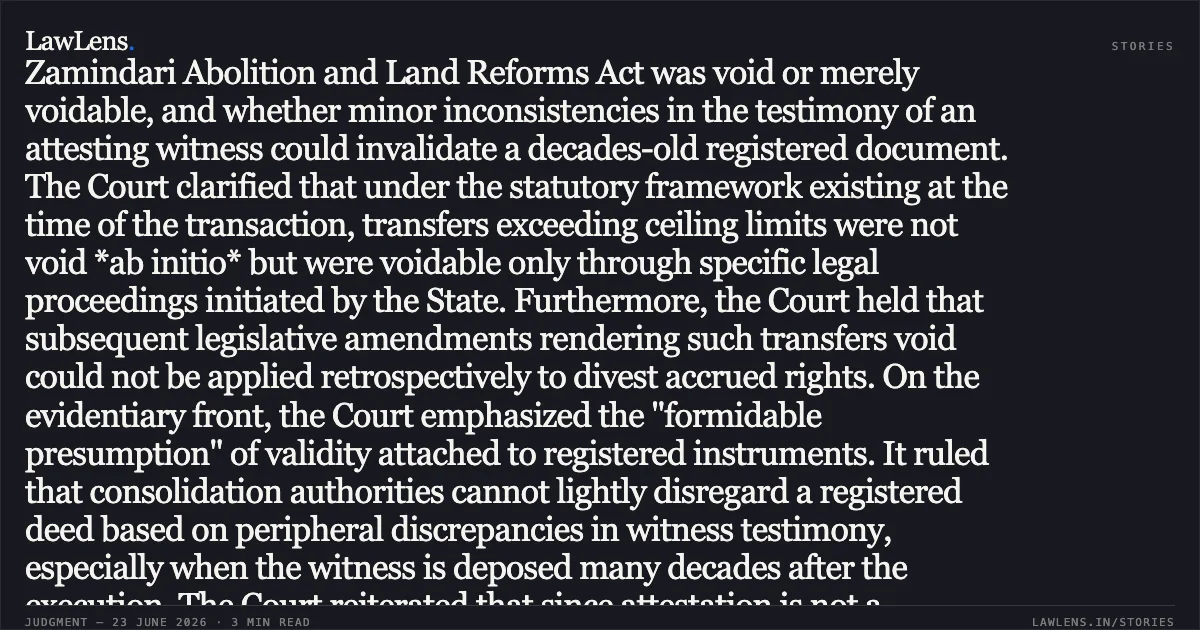
Whether a transfer in contravention of Section 154 of the Abolition Act was void ab initio or merely voidable at the instance of the Gaon Sabha under the law as it stood in 1957
Source reference: p. 5, 11Whether the 1982 amendments to Sections 166 and 167 of the Abolition Act, which rendered such transfers void, apply retrospectively to a 1957 transaction
Source reference: p. 14-15Whether Consolidation Authorities have the jurisdiction to disregard a registered sale deed that is voidable but not yet cancelled by a Civil Court
Source reference: p. 19-20Whether minor discrepancies in an attesting witness’s description can dislodge the legal presumption of genuineness attached to a 38-year-old registered document
Source reference: p. 22-23Law Applied
Section 154 of the Abolition Act (pre-1981 version), which restricted transfers exceeding ceiling limits, and Section 163, which provided that such transfers merely made the transferee liable to ejectment via a suit by the Gaon Sabha.
Source reference: p. 9, 10Doctrine from Kripashanker v. Director of Consolidation clarifying that such transfers are voidable, not void.
Source reference: para. 29Principle from Zile Singh v. State of Haryana and Section 6 of the U.P. General Clauses Act, 1904, holding that substantive changes to rights are prospective.
Source reference: para. 36, p. 17Precedents in Gorakh Nath Dube v. Hari Narain Singh and Khursheed v. Shaqoor establishing that consolidation authorities cannot ignore voidable documents until cancelled.
Source reference: para. 46, para. 48Section 79 of the Indian Evidence Act, 1872 and Hemalatha v. Tukaram regarding the presumption of validity of registered instruments.
Source reference: p. 24, para. 51Reasoning
Under the unamended Section 163, a transfer violating ceiling limits was not automatic or self-operative but required a suit for ejectment within six years, which never occurred.
Source reference: p. 10, 12The 1982 amendment to Section 166 (declaring such deeds void) introduced a substantive change and could not be applied retrospectively to a 1957 deed, as it would unsettle vested rights.
Source reference: p. 18Because the deed was at most voidable, the Consolidation Authorities exceeded their jurisdiction by treating it as void; they were bound by the deed until a Civil Court cancelled it.
Source reference: p. 22Since a sale deed does not legally require attestation, a minor discrepancy in the witness's village description (recorded 38 years after the fact) was insufficient to rebut the "formidable presumption" of validity afforded to registered documents.
Source reference: p. 23-25Holding
The 1957 sale deed was not void, the 1982 amendments were prospective, and the Consolidation Authorities erred in disregarding a registered instrument based on immaterial discrepancies.
The Supreme Court allowed the appeal, setting aside the orders of the High Court and Consolidation Authorities and directed that the names of the appellants be recorded in the revenue records.
Source reference: p. 27Acts & Sections Cited
16 provisions across 6 statutes referred to in this judgment. Linked provisions open on LawLens.
U.P. Zamindari Abolition and Land Reforms Act, 19506
U.P. Land Revenue Act, 19011
U.P Consolidation of Holdings Act, 19535
Indian Evidence Act, 18721
U.P. General Clauses Act, 19042
U.P. Co-operative Societies Act, 19651
Original Court PDF
Sarafat Ali (Deceased) Through LrsvsDeputy Director Of Consolidation Haridwar
Click to open original judgment
Original judgment, available to read, download and summarize on LawLens.in