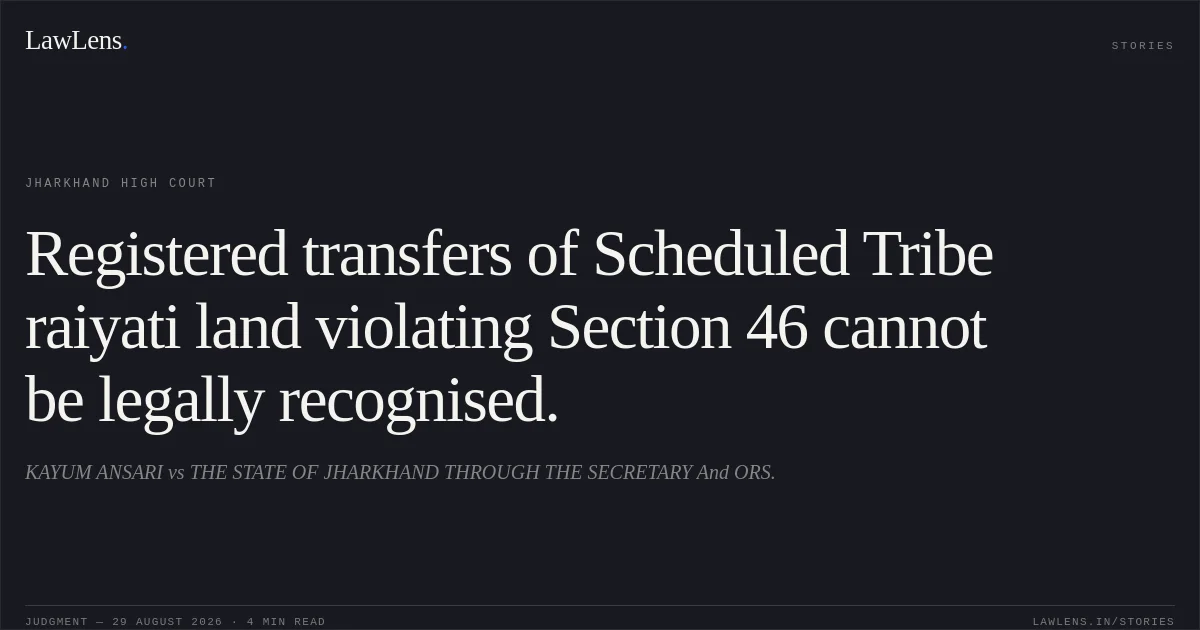
Facts
The dispute concerned 0.92 acres of land comprised in Khata No. 42, Plot No. 1273, Village Ghutwa, originally recorded in the names of Bhikhwa Bediya and Bepata/Bipate Bediya.
Source reference: pp. 3–5The petitioners claimed title through Sukra Bediya, who allegedly sold the land to Sadik Mian by registered Sale Deed No. 6111 dated 2 July 1970, following which the petitioners claimed continuous possession.
Source reference: pp. 3–5Their mutation application was not accepted despite issuance of a public notice inviting objections.
Source reference: pp. 3–5Respondent No. 7 claimed to have purchased 0.67 acres from Sukra Bediya by registered deed dated 13 May 2003 after obtaining permission from the Deputy Commissioner under Section 46(1) of the Chhotanagpur Tenancy Act, 1908 (“CNT Act”), and claimed that she was dispossessed within six months of the purchase.
Source reference: pp. 6–7Her name was mutated in the revenue records.
Source reference: pp. 6–7She thereafter instituted Restoration Case No. 12/2004–05 under Section 46(4-A) of the CNT Act.
Source reference: pp. 2–3The L.R.D.C. allowed the restoration application on 21 April 2005; the Additional Collector set that order aside on 30 August 2005, principally holding the claim to be time-barred; and the Commissioner, North Chhotanagpur Division, in Revision Case No. 97 of 2005, restored the L.R.D.C.’s order on 10 May 2013.
Source reference: pp. 2–3The petitioners challenged the revisional order and the original restoration order under Article 226 of the Constitution.
Source reference: pp. 2–3Issues
1. Whether the disputed land was protected Adivasi/raiyati land and whether the Bedia community was included within the Scheduled Tribes for Bihar under the Constitution (Scheduled Tribes) Order, 1950.
Source reference: paras. 7–9; pp. 8–102. Whether the transfer claimed by the petitioners in 1970 could be recognised when the transferees were not members of a Scheduled Tribe and the statutory restrictions under Section 46 of the CNT Act applied.
Source reference: paras. 10–15; pp. 10–133. Whether respondent No. 7’s restoration application under Section 46(4-A)(a) of the CNT Act was barred by the twelve-year limitation period.
Source reference: paras. 16–17; pp. 13–144. Whether the Commissioner’s order restoring respondent No. 7’s claim suffered from any jurisdictional or legal error warranting interference under Article 226.
Source reference: paras. 18–20; pp. 14–15Law Applied
The Court applied Section 6(1) of the CNT Act, which defines “raiyat” to include a person who has acquired the right to hold land for cultivation and the successor-in-interest of such person.
Source reference: para. 10; p. 10Section 46(1) restricts transfers of a raiyat’s holding and permits an occupancy-raiyat belonging to a Scheduled Tribe to transfer land, with prior sanction of the Deputy Commissioner, only to another Scheduled Tribe member residing within the relevant police-station limits.
Source reference: para. 12; pp. 11–12Under Section 46(3), a transfer made in contravention of Section 46(1) cannot be registered or recognised as valid by any civil, criminal, or revenue court.
Source reference: para. 14; p. 12Section 46(4-A)(a) authorises the Deputy Commissioner to annul an impermissible transfer on an application by an occupancy-raiyat who is a Scheduled Tribe member, provided the application is filed within twelve years from the date of transfer.
Source reference: para. 16; p. 13The Court relied on Bina Rani Ghosh v. Commissioner, South Chhotanagpur Division, 1988 Supreme (Pat.) 195, for the principle that the CNT Act gives broad protection to Scheduled Tribe raiyati land against unlawful, fraudulent, or collusive transfers.
Source reference: para. 18; pp. 13–15The constitutional notification dated 6 September 1950 expressly included “Bedia” among the Scheduled Tribes in Bihar.
Source reference: paras. 7–8; pp. 8–10Reasoning
The Court found that the land was Adivasi land and that “Bedia,” as distinguished from the similarly spelled “Bediya” community referred to by the petitioners, was included in the Scheduled Tribes list for Bihar under the 1950 Presidential Order.
Source reference: paras. 7–9; pp. 8–10The petitioners admittedly were not Scheduled Tribe members.
Source reference: paras. 12–15; pp. 11–13Consequently, their claimed 1970 purchase could not prevail against the restrictions in Section 46, particularly because a transfer contrary to Section 46(1) cannot be recognised under Section 46(3).
Source reference: paras. 12–15; pp. 11–13The Court treated respondent No. 7 as a raiyat or successor-in-interest within Section 6 and relied on the fact that she had obtained prior permission from the Deputy Commissioner in Case No. 40 of 2002 dated 13 January 2003 and had secured mutation in her favour.
Source reference: paras. 11–13; pp. 10–12Since she claimed dispossession within six months of the 2003 transfer, her application under Section 46(4-A)(a) was held to be within the prescribed twelve-year period.
Source reference: para. 17; p. 14On that basis, the Commissioner was justified in setting aside the Additional Collector’s limitation-based order and affirming restoration.
Source reference: paras. 18–20; pp. 14–15The Court found no ground for exercising writ jurisdiction against the revisional decision.
Source reference: paras. 18–20; pp. 14–15Holding
The writ petition was dismissed.
The Court upheld the Commissioner’s order dated 10 May 2013 in Revision Case No. 97 of 2005, thereby maintaining the restoration of the disputed land in favour of respondent No. 7 under Section 46(4-A) of the CNT Act.
Source reference: para. 20; p. 15The Court rejected the petitioners’ challenges concerning the Scheduled Tribe status of the Bedia community, the validity of the protected land transfer, and limitation.
Source reference: para. 20; p. 15Any pending interlocutory application was also disposed of.
Source reference: para. 21; p. 15Acts & Sections Cited
1 provisions across 1 statute referred to in this judgment. Each provision opens on LawLens.
Banking Companies (Acquisition and Transfer of Undertakings) Act, 19701
Original Court PDF
KAYUM ANSARIvsTHE STATE OF JHARKHAND THROUGH THE SECRETARY And ORS.
Click to open original judgment
Original judgment, available to read, download and summarize on LawLens.in
![A police constable cannot be removed for unauthorized absence without a Rule 359-compliant inquiry.. Mohammad Sidiq Khan vs D/o Home Ut Of Jammu & Kashmir. CAT - ['Srinagar']. LawLens](/stories/thumbnails/a-police-constable-cannot-be-removed-for-unauthorized-absence-without-a-rule-359-compliant-7b43fc316bd94f22a62676153bbc9d54.webp)
![A Review DPC lacks authority to determine or alter inter se seniority.. SAURABH KUMAR vs REVENUE. CAT - ['Patna']. LawLens](/stories/thumbnails/a-review-dpc-lacks-authority-to-determine-or-alter-inter-se-seniority-4b21640f20af46fcabdfc8273d2ce959.webp)