Facts
The petitioner, a Sub-Registrar appointed under Section 6 of the Registration Act, 1908, registered two sale deeds in favor of the MP Electricity Board on February 21, 1994.
Source reference: para. 2The registrations were conducted at the private residences of the sellers in exercise of powers under the proviso to Section 31 of the Act.
Source reference: para. 2Subsequently, the State initiated departmental proceedings against the petitioner, alleging two charges of misconduct: (i) registering land held under government lease without the Collector's permission, thereby violating Section 165(7-b) and (10) of the CG Land Revenue Code, 1959; and (ii) visiting the sellers' residences for registration despite the sellers being physically capable of attending the office.
Source reference: para. 2On October 31, 2000, the disciplinary authority imposed a penalty of stoppage of three increments with cumulative effect, a decision affirmed by the appellate authority on May 18, 2018.
Source reference: para. 1, 3The petitioner challenged these orders via a writ petition under Article 226.
Source reference: para. 1Issues
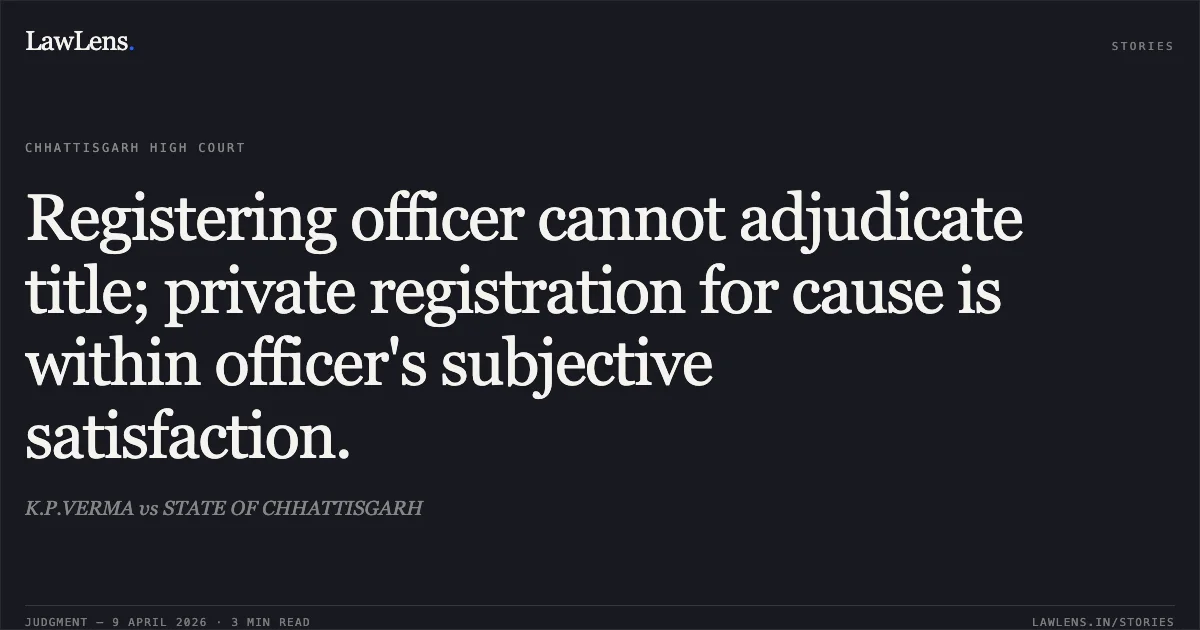
1. Whether a registering officer is duty-bound to adjudicate upon the title of the property or the validity of a transfer under the CG Land Revenue Code when the revenue records do not indicate any restriction.
Source reference: para. 7, 132. Whether the exercise of discretion to register documents at a private residence under the proviso to Section 31 of the Registration Act, 1908, constitutes misconduct.
Source reference: para. 15, 17Law Applied
The Court applied Sections 34(3) and 35(1) of the Registration Act, 1908, which limit the registering officer’s inquiry to the factum of execution and the identity of the parties.
Source reference: para. 7-9It relied on K. Gopi v. Sub-Registrar and Others (2025 SCC OnLine SC 740), which held that a registering officer lacks adjudicatory power to decide title.
Source reference: para. 10The Court interpreted Section 165(7-b) and (10) of the CG Land Revenue Code, 1959, which prohibits the transfer of government-leased land without Collector’s permission.
Source reference: para. 11-12The Court applied Section 31 of the Registration Act, 1908, which allows registration at a private residence upon "special cause being shown".
Source reference: para. 15Reasoning
The Court found that the petitioner’s statutory obligations under Sections 34 and 35 of the Registration Act were limited to verifying the identity of the executants and the factum of execution, rather than investigating title.
Source reference: para. 7-10Regarding the alleged violation of the CG Land Revenue Code, the Court observed that the revenue records provided to the petitioner recorded the sellers as Bhoomiswami and did not mention their status as government lessees.
Source reference: para. 13Since the sale deeds explicitly declared no violation of Section 165, and the State failed to show that any material existed at the time of registration to suggest the land was a government lease, the petitioner could not be held liable for registering the deeds without the Collector's permission.
Source reference: para. 13-14The Court held that the proviso to Section 31 is an enabling provision based on the "subjective satisfaction" of the officer; once a cause was assigned and accepted, the decision could not be termed misconduct.
Source reference: para. 17Holding
The Court held that the charge-sheeting authority failed to establish the charges of misconduct against the petitioner.
The High Court quashed the disciplinary order dated October 31, 2000, and the appellate order dated May 18, 2018, and directed that the petitioner is entitled to all consequential benefits.
Source reference: para. 18The writ petition was allowed.
Source reference: para. 19Acts & Sections Cited
9 provisions across 1 statute referred to in this judgment. Each provision opens on LawLens.
Original Court PDF
K.P.VERMAvsSTATE OF CHHATTISGARH
Click to open original judgment
Original judgment, available to read, download and summarize on LawLens.in