Facts
The Appellant, a major liquor conglomerate, filed Trade Mark Application No. 5514779 on July 3, 2022, for the mark "OFFER" in Class 33 (alcoholic beverages) on a 'proposed to be used' basis
Source reference: p. 1-2The Respondent issued an Examination Report raising a standard objection under Section 9(1)(a) of the Trade Marks Act, 1999, claiming the mark was a common name or non-distinctive figure
Source reference: p. 2Despite the Appellant’s detailed replies and citations of previously registered composite marks containing "OFFER," the Respondent issued an order on October 30, 2025, refusing registration
Source reference: p. 3The Respondent's reasoning was that the word "OFFER" lacks "uniqueness" as it is commonly used to demand discounts in general parlance
Source reference: p. 3, 8-9Issues
1. Whether the Respondent’s order was legally tenable despite being non-speaking and failing to consider the Appellant’s submissions and precedents
Source reference: p. 9 / para. 15-162. Whether "uniqueness" is a valid statutory parameter for refusing registration under Section 9(1)(a) of the Trade Marks Act, 1999
Source reference: p. 11 / para. 173. Whether the mark "OFFER" is inherently distinctive and capable of distinguishing the goods (alcoholic beverages) of the Appellant from others
Source reference: p. 16 / para. 22Law Applied
Section 9(1)(a) of the Trade Marks Act, 1999, which prohibits registration of marks "devoid of any distinctive character," defined as being "not capable of distinguishing" goods/services
Source reference: p. 9, 11A finding of non-distinctiveness is difficult to sustain if no similar mark is in use (Abu Dhabi Global Market v. Registrar of Trademarks)
Source reference: p. 4, 9Principles used to differentiate between generic, descriptive, suggestive, and arbitrary marks, emphasizing that distinctiveness must be judged in relation to the specific goods (Oswaal Books and Learnings Pvt. Ltd. v. Registrar of Trade Marks and Teleecare Network India Pvt. Ltd. v. Asus Technology Pvt. Ltd.)
Source reference: p. 5, 12-14Reasoning
The Court found the Respondent’s order to be "wholly non-speaking, unreasoned and cryptic," as it ignored 31 registered marks cited by the Appellant and failed to address legal precedents
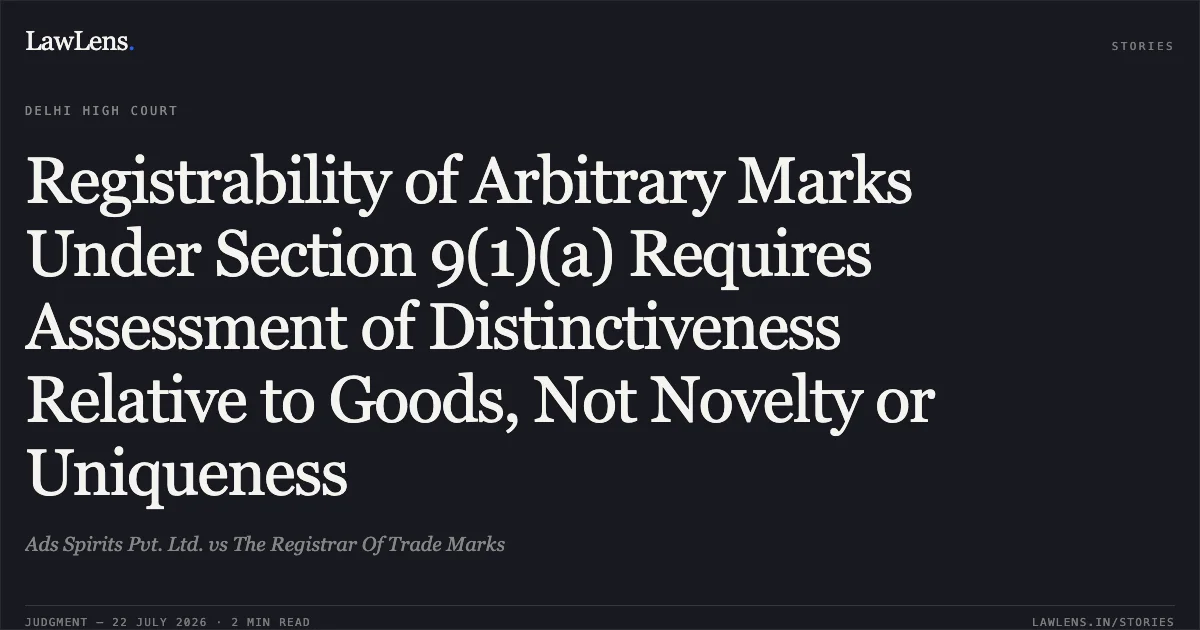
Source reference: para. 15-16Crucially, the Court determined the Respondent applied a "wrong test" by using "uniqueness" as a criterion for refusal, noting that Section 9(1)(a) only requires "distinctive character"
Source reference: para. 17, 22The Court reasoned that a mark's distinctiveness must be assessed relative to the category of goods; while "OFFER" is a common English word, it may be arbitrary in the context of alcoholic beverages as it does not directly describe the product's character or quality
Source reference: para. 19-21The Court rejected the Respondent’s equate of "offer" with "discount," noting they are not synonymous and that "offer" is rarely used as a standalone promotional term
Source reference: para. 23Holding
The Court answered the issues in the negative, holding that the Respondent failed its quasi-judicial duty to pass a reasoned order and applied an incorrect legal standard
The High Court quashed and set aside the impugned order dated October 30, 2025. The Respondent was directed to reconsider Application No. 5514779 within four months, specifically testing the distinctiveness of "OFFER" relative to alcoholic beverages in Class 33 and providing the Appellant an opportunity for a hearing
Source reference: para. 25-26Acts & Sections Cited
4 provisions across 2 statutes referred to in this judgment. Each provision opens on LawLens.
Trade Marks Act, 19993
Code of Civil Procedure, 19081
Original Court PDF
Ads Spirits Pvt. Ltd.vsThe Registrar Of Trade Marks
Click to open original judgment
Original judgment, available to read, download and summarize on LawLens.in