Facts
The Plaintiff (ITM) filed a suit in 2015 against the Defendant (Samata) regarding the alleged abuse of the "ITM Marks"
Source reference: para. 1ITM had initiated three rectification proceedings before the Registrar of Trade Marks between 2014 and 2015 seeking cancellation of Samata’s registrations
Source reference: para. 2Conversely, Samata filed 17 rectification applications against ITM before the IPAB, which, following the IPAB’s disbandment, were transferred to the Bombay High Court
Source reference: para. 2-3By an order dated January 2, 2025, Samata’s 17 proceedings were clubbed with the Suit
Source reference: para. 3ITM subsequently filed the present Transfer Application (IA No. 3128/2025) as an Interim Application within the Suit, seeking to transfer its three pending rectification proceedings from the Registrar to the High Court for consolidated adjudication
Source reference: para. 4-5Issues
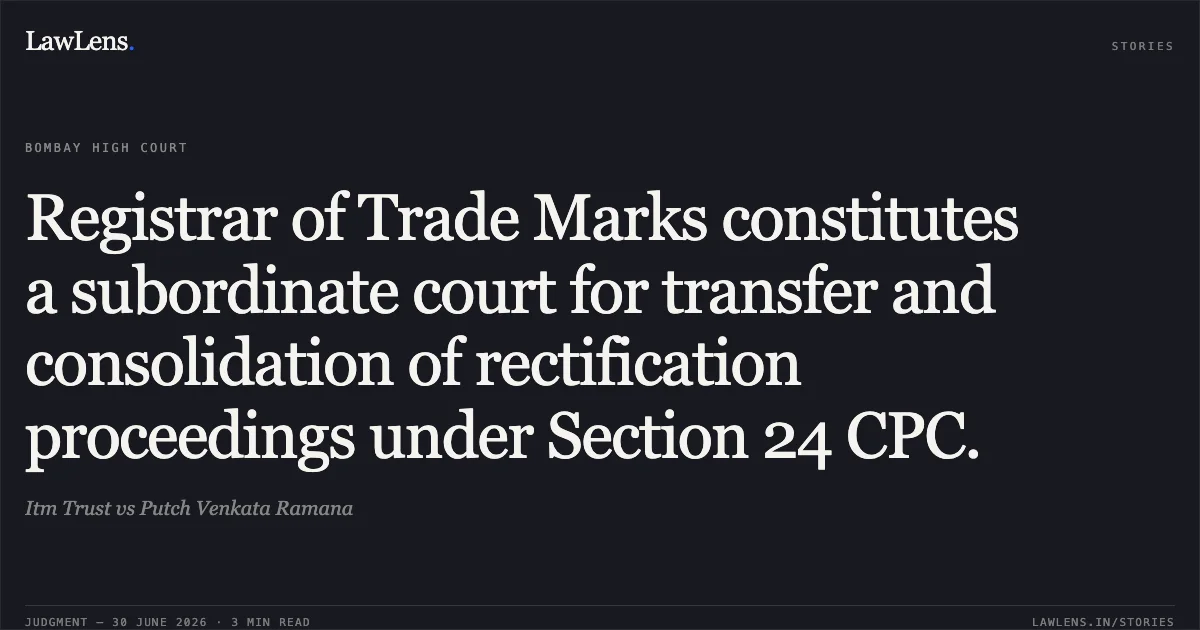
1. Whether the Registrar of Trade Marks constitutes a "Court subordinate to the High Court" within the meaning of Section 24 of the CPC to allow the transfer of proceedings
Source reference: para. 5, 152. Whether the High Court has the inherent power under Section 151 of the CPC to transfer and consolidate proceedings from the Registrar to itself in the absence of specific High Court IPR Rules
Source reference: para. 8, 313. Whether a transfer application under Section 24 of the CPC regarding a Trade Marks Act matter is maintainable as an Interim Application on the Original Side or must be filed as a Miscellaneous Application on the Appellate Side
Source reference: para. 11, 56Law Applied
Section 24 of the CPC, which grants High Courts general powers to withdraw and transfer suits or proceedings from subordinate courts
Source reference: para. 13-14Section 151 of the CPC regarding inherent powers to meet the ends of justice
Source reference: para. 31Section 127 of the Trade Marks Act, 1999, which clothes the Registrar with the trappings of a civil court
Source reference: para. 16Section 91, which establishes the High Court's appellate jurisdiction over the Registrar
Source reference: para. 18Rule 835 of the Bombay High Court Original Side Rules, trademark matters are governed by the specialized Chapter XLV
Source reference: para. 58-60Reasoning
The Court rejected the argument that the Registrar is not a "Court," reasoning that the Registrar exercises concurrent jurisdiction with the High Court in rectification matters and possesses civil court powers under Section 127
Source reference: para. 24, 26Since decisions of the Registrar are appealable to the High Court under Section 91, the Registrar is "subordinate" to the High Court for the purposes of Section 24 of the CPC
Source reference: para. 19, 26, 54The Judge held that denuding the High Court of the power to transfer would lead to "fragmented litigation" and "divergent parallel outcomes"
Source reference: para. 7, 29, 33Regarding procedural objections, the Court held that even in the absence of specific IPR Rules (unlike the Delhi High Court), the substantive power of transfer remains
Source reference: para. 37Holding
The Court allowed the Transfer Application. It held that the Registrar is a subordinate court for the purposes of Section 24 of the CPC and that the High Court possesses inherent powers under Section 151 to consolidate proceedings for efficient justice delivery
The Court directed the Registrar of Trade Marks to transmit the records of the three ITM Rectification Applications to the High Court Registry within six weeks. The Registry was ordered to convert these into Commercial Miscellaneous Petitions and tag them with the existing Suit and the 17 other rectification applications for consolidated hearing
Source reference: para. 65, 66Acts & Sections Cited
18 provisions across 6 statutes referred to in this judgment. Each provision opens on LawLens.
Trade Marks Act, 19997
Code of Civil Procedure, 19083
Limitation Act, 19632
General Clauses Act, 18971
Bombay High Court (Letters Patent) Act, 1866.3
Original Court PDF
Itm TrustvsPutch Venkata Ramana
Click to open original judgment
Original judgment, available to read, download and summarize on LawLens.in