Facts
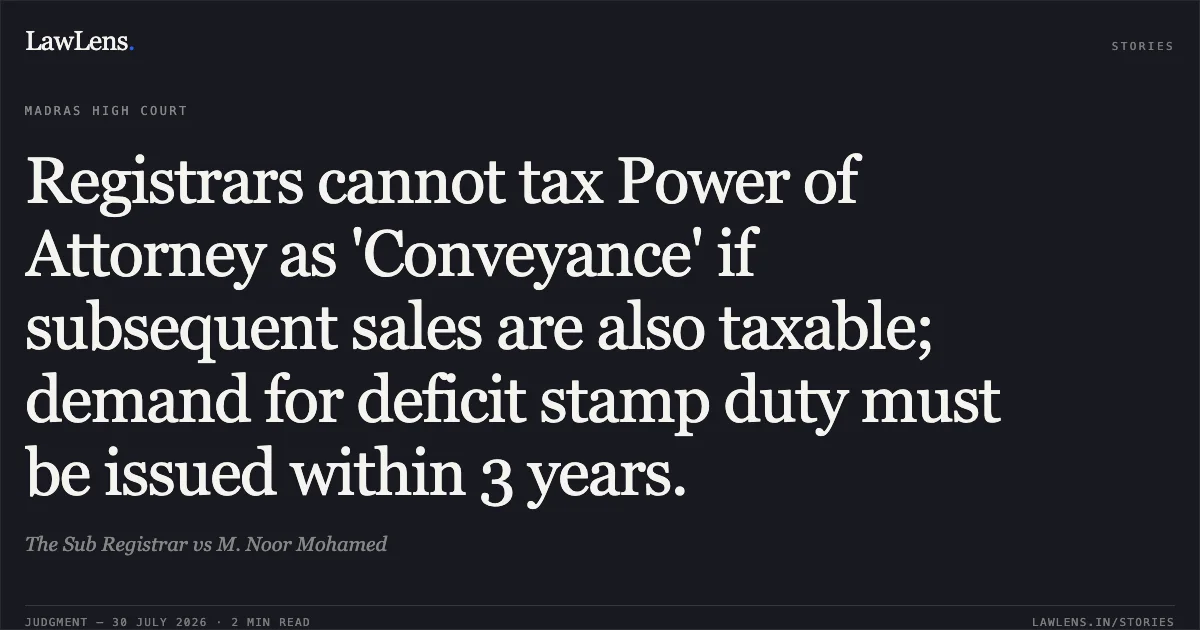
The respondent (writ petitioner) was granted a power of attorney (POA) by one T.G. Ponurathinam to develop and alienate specific portions of a property
Source reference: p. 3The POA was registered as Doc. No. 8052/2013 on 29.11.2013
Source reference: p. 3On 27.03.2017, the appellant (Sub Registrar) issued a notice under Section 33A of the Stamp Act, 1899, claiming the POA was a "conveyance" with consideration and demanding deficit stamp duty
Source reference: p. 2The respondent challenged this notice in W.P.(MD) No. 5877 of 2017. The learned Single Judge quashed the notice on 16.12.2024, leading to this Writ Appeal by the State
Source reference: p. 1-2Issues
1. Whether the notice issued under Section 33A of the Stamp Act was barred by the three-year limitation period prescribed under the second proviso of the said section
Source reference: p. 3 / para. 42. Whether a Sub Registrar has the jurisdiction to issue a notice for deficit stamp duty under Section 33A after a document has been registered
Source reference: p. 2-5 / para. 4, 93. Whether a Power of Attorney authorizing an agent to sell property can be legally treated as a "conveyance" for the purpose of levying stamp duty
Source reference: p. 3-4 / para. 6, 8Law Applied
The Court applied Section 33A of the Stamp Act, 1899, which empowers the "Registrar" to initiate recovery of deficit stamp duty but expressly prohibits such enquiry after three years from the date of registration under its second proviso
Source reference: p. 3, 5It relied on Section 54 of the Transfer of Property Act, 1882, defining "Sale" as a transfer of ownership for a price, requiring a registered instrument and delivery of possession
Source reference: p. 4The Court further applied the principle of functus officio, holding that a registering officer loses authority over a document once the official act of registration is complete
Source reference: p. 5Finally, it followed the precedent in W.A.No.1999 of 2023, which held that negative/prohibitory language in a proviso is mandatory and creates an absolute embargo on the authority’s power after the expiry of the limitation period
Source reference: p. 6Reasoning
The POA was registered in November 2013, but the notice was issued in March 2017, clearly exceeding the three-year statutory limit under the second proviso to Section 33A; such a delay renders the action void
Source reference: p. 3, 5-6The Court noted that Section 33A vests the power to issue notices in the "Registrar" (a superior officer), whereas the notice here was issued by the Sub Registrar, who became functus officio upon completing the registration
Source reference: p. 5On merits, the Court rejected the appellant's interpretation that the POA constituted a "conveyance." It reasoned that a POA is merely an authority to convey, whereas a sale deed is the instrument that actually transfers ownership
Source reference: p. 4If the POA were taxed as a conveyance, the State would impermissibly collect stamp duty twice for a single transfer of property (once on the POA and once on the eventual sale deed)
Source reference: p. 4Holding
The Court answered the issues in favor of the respondent, holding that the notice was barred by limitation, issued without jurisdiction, and based on a legal misinterpretation of the nature of the instrument
The Court dismissed the Writ Appeal and upheld the order of the Single Judge quashing the proceedings in Doc.No.8052/2013
Source reference: p. 7Acts & Sections Cited
2 provisions across 2 statutes referred to in this judgment. Each provision opens on LawLens.
Indian Stamp Act, 18991
Transfer of Property Act, 18821
Original Court PDF
The Sub RegistrarvsM. Noor Mohamed
Click to open original judgment
Original judgment, available to read, download and summarize on LawLens.in