Facts
The Petitioner, serving as the Registrar of the Industrial Tribunal, Guwahati, challenged a government communication dated 20.01.2023.
Source reference: p.3, 17This communication denied the enhancement of his Grade Pay to be at par with Sheristadars (Chief Administrative Officers) of District and Sessions Judges' establishments.
Source reference: p.3-4Historically, the post of Registrar was created with scales higher than or comparable to ministerial staff.
Source reference: p.5Following the Shetty Commission recommendations and subsequent Supreme Court orders in All India Judges Association, the Assam Government implemented pay revisions for subordinate court staff effective 01.04.2003.
Source reference: p.11-13While these benefits were extended to all ministerial staff in Industrial Tribunals and Labour Courts via a 2012 notification, the Registrars were excluded.
Source reference: p.14-15A High Court Committee recommended parity in 2012, but the Finance Department rejected it, claiming Registrars were not covered by the Shetty Commission and fell under the Labour Department’s purview.
Source reference: p.15-18, 20Issues
1. Whether the Industrial Tribunals and Labour Courts fall within the definition of "Subordinate Judiciary" under the administrative control of the High Court under Article 235 of the Constitution.
Source reference: p.43, 482. Whether the post of Registrar of the Industrial Tribunal/Labour Court is entitled to parity in pay scale and Grade Pay with the Chief Administrative Officer (Sheristadar) of the District Judiciary.
Source reference: p.39, 483. Whether the Finance Department has the competence to override the High Court's recommendation regarding the status and parity of ministerial staff within the Subordinate Courts.
Source reference: p.48-49Law Applied
Article 235 of the Constitution, which vests "control" over subordinate courts and their ministerial staff in the High Court.
Source reference: p.41, 43State of Maharashtra v. Labour Law Practitioners' Association, establishing that Labour/Industrial Court judges belong to the "judicial service" and these tribunals are part of the West specialized hierarchy of District Courts.
Source reference: p.28, 44-47Principle of Equal Pay for Equal Work under Articles 14 and 16, supported by State of Kerala v. V. Renjith Kumar, which held that qualitative similarity in functions overrides differences in the source of recruitment or appointment.
Source reference: p.50-54All India Judges Association v. Union of India (2024), reaffirming that pay revisions must extend to specialized tribunals regardless of whether they are presided over by career judicial officers.
Source reference: p.54Reasoning
The Court found that although the Petitioner was appointed by the Labour Department, the Industrial Tribunals perform judicial functions and are subject to the High Court’s superintendence under Article 227 and "control" under Article 235.
Source reference: p.35, 47A factual comparison showed that the Registrar’s duties (administration, supervising staff, issuing processes) are identical to, or exceed, those of a Sheristadar/Chief Administrative Officer (CAO).
Source reference: p.37-39The Court rejected the Finance Department's argument regarding different recruitment sources, noting that the State already granted parity to CAOs of Motor Accident Claims Tribunals (MACT), making the denial to Industrial Tribunal Registrars arbitrary and discriminatory.
Source reference: p.55-57Crucially, the Court held that since "control" is vested in the High Court to ensure judicial independence, the Finance Department cannot unilaterally reject parities determined by a High Court Committee approved by the Chief Justice.
Source reference: p.48-49, 61-62Holding
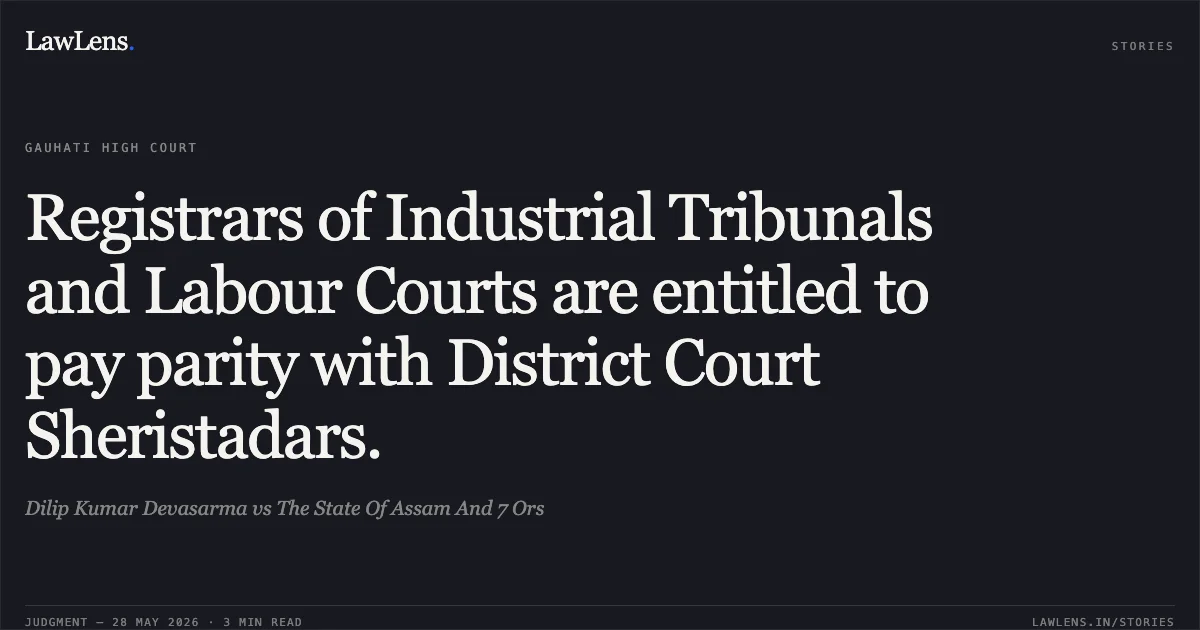
The Court allowed the writ petition, quashing the communication dated 20.01.2023, holding that Registrars of Industrial Tribunals/Labour Courts are part of the Subordinate Courts and fall under the High Court's control under Article 235.
The Court directed the State to grant the Petitioner a Scale of Pay and Grade Pay equivalent to the Chief Administrative Officer of the District Judge/MACT establishments, effective from the date such benefits were provided to CAOs.
Source reference: p.59-60Arrears are to be paid within six months, and compliance affidavits must be filed by the Registrar General and State Secretaries within eight months.
Source reference: p.61Acts & Sections Cited
1 provisions across 1 statute referred to in this judgment. Each provision opens on LawLens.
Motor Vehicles Act, 19881
Original Court PDF
Dilip Kumar DevasarmavsThe State Of Assam And 7 Ors
Click to open original judgment
Original judgment, available to read, download and summarize on LawLens.in