Facts
The petitioner (wife) and respondent (husband) married on 30.04.2006 according to community and customary rites
Source reference: p. 2Both parties belong to the "Meda" Scheduled Tribe
Source reference: p. 3After separating in 2009, the husband initially filed for divorce under the Hindu Marriage Act (M.C. No. 46/2015), which was rejected for want of jurisdiction under Section 2(2) of that Act, which excludes Scheduled Tribes
Source reference: p. 3The husband subsequently filed for divorce under Section 27 of the Special Marriage Act, 1954 (M.C. No. 18/2024)
Source reference: p. 3The wife filed an interlocutory application (I.A. No. I) seeking to reject the petition, contending that because the marriage was neither solemnized nor registered under the Special Marriage Act, the court had no jurisdiction
Source reference: p. 3-4The Trial Court rejected the wife's application on 26.06.2025, a decision she challenged via this Writ Petition
Source reference: p. 4-5Issues
1. Whether a petition for divorce under Section 27 of the Special Marriage Act, 1954, is maintainable if the marriage was not originally solemnized or registered under the said Act
Source reference: p. 72. Whether registration of a marriage under Section 15 of the Special Marriage Act is a mandatory prerequisite for seeking matrimonial relief under Section 27 of the Act
Source reference: p. 8Law Applied
Section 2(2) of the Hindu Marriage Act, which exempts Scheduled Tribes from its application unless notified by the Central Government
Source reference: p. 6Section 15 of the Special Marriage Act, 1954 provides a procedure for the registration of marriages celebrated in other forms but does not mandate such registration for all marriages
Source reference: p. 8Section 27 of the Special Marriage Act, 1954 provides the grounds for divorce "subject to the provisions of this Act" but does not explicitly state that registration is a condition precedent for filing a petition
Source reference: p. 9The court also distinguished Amitava Bhattacharya v. Smt. Aparna Bhattacharya (2009), noting it dealt with the validity of a registration rather than the maintainability of a divorce petition in the absence of registration
Source reference: p. 5, 8Reasoning
The Court reasoned that Section 15 of the Special Marriage Act is directory rather than mandatory; it prescribes conditions for registration but does not declare that a marriage must be registered to invoke the Court's jurisdiction for divorce
Source reference: para. 12, 14While Section 18 of the Act provides specific benefits upon registration, the absence of registration does not strip a party of the right to seek a decree of divorce under Section 27
Source reference: para. 12The Court observed that since the parties were excluded from the Hindu Marriage Act due to their Scheduled Tribe status under Section 2(2), the Special Marriage Act serves as the alternative legal remedy
Source reference: para. 9, 13The Court concluded that Section 27 of the Act does not contemplate a requirement of prior registration as a maintainability threshold for a divorce petition
Source reference: para. 15Holding
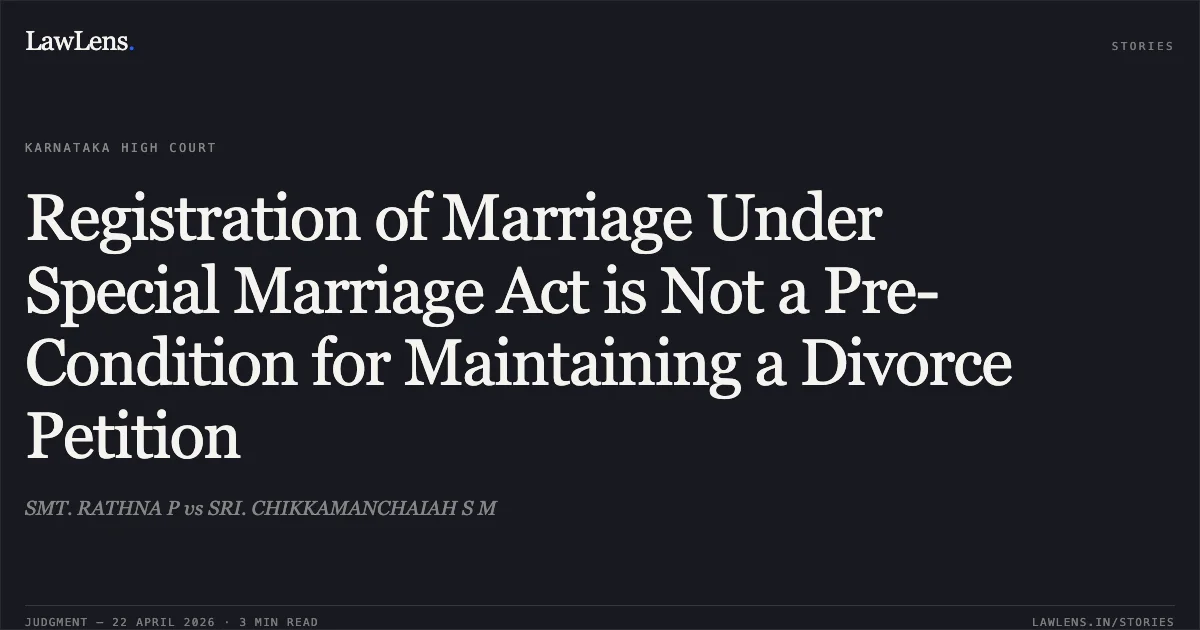
The Court held that a petition for divorce under Section 27 of the Special Marriage Act, 1954, is maintainable even if the marriage was not registered under Section 15 of the Act
The High Court dismissed the Writ Petition and upheld the Trial Court's order dated 26.06.2025
Source reference: p. 11The rejection of I.A. No. I was deemed appropriate as the registration of marriage is not a mandatory prerequisite for seeking dissolution of marriage under the Act
Source reference: para. 12, 16Acts & Sections Cited
6 provisions across 2 statutes referred to in this judgment. Each provision opens on LawLens.
Special Marriage Act, 19544
Hindu Marriage Act, 19552
Original Court PDF
SMT. RATHNA PvsSRI. CHIKKAMANCHAIAH S M
Click to open original judgment
Original judgment, available to read, download and summarize on LawLens.in