Facts
The Plaintiff (Appellant) and his three brothers purchased 18 bighas and 6 biswas of land in 1954.
Source reference: p. 4, para. 3The Plaintiff asserted an oral family settlement was reached in 1986, allotting him a specific portion where he constructed two shops (Mark A and B).
Source reference: p. 6, para. 9He alleged that Defendant No. 1 (Respondent), his brother, forcibly dispossessed him of Shop 'A' and an adjoining portion ('AA') on 20.02.1992.
Source reference: p. 7, para. 13Defendant No. 1 denied the 1986 settlement, claiming a 1966 partition and asserting long-term possession.
Source reference: p. 9-10, para. 24-27The Trial Court decreed the suit in favor of the Plaintiff.
Source reference: p. 14, para. 43However, the First Appellate Court (ADJ) reversed this, citing a lack of cogent evidence of the settlement terms and the Plaintiff's exclusive share.
Source reference: p. 14, para. 44-45Issues
1. Whether the findings of the First Appellate Court were perverse for ignoring material evidence, admissions, and municipal records supporting the oral family settlement.
Source reference: p. 17, para. 55(a)2. Whether a Memorandum recording a past oral family settlement requires compulsory registration under the Registration Act, 1908.
Source reference: p. 17, para. 55(c)3. Whether the First Appellate Court was justified in reversing the Trial Court's finding of fact when the Trial Court's view was plausible and supported by evidence.
Source reference: p. 17, para. 55(b)Law Applied
The Court applied the principles of Section 17 and 49 of the Registration Act, 1908, regarding the registration of partition documents.
Source reference: p. 31-33It relied on Kale and Others v. Deputy Director of Consolidation (1976), which established that an oral family settlement or a memorandum recording past transactions for mutation purposes does not require registration.
Source reference: p. 31-32, para. 102-103It further cited Mathuri Pullaiah v. Maturi Narasimham (1966) and Ravinder Kaur Grewal v. Manjit Kaur (2020) on the finality of family arrangements and the principle of estoppel preventing parties from resiling from settlements already acted upon.
Source reference: p. 28-29, 34Reasoning
The High Court found that the First Appellate Court erred by overlooking overwhelming evidence of the 1986 settlement.
Source reference: p. 27, para. 92The Court noted that the Memorandum of Settlement (Ex. PW3/5) signed by all four brothers and the annexed Site Plan (Ex. PW3/6) clearly demarcated the shares.
Source reference: p. 23-24, para. 76-78Crucially, the parties had acted upon this settlement by applying for separate electricity connections (Ex. PW1/1), paying individual House Tax (Ex. PW3/9), and submitting site plans to the MCD.
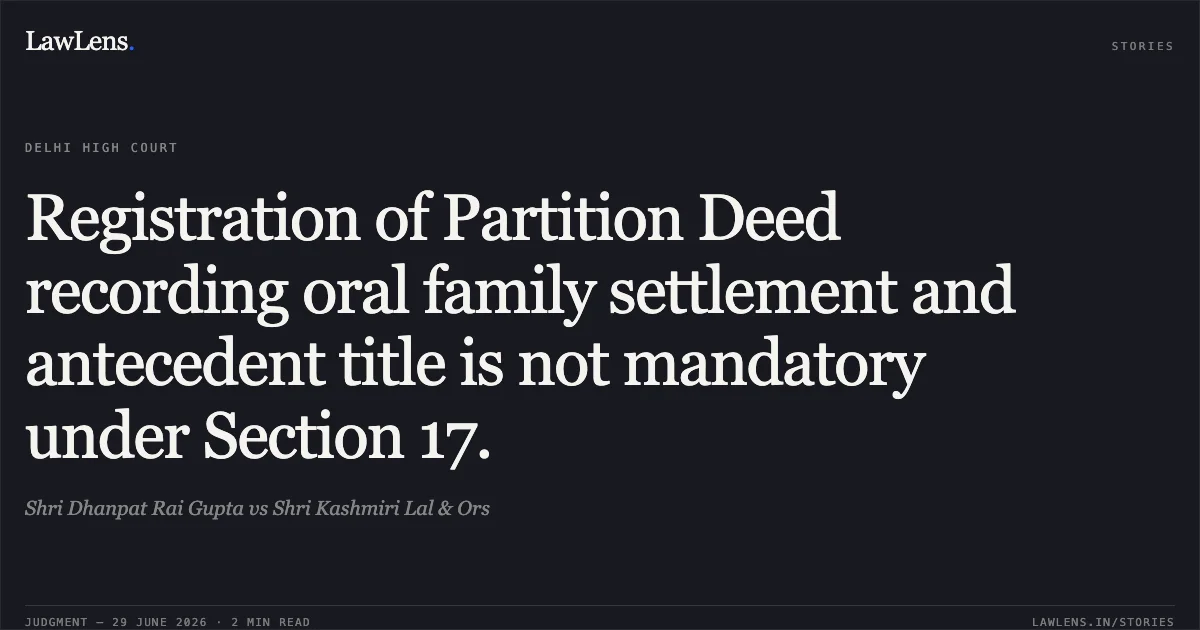
Source reference: p. 24-25, para. 79-82The Court reasoned that the Memorandum (Ex. PW3/5) did not create new rights but merely recorded a past oral partition; thus, it did not require registration under Section 17 of the Registration Act.
Source reference: p. 33, para. 105The Defendant's own admission in cross-examination that the brothers occupied distinct areas further corroborated the Plaintiff's claim.
Source reference: p. 21, para. 71Consequently, the High Court held that the Plaintiff’s dispossession from Shop 'A'—part of his allotted share—was illegal.
Source reference: p. 27, para. 90Holding
The Court held that a Memorandum recording a past family settlement is admissible without registration and that the Trial Court had correctly appreciated the evidence.
The High Court allowed the appeal and set aside the Judgment dated 17.09.2013 passed by the First Appellate Court.
Source reference: p. 34, para. 111The Court restored the Decree of the Trial Court, granting the Plaintiff recovery of possession of Shop 'A' and portion 'AA'.
Source reference: p. 34, para. 112Acts & Sections Cited
5 provisions across 2 statutes referred to in this judgment. Each provision opens on LawLens.
Code of Civil Procedure, 19083
Registration Act, 19082
Original Court PDF
Shri Dhanpat Rai GuptavsShri Kashmiri Lal & Ors
Click to open original judgment
Original judgment, available to read, download and summarize on LawLens.in