Facts
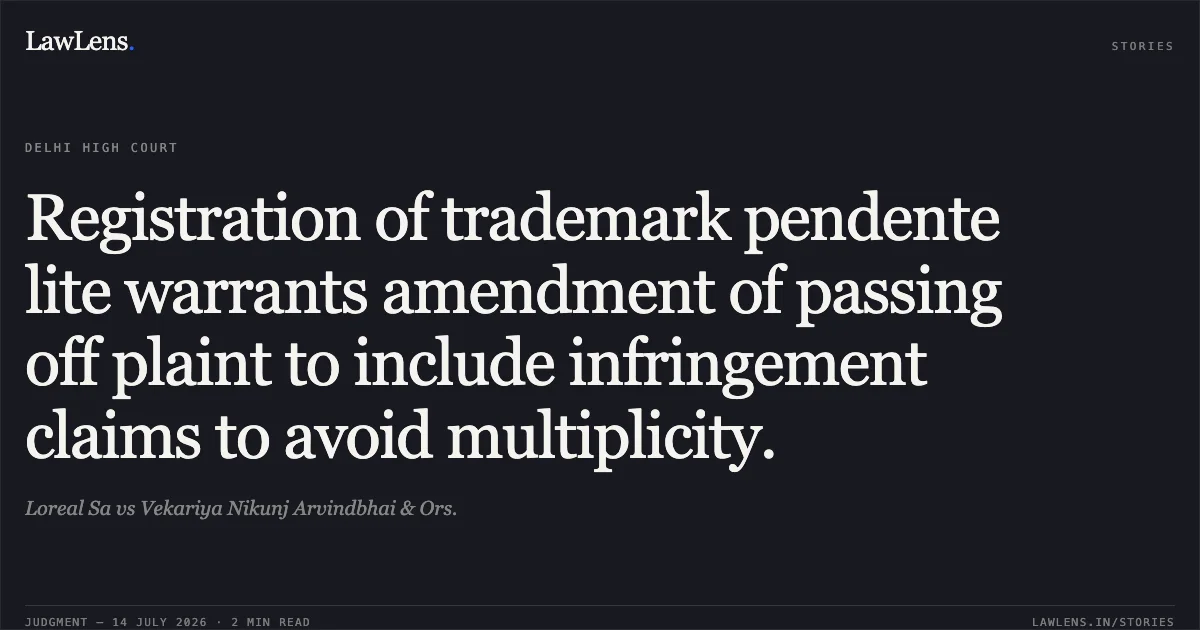
The Petitioner, L’Oreal SA, filed a suit for passing off in April 2024 against the Respondents for using marks (GARUDA BRIGHT COMPLETE, etc.) similar to its "GARNIER BRIGHT COMPLETE" mark.
Source reference: para. 2At the time of filing, the Petitioner’s trademark application was pending. On April 20, 2025, the registration was granted.
Source reference: para. 3The Petitioner subsequently moved an application under Order VI Rule 17 of the CPC to amend the plaint to include the factum of registration and the additional relief of infringement.
Source reference: para. 3The Trial Court dismissed the application on February 10, 2026, ruling that it introduced a new cause of action not pleaded in the original plaint and that the trial had already progressed.
Source reference: para. 3, 7The Petitioner challenged this dismissal under Article 227 of the Constitution.
Source reference: para. 1Issues
1. Whether the Petitioner was entitled to amend the plaint to incorporate the relief of trademark infringement following a registration granted during the pendency of a passing off suit.
Source reference: para. 8Law Applied
The Court applied Order VI Rule 17 of the Code of Civil Procedure (CPC), emphasizing that amendments necessary for determining the "real question in controversy" should be allowed.
Source reference: para. 4, 8It relied on Rajesh Kumar Aggarwal v. K.K. Modi, which held that the rule of amendment is one of justice and equity, and subsequent events should be considered to shorten litigation.
Source reference: para. 8It further cited Usha International v. Usha Television Ltd. and Pravesh Narula v. Raj Kumar Jain, establishing that an action for passing off can be "telescoped" into an action for infringement if registration is obtained pendente lite, as both are based on fundamentally similar principles and facts.
Source reference: para. 9, 10Reasoning
The Court reasoned that the Trial Court adopted a hyper-technical approach.
Source reference: para. 10It observed that the cause of action for infringement arose from the same set of facts, rival marks, and products as the passing off claim.
Source reference: para. 11Since the registration was granted after the suit was filed, the Petitioner could not have pleaded the registration in the original plaint; thus, the Trial Court’s finding of lack of "due diligence" or failure to mention the application was erroneous.
Source reference: para. 7, 11The Court found that denying the amendment would necessitate a second suit for infringement, leading to multifariousness and a waste of judicial time.
Source reference: para. 11Furthermore, since Respondents 2–5 were already ex parte, the amendment caused no prejudice to the defense.
Source reference: para. 5, 11Holding
The Court answered the issue in the affirmative, holding that the amendment was imperative for an effective adjudication and to avoid multiplicity of proceedings.
The High Court quashed the Trial Court's order dated February 10, 2026, allowed the application under Order VI Rule 17 CPC, and directed the Trial Court to take the amended plaint on record and proceed with the suit.
Source reference: para. 12, 13Original Court PDF
Loreal SavsVekariya Nikunj Arvindbhai & Ors.
Click to open original judgment
Original judgment, available to read, download and summarize on LawLens.in