Facts
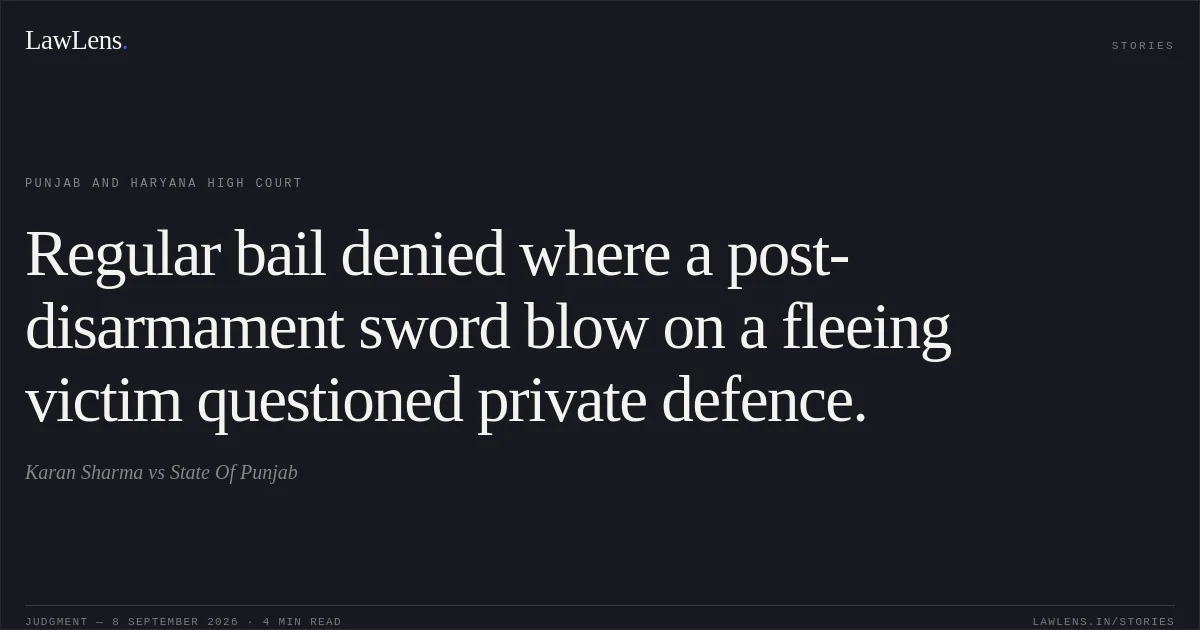
The petitioner sought regular bail under Section 483 of the Bharatiya Nagarik Suraksha Sanhita, 2023, corresponding to Section 439 of the Code of Criminal Procedure, in FIR No. 77 dated 21.06.2025, registered at Police Station Division No. 3, Ludhiana, for offences under Sections 115(2), 351(2), 126(2), 191(3), 190, 109 and 117(2) of the Bharatiya Nyaya Sanhita, 2023, corresponding to Sections 323, 506, 341, 148, 149, 307 and 325 IPC.
Source reference: p.1; para. 1The prosecution alleged that on 20.06.2025, the complainant and others were attacked by a group of approximately 15–20 armed persons. The specific allegation against Karan Sharma was that he inflicted a sword blow on the rear side of the complainant’s head, while other accused caused injuries to the complainant and another injured person.
Source reference: p.1; para. 2The petitioner claimed false implication and pleaded private defence, asserting that the complainant party had initially attacked him while he was playing cricket, that he sustained a sword injury to his hand, and that after snatching the sword from the assailant, he inflicted the blow while protecting himself.
Source reference: pp.2–3; para. 3He also challenged the alleged non-communication of the grounds of arrest on the basis that the arrest memo did not bear his signatures because of his medical condition.
Source reference: p.3; para. 3.1Issues
Whether the petitioner was entitled to regular bail under Section 483 of the Bharatiya Nagarik Suraksha Sanhita, 2023, considering the specific allegation that he inflicted a sword blow on the complainant’s vital body part?
Source reference: pp.1, 4–6; paras. 1, 5–5.2Whether the petitioner’s plea of private defence was sufficient, at the bail stage, to justify his enlargement on bail?
Source reference: pp.2–3, 4–6; paras. 3, 5–5.2Whether the alleged absence of the petitioner’s signatures on the arrest memo, and the consequent challenge to communication of the grounds of arrest, constituted sufficient basis for granting regular bail?
Source reference: p.3, p.5; paras. 3.1, 5.1Law Applied
The Court applied Section 483 of the Bharatiya Nagarik Suraksha Sanhita, 2023, corresponding to Section 439 CrPC, governing the High Court’s discretionary jurisdiction to grant regular bail.
Source reference: p.1; para. 1At the bail stage, a plea of private defence involving disputed facts and appreciation of evidence ordinarily cannot be conclusively adjudicated; the Court must consider the nature of the accusation, the specific role attributed to the accused, the weapon used, the situs of the injury, and the surrounding circumstances.
Source reference: pp.4–6; paras. 5–5.2The limits of private defence were material to the assessment of the bail claim, particularly where the alleged act occurred after the aggressor had been disarmed and was retreating.
Source reference: pp.4–5; para. 5The petitioner’s challenge concerning communication of the grounds of arrest required examination on the basis of the complete record and, by itself, was not sufficient for bail in the circumstances of the case.
Source reference: p.5; para. 5.1Reasoning
The Court found that the petitioner’s own version weakened, rather than supported, his plea of private defence. According to that version, after sustaining an injury, he had disarmed the alleged aggressor by snatching the sword. Once the complainant party was allegedly retreating, the immediate danger had materially altered; therefore, the subsequent sword blow to the rear of the complainant’s head raised a serious question whether the petitioner had exceeded the permissible limits of private defence.
Source reference: p.4; para. 5The alleged use of a sword against a vital part of the body, coupled with the petitioner’s specific role in an occurrence involving several armed persons and multiple injuries, warranted a cautious approach at the bail stage.
Source reference: pp.4–5; paras. 5–5.1The fact that the injury was described as simple did not outweigh the manner of use of the weapon or the location of the injury.
Source reference: p.5; para. 5.1Similarly, the issue regarding the petitioner’s signatures on the arrest memo involved factual examination and did not justify release on regular bail.
Source reference: p.5; para. 5.1Holding
The Court answered the bail-related issues against the petitioner. It held that the plea of private defence involved disputed factual questions to be determined at trial and could not be accepted at face value at the bail stage.
Considering the gravity of the alleged offence, the specific sword blow attributed to the petitioner, the vital part targeted, and the circumstances in which the blow was allegedly inflicted, the Court declined to exercise its discretion under Section 483 BNSS.
Source reference: p.6; para. 5.3The regular bail petition was accordingly dismissed, with the clarification that the observations were confined to the bail proceedings and would not prejudice the merits of the case or the petitioner’s defence at trial.
Source reference: p.6; para. 5.3Pending miscellaneous applications, if any, were disposed of as infructuous.
Source reference: p.6; para. 6Acts & Sections Cited
16 provisions across 4 statutes referred to in this judgment. Each provision opens on LawLens.
Bharatiya Nagarik Suraksha Sanhita, 20231
Code of Criminal Procedure, 19731
Bharatiya Nyaya Sanhita, 20237
Indian Penal Code, 18607
Original Court PDF
Karan SharmavsState Of Punjab
Click to open original judgment
Original judgment, available to read, download and summarize on LawLens.in