01Facts
The applicant, a Field Officer at Axis Bank, was accused of assisting the complainant in operating a savings account and, on the pretext of activating ATM and mobile-banking facilities, retaining the complainant’s ATM card and obtaining his mobile number.
¶ 1–2Between 16 February and 22 March 2024, approximately ₹9,50,000 was allegedly withdrawn through ATM and IMPS transactions without authorisation.
¶ 1–2A further ₹1,09,000 was allegedly taken in cash on the representation that it would be credited to the complainant’s agricultural loan account.
¶ 1–2The complainant lodged the report on 10 July 2025, more than 15 months after the alleged transactions, leading to registration of Crime No. 65/2025 under Sections 420 and 409(2) IPC; Section 66(D) of the Information Technology Act was subsequently added.
¶ 1–2The applicant was arrested on 26 May 2026, and the charge-sheet had been filed by the time of consideration of the bail application.
¶ 1–2The applicant sought regular bail under Section 483 of the Bharatiya Nagarik Suraksha Sanhita, 2023, relying on the delay in lodging the FIR, the complainant’s literacy and knowledge of banking operations, absence of criminal antecedents, and the filing of the charge-sheet.
¶ 3The State opposed the application but acknowledged that the applicant had no criminal antecedents and that the charge-sheet had been filed.
¶ 402Issues
i.1. Whether the applicant should be released on regular bail under Section 483 of the Bharatiya Nagarik Suraksha Sanhita, 2023, in connection with the alleged offences under Sections 420 and 409(2) IPC and Section 66(D) of the Information Technology Act.
¶ 1, 5–6ii.2. Whether the delay of more than 15 months in lodging the FIR, completion of investigation and filing of the charge-sheet, absence of criminal antecedents, and the applicant’s period of custody justified grant of bail.
¶ 603Law Applied
The Court applied Section 483 of the Bharatiya Nagarik Suraksha Sanhita, 2023, which empowers the High Court to grant bail to a person accused of an offence and in custody.
¶ 1The alleged offences were under Sections 420 and 409(2) of the IPC and Section 66(D) of the Information Technology Act, concerning cheating, criminal breach of trust and cheating by personation through computer or communication resources.
¶ 1–2In deciding bail, the Court considered the prima facie circumstances, the stage of investigation, the period of custody, the applicant’s criminal antecedents, the likelihood of delay in trial, and the requirement to secure the applicant’s presence during proceedings.
¶ 6Provisions in the judgment · 7 · Linked ones open on LawLens
Bharatiya Nagarik Suraksha Sanhita, 2023 Section 483Section 84Section 351
Indian Penal Code, 1860 Section 420Section 409
Bharatiya Nyaya Sanhita, 2023 Section 269Section 209
04Reasoning
The Court found that the charge-sheet had already been filed, thereby reducing the need for continued custodial interrogation.
¶ 6It also treated the more than 15-month delay between the alleged transactions and registration of the FIR as a relevant circumstance favouring bail.
¶ 6The applicant had no criminal antecedents, had remained in custody since 26 May 2026, and the trial was likely to take time.
¶ 6Although the allegations involved substantial alleged withdrawals and misuse of banking credentials, the Court considered that the prosecution case would ultimately require adjudication at trial and that continued detention was not warranted at the bail stage.
¶ 6–7Bail was therefore granted subject to conditions designed to prevent delay, secure attendance, and deter misuse of liberty.
¶ 6–705Holding
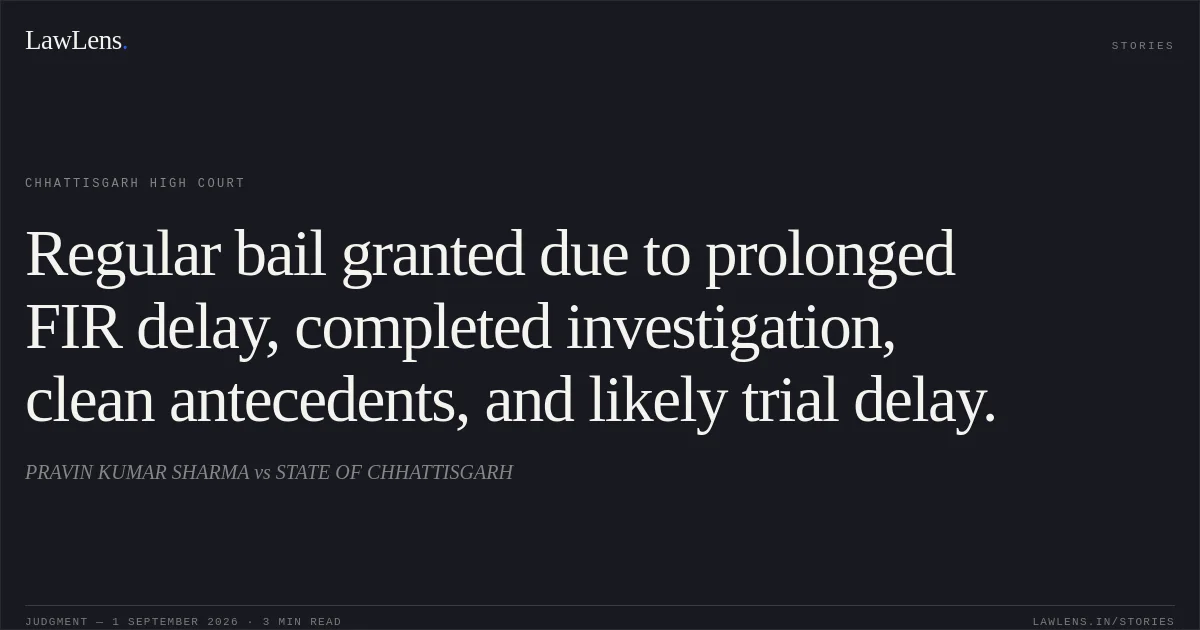
The High Court allowed the first regular bail application and directed that Pravin Kumar Sharma be released on bail in Crime No. 65/2025 upon furnishing a personal bond with two sureties in the like amount to the satisfaction of the trial court.
¶ 6The applicant was required, inter alia, not to seek adjournments when witnesses were present, to remain present on scheduled dates, to appear personally on the dates of opening of the case, framing of charge and recording of his statement under Section 351 BNSS, and to comply with the consequences prescribed in the event of absence or misuse of bail.
¶ 7A certified copy of the order was directed to be sent to the trial court for compliance.
¶ 8Original Court PDF
PRAVIN KUMAR SHARMAvsSTATE OF CHHATTISGARH
Click to open original judgment
Original judgment, available to read, download and summarize on LawLens.in