Facts
The applicant, Shabbir Khan, filed a second bail application under Section 483 of the Bhartiya Nagarik Suraksha Sanhita (BNSS), 2023, following the rejection of his first bail application on merits on January 8, 2026.
Source reference: para. 1-2The prosecution alleged that the applicant was involved in a cyber fraud syndicate where 128 "mule accounts" were opened in the Bank of Maharashtra, Raipur, to receive proceeds of cybercrime.
Source reference: para. 3Consequently, Crime No. 129/2025 was registered under the Bhartiya Nyaya Sanhita (BNS), 2023.
Source reference: para. 3The applicant has been in custody since July 3, 2025.
Source reference: para. 4Counsel for the applicant sought bail on the grounds of parity with a co-accused, the absence of criminal antecedents, and the fact that the charge-sheet had already been filed.
Source reference: para. 4Issues
1. Whether the applicant is entitled to regular bail on the ground of parity with a co-accused who was granted bail subsequent to the rejection of the applicant’s first bail application.
Source reference: para. 4, 72. Whether the completion of the investigation (filing of the charge-sheet) and the duration of the applicant's incarceration warrant his release pending trial.
Source reference: para. 7Law Applied
The Court exercised its jurisdiction under Section 483 of the Bhartiya Nagarik Suraksha Sanhita (BNSS), 2023, which governs the power of the High Court to grant regular bail.
Source reference: para. 1The substantive offenses were registered under Sections 317(2), 317(4), 317(5) (dealing with stolen property/proceeds of crime), 111 (organized crime), and 3(5) (common intention) of the Bhartiya Nyaya Sanhita (BNS), 2023.
Source reference: para. 1The Court also applied the principle of parity, relying on its own previous order in Krishna Ghodesawar v. State of Chhattisgarh (MCRC No. 902 of 2026), where an identically situated co-accused was granted bail.
Source reference: para. 7Reasoning
The Court evaluated the applicant's prayer by weighing the gravity of the cyber fraud allegations against the procedural status of the case.
Source reference: para. 7It noted that the investigation was complete as the charge-sheet had been submitted to the competent court.
Source reference: para. 7The Court specifically observed that the applicant had no prior criminal record and had been incarcerated for nearly nine months since July 2025.
Source reference: para. 7Most significantly, the Court found that a co-accused, Krishna Ghodesawar, whose circumstances were identical to the applicant’s, had been granted bail by the same Court on January 28, 2026.
Source reference: para. 7Applying the principle of parity and considering that the conclusion of the trial would likely be delayed, the Court determined that continued pretrial detention was no longer necessary.
Source reference: para. 7Holding
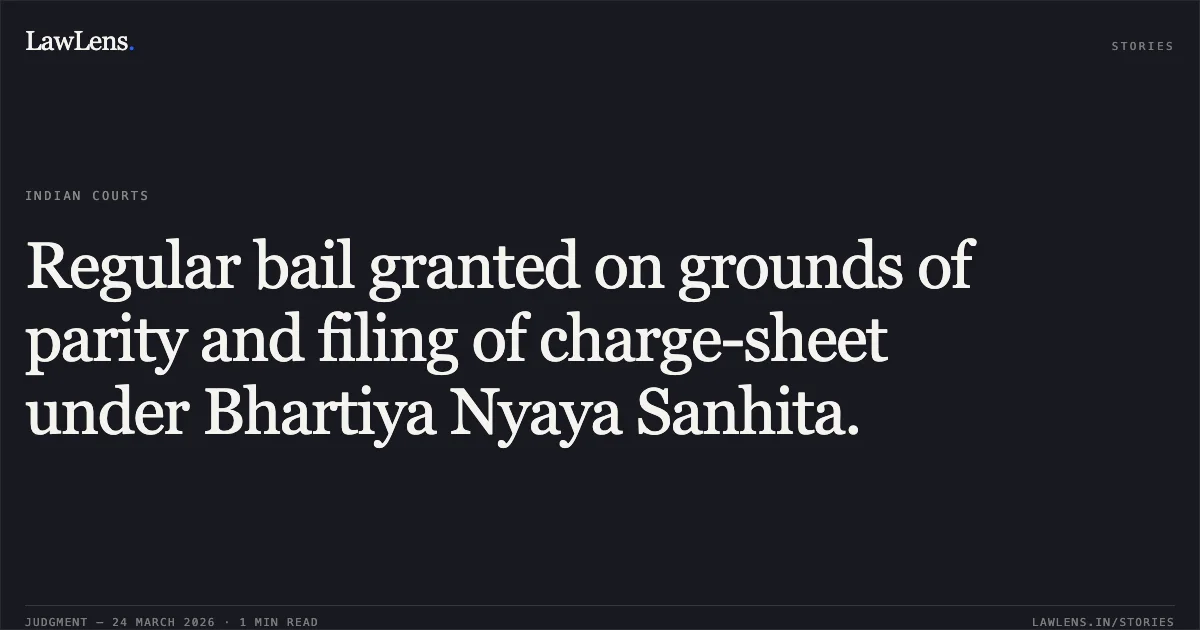
The Court allowed the second bail application and ordered the release of Shabbir Khan on bail upon furnishing a personal bond with two sureties.
The holding was based primarily on the ground of parity and the filing of the charge-sheet.
Source reference: para. 7The release is subject to strict conditions, including an undertaking not to seek unnecessary adjournments [para. 8(i)], mandatory presence at trial under threat of proceedings for non-attendance [para. 8(ii)-(iii)], and personal appearance during specific trial stages such as the framing of charges and recording of statements under Section 351 of the BNSS.
Source reference: para. 8(iv)Acts & Sections Cited
8 provisions across 2 statutes referred to in this judgment. Each provision opens on LawLens.
Bharatiya Nyaya Sanhita, 20235
Bharatiya Nagarik Suraksha Sanhita, 20233
Original Court PDF
SHABBIR KHANvsSTATE OF CHHATTISGARH
Click to open original judgment
Original judgment, available to read, download and summarize on LawLens.in