01Facts
On 4 July 2026, police officials of Police Station Nawagarh, District Janjgir-Champa, allegedly received information regarding the illegal possession of country-made liquor.
¶ 2Upon conducting a search, the police allegedly recovered six bulk litres of country-made liquor from the applicant, Sukhdev Kashyap.
¶ 2The liquor was seized and Crime No. 199/2026 was registered against him for an offence under Section 34(2) of the Excise Act; he was thereafter arrested and remained in judicial custody from 4 July 2026.
¶ 2The applicant denied the allegations, contended that he had been falsely implicated and that the seizure memo was fabricated.
¶ 3The State opposed bail, pointing out that he had one previous criminal antecedent.
¶ 4The charge-sheet had already been filed before the competent court.
¶ 602Issues
i.Whether the applicant should be granted regular bail under Section 483 of the Bharatiya Nagarik Suraksha Sanhita, 2023, in connection with the offence under Section 34(2) of the Excise Act.
¶ 1ii.Whether the applicant’s period of detention, filing of the charge-sheet, and the likelihood of delay in conclusion of the trial justified release on bail despite the alleged recovery and one prior criminal antecedent.
¶ 4–603Law Applied
The Court applied Section 483 of the Bharatiya Nagarik Suraksha Sanhita, 2023, governing the High Court’s power to grant regular bail, and considered the allegation under Section 34(2) of the Excise Act.
¶ 1The governing bail principle applied was that release may be granted after assessing the nature and gravity of the alleged offence, the period of custody, the stage of the proceedings, the filing of the charge-sheet, the likelihood of the trial’s timely conclusion, and the possibility of regulating the accused’s presence through appropriate conditions.
¶ 6The order also imposed conditions concerning attendance, non-seeking of unnecessary adjournments, personal appearance at material stages, and consequences for misuse of bail.
¶ 7Provisions in the judgment · 5 · Linked ones open on LawLens
Bharatiya Nagarik Suraksha Sanhita, 2023 Section 483Section 84Section 351
Bharatiya Nyaya Sanhita, 2023 Section 269Section 209
04Reasoning
The Court considered the prosecution allegation of recovery of six bulk litres of country-made liquor, the applicant’s denial of the seizure, and the State’s objection based on his previous criminal antecedent.
¶ 2–4On an overall assessment of the case diary, the Court gave weight to the applicant’s custody since 4 July 2026, the fact that the charge-sheet had already been filed, and the likelihood that the trial would take considerable time to conclude.
¶ 5–6These circumstances persuaded the Court that continued detention was not necessary at that stage and that the applicant’s presence could be secured through stringent bail conditions.
¶ 6–705Holding
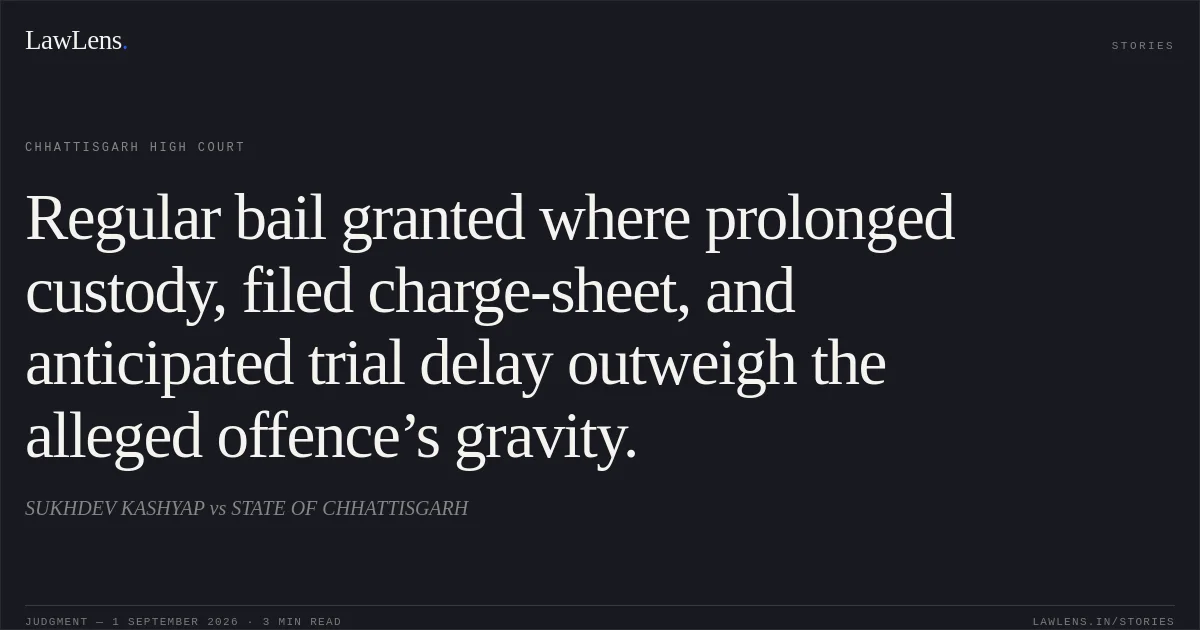
The High Court allowed the first regular bail application.
¶ 7The High Court directed that Sukhdev Kashyap be released in Crime No. 199/2026 upon furnishing a personal bond with two local sureties for the like sum to the satisfaction of the concerned trial court.
¶ 7The bail was subject to conditions requiring him not to seek adjournments when witnesses were present, to remain present on each date fixed by the trial court, to appear personally at the opening of the case, framing of charge, and recording of his statement, and to face appropriate proceedings in the event of misuse of bail or non-appearance pursuant to proclamation.
¶ 7A certified copy of the order was directed to be sent to the trial court for compliance.
¶ 8Original Court PDF
SUKHDEV KASHYAPvsSTATE OF CHHATTISGARH
Click to open original judgment
Original judgment, available to read, download and summarize on LawLens.in