Facts
Basappa Vithal Madar was appointed as a temporary Class IV employee on daily wages on 5 April 1984.
Source reference: para. 4–8After his termination in December 1990, the High Court stayed the termination order in proceedings to which he was a party.
Source reference: para. 4–8Although he sought to resume work, he was permitted to do so only from 1 August 1996.
Source reference: para. 4–8He sought regularisation under the Government Order dated 3 November 1994 and related service benefits; his claim was rejected on the ground that he had not completed ten years’ continuous service.
Source reference: para. 4–8The Single Judge allowed his petition, directing the authorities to use 5 April 1984 as the starting date for computing ten years and to consider regularisation and consequential benefits.
Source reference: para. 9The Board appealed.
Source reference: para. 1, 9Issues
1. Whether the respondent was entitled to consideration for regularisation and service benefits on the basis of parity with a similarly situated employee who had received regularisation.
Source reference: para. 11–132. Whether the period during which the termination order was stayed could be relied on by the authorities as a break in service, where the respondent was not permitted to resume duty despite the interim order.
Source reference: para. 12Law Applied
The appeal was brought under Section 4 of the Karnataka High Court Act, 1961.
Source reference: para. 1The Court applied the principle that an employee should not be treated differently from similarly situated employees without justification.
Source reference: para. 11It also considered the Government Order dated 3 November 1994, which the respondent invoked as the basis for regularisation of eligible daily-wage employees, and the Supreme Court decisions in Dharwad PWD Literate Daily Wages Employees Association v. State of Karnataka and State of Karnataka v. Umadevi, which were raised in the proceedings.
Source reference: para. 5–8The appeal was resolved on parity and the effect of the stay order; the Court did not undertake a separate exposition of those precedents.
Source reference: para. 11–13Reasoning
The Court noted that S.S. Siddapur, who was similarly situated, was also a party to the earlier writ proceedings and had obtained regularisation after his termination was stayed.
Source reference: para. 12The respondent was likewise a party to those proceedings, and the authorities had not disputed the asserted similarity.
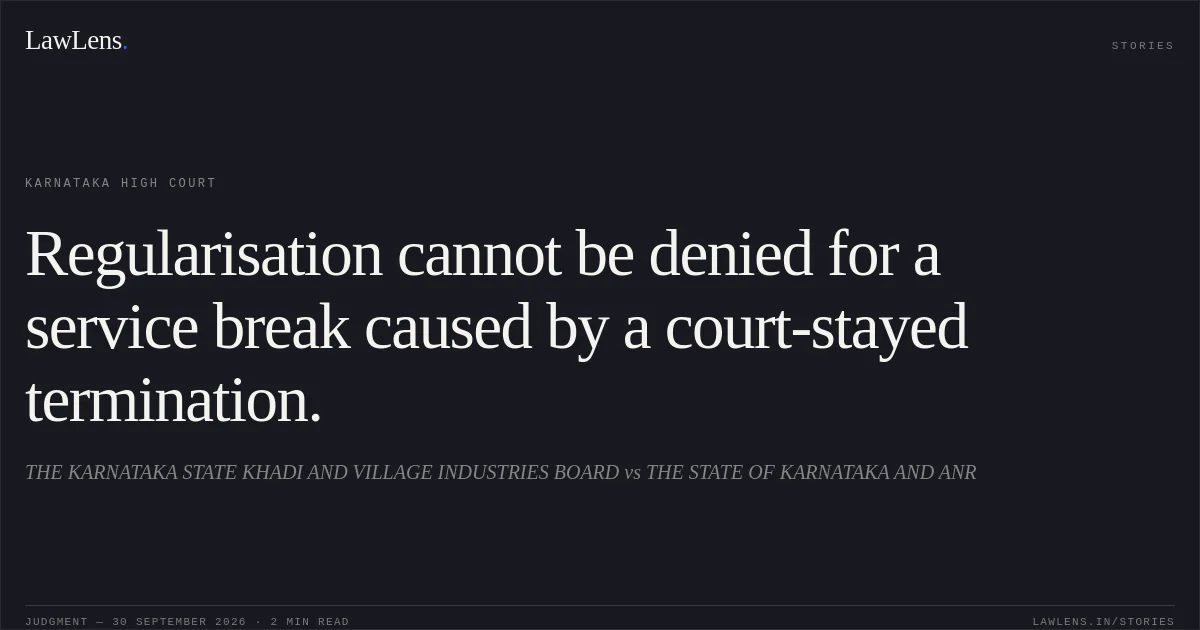
Source reference: para. 12Further, because the termination order had been stayed and the respondent was not allowed to report for duty, the authorities could not rely on the resulting interruption to deny him consideration for the benefit while extending it to a comparable employee.
Source reference: para. 12The Court therefore found no error in the Single Judge’s direction.
Source reference: para. 13–14Holding
The Court held that the respondent was entitled to equal consideration for regularisation and consequential service benefits, and that the Single Judge’s order warranted no interference.
The writ appeal was rejected.
Source reference: para. 14Acts & Sections Cited
1 provisions across 1 statute referred to in this judgment. Each provision opens on LawLens.
KARNATAKA HIGH COURT ACT, 19611
Original Court PDF
THE KARNATAKA STATE KHADI AND VILLAGE INDUSTRIES BOARDvsTHE STATE OF KARNATAKA AND ANR
Click to open original judgment
Original judgment, available to read, download and summarize on LawLens.in