Facts
The petitioners were appointed as Dressers on temporary engagements against sanctioned posts in the Bihar prison administration: Lalchand Mishra on 22 December 1989, Shatrughan Prasad Singh on 3 June 1988, and Md. Shahabuddin Ansari, who joined on 10 March 1989 pursuant to an appointment order dated 23 February 1989.
Source reference: paras. 4, 9Forty regular posts of Dresser were subsequently created for absorption of existing continuous personnel, and the petitioners were recommended for absorption in 2004.
Source reference: para. 5Their services were terminated in October 2004, but the termination orders were set aside by the High Court.
Source reference: paras. 5, 9Pursuant to proceedings in M.J.C. No. 2431 of 2005, the High Court held that the petitioners fell within the one-time regularisation contemplated by paragraph 44 of Secretary, State of Karnataka v. Umadevi (3).
Source reference: para. 6The authorities thereafter issued Memo No. 3979 dated 25 June 2007, regularising them prospectively from 2007.
Source reference: para. 6In earlier writ proceedings, the prospective restriction was set aside and the authorities were directed to reconsider the petitioners’ past continuous service.
Source reference: paras. 7, 10Nevertheless, Memo No. 506 dated 25 January 2016 and Memo No. 2417 dated 8 May 2013 rejected their claims for counting past service for pay fixation, seniority, continuity, and pensionary benefits.
Source reference: paras. 7, 10The State contended that the petitioners’ initial engagements were temporary or daily-wage appointments and that their regularisation in 2007 amounted to fresh appointments after the introduction of the New Pension Scheme.
Source reference: para. 12During the proceedings, however, the State disclosed that administrative approval had been granted on 15 September 2025 to extend the Old Pension Scheme to Lalchand Mishra.
Source reference: para. 13Issues
1. Whether the authorities could treat the petitioners’ regularisation on 25 June 2007 as a fresh prospective appointment and refuse to count their uninterrupted service rendered from 1988–1990 for pay fixation, seniority, continuity, and retiral benefits.
Source reference: para. 14; p. 72. Whether Memo No. 506 dated 25 January 2016 and Memo No. 2417 dated 8 May 2013, rejecting the petitioners’ claims for recognition of past service, were legally sustainable in light of the earlier orders of the High Court and the principles governing regularisation of long-serving employees.
Source reference: para. 14; p. 73. Whether denial of the Old Pension Scheme to Lalchand Mishra, while similarly situated employees were retained under the GPF scheme, was arbitrary and discriminatory under Article 14 of the Constitution.
Source reference: paras. 11, 26Law Applied
The Court applied paragraph 44 of Secretary, State of Karnataka v. Umadevi (3), (2006) 4 SCC 1, which permits one-time regularisation of irregularly appointed, duly qualified employees who have worked for ten years or more against sanctioned posts, provided their service was not protected by court orders.
Source reference: para. 16It relied on State of Karnataka v. M.L. Kesari, (2010) 9 SCC 247, clarifying the requirements of ten years’ service against sanctioned posts and absence of judicial protection during the relevant period.
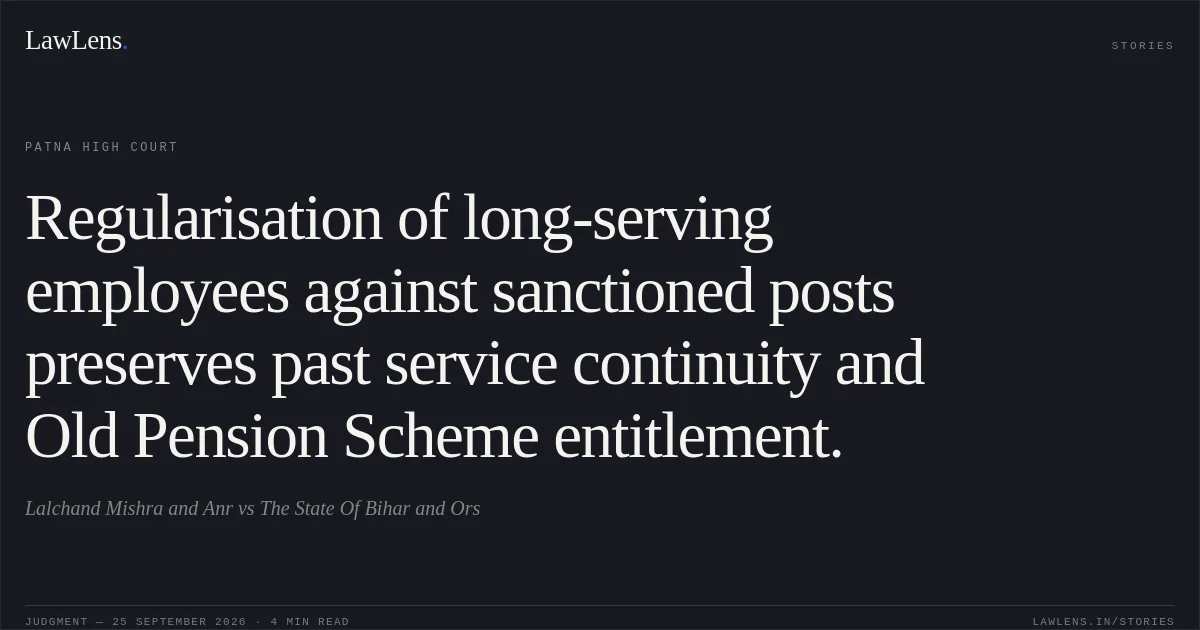
Source reference: para. 17The Court further relied on Sheo Kumar Shukla v. State of Bihar, 2014 (3) PLJR 609, for the principle that regularisation recognising an existing employer–employee relationship is not a fresh appointment for pension purposes.
Source reference: para. 22It also invoked Jaggo v. Union of India, 2025 (1) PLJR (SC) 165, and Bhola Nath v. State of Jharkhand, SLP (Civil) No. 30762 of 2024, for the principles that contractual or daily-wage labels cannot justify perpetual ad hocism, and that long-serving employees performing essential functions against sanctioned posts cannot be denied fair regularisation merely through nomenclature or procedural technicalities.
Source reference: paras. 18–23Article 14 required parity among employees regularised through the same departmental process.
Source reference: para. 26Reasoning
The Court found that the petitioners had served continuously for approximately 14–19 years against sanctioned posts created, inter alia, for absorption of existing personnel, and that their eligibility for regularisation under paragraph 44 of Umadevi had already been recognised in the earlier proceedings.
Source reference: paras. 20–21Their termination orders had been quashed, meaning that the employment relationship was not legally severed; consequently, the 2007 order had to be understood as regularisation of an existing service relationship rather than a fresh post-2005 entry.
Source reference: para. 22Treating the petitioners as fresh appointees would therefore unlawfully erase their past service and defeat the purpose of the regularisation directions.
Source reference: paras. 21, 23–25The Court also held that the State could not apply different pension rules to employees regularised through the same process, particularly when similarly situated employees were receiving GPF benefits and the State had itself approved coverage of Lalchand Mishra under the Old Pension Scheme.
Source reference: para. 26Holding
The writ petitions were allowed.
Memo No. 506 dated 25 January 2016 and Memo No. 2417 dated 8 May 2013 were quashed.
Source reference: para. 28(I)–(II)Md. Shahabuddin Ansari’s service was directed to be treated as regularised from his initial engagement/absorption date, stated in the operative order as 15 May 1990, with consequential benefits including pay fixation, seniority, continuity, and retiral benefits.
Source reference: para. 28(III)Shatrughan Prasad Singh was directed to receive regularisation and full continuity from 3 June 1988, including pay protection, increments, seniority, and revised pensionary benefits.
Source reference: para. 28(IV)Lalchand Mishra was directed to be formally covered under the Old Pension Scheme and treated as continuously regularised from 22 December 1989, with pay, seniority, and retiral benefits.
Source reference: para. 28(V)The State was directed to calculate and release the pension, GPF, gratuity, leave encashment, arrears, and other consequential benefits of the petitioners within six weeks.
Source reference: para. 28(VI)–(VII)Original Court PDF
Lalchand Mishra and AnrvsThe State Of Bihar and Ors
Click to open original judgment
Original judgment, available to read, download and summarize on LawLens.in