Facts
The Collector granted administrative approval for construction works in four villages, including a PDS Godown at Bheempura, District Damoh, with the Rural Engineering Department as the construction agency.
Source reference: no citationThe petitioner participated in the tender process, executed an agreement with the respondent department on 27 February 2024, and received a work order dated 29 February 2024.
Source reference: no citationHe claimed to have completed construction up to the roof level and submitted bills for payment.
Source reference: no citationHowever, the work was allegedly not reflected on the online portal, preventing payment.
Source reference: no citationThe Executive Engineer and the petitioner made several communications and representations seeking correction of the portal and release of payment, but no decision was taken.
Source reference: para. 2During the proceedings, the petitioner could not produce a work-completion certificate.
Source reference: para. 3The respondents asserted that there was a dispute concerning the sanction of the work and that no completion certificate had been issued.
Source reference: paras. 3–4Issues
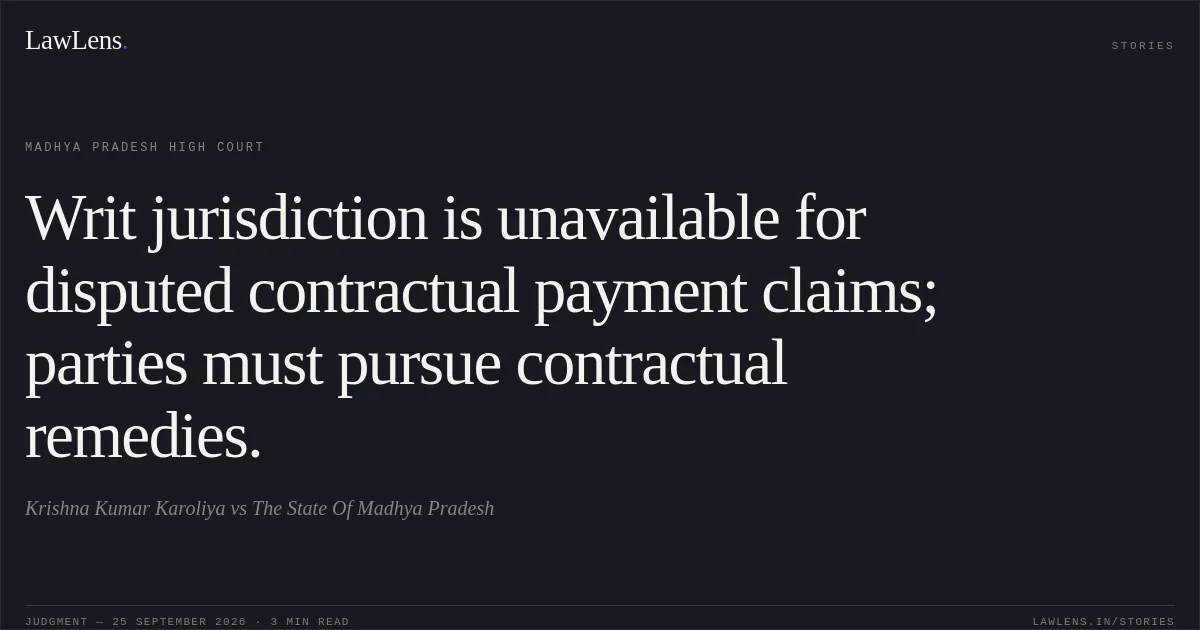
Whether the High Court could issue a writ of mandamus directing the respondents to correct the online portal and release payment allegedly due under the construction work order.
Source reference: paras. 1–3Whether the writ petition was maintainable in view of the disputed sanction of the work, absence of a work-completion certificate, and availability of a contractual remedy.
Source reference: paras. 4–6Law Applied
The Court held that writ jurisdiction should be exercised with restraint in contractual and commercial matters.
Source reference: para. 7In Tata Motors Ltd. v. Brihan Mumbai Electric Supply & Transport Undertaking (BEST), 2023 SCC OnLine SC 671, the Supreme Court held that interference in contractual matters is ordinarily unwarranted unless arbitrariness, mala fides, bias, or irrationality is clearly established; courts must also avoid entering into technical and commercial questions.
Source reference: para. 7Relying on Tata Cellular v. Union of India, (1994) 6 SCC 651, the Court reiterated that judicial review examines the decision-making process and not the merits of the contractual decision, and that courts should not substitute their own view for that of the authorities in the absence of arbitrariness or illegality.
Source reference: para. 8Where contractual remedies are available and factual or technical disputes arise, a writ of mandamus ordinarily should not be issued.
Source reference: paras. 6, 9Reasoning
The Court found that the respondents had raised a dispute regarding the sanction of the work, as reflected in the communication dated 19 September 2024, and that the petitioner had not placed any work-completion certificate on record.
Source reference: para. 6Since the claim for payment depended on disputed contractual facts, including the validity of the sanction and completion of the work, the Court held that the matter could not appropriately be adjudicated in writ jurisdiction.
Source reference: paras. 6, 9The alleged non-reflection of the work on the online portal did not, by itself, establish an enforceable public-law entitlement to payment.
Source reference: paras. 6, 9Applying the principles of restraint governing contractual disputes, the Court concluded that the petitioner had an adequate remedy under the contract.
Source reference: paras. 6, 9Holding
The Court declined to issue a writ directing correction of the online portal or release of payment.
The writ petition was dismissed because the dispute concerned contractual matters, no work-completion certificate had been produced, and a contractual remedy was available to the petitioner.
Source reference: para. 9The petitioner was granted liberty to avail the remedy provided under the contract for redressal of his grievances.
Source reference: para. 10Original Court PDF
Krishna Kumar KaroliyavsThe State Of Madhya Pradesh
Click to open original judgment
Original judgment, available to read, download and summarize on LawLens.in