Facts
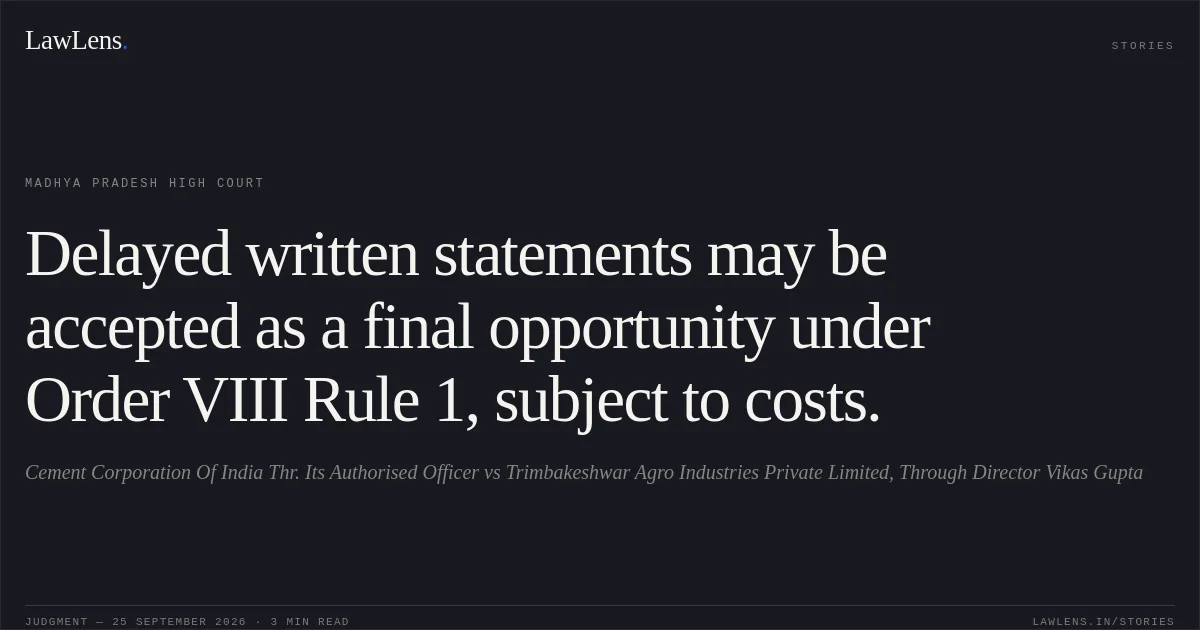
The petitioners invoked Article 227 of the Constitution challenging the trial court’s orders dated 22 June 2026 and 13 July 2026, by which their right to file a written statement was closed.
Source reference: p.1The underlying suit was filed by the respondents for recovery of ₹4,50,000 towards goods supplied to the petitioner-company.
Source reference: p.1Although the petitioners’ counsel had entered appearance in January 2025, no written statement was filed despite repeated opportunities.
Source reference: p.1The petitioners attributed the delay to the retirement of the concerned officer and a subsequent change of counsel, and submitted that the written statement was ready and would be filed within seven days if permission were granted.
Source reference: p.1The respondents opposed the request, relying on the delay and the limitation contemplated under Order VIII Rule 1 CPC, but stated that if relief were granted, appropriate costs should be imposed.
Source reference: p.1Issues
1. Whether the High Court, in exercise of its supervisory jurisdiction under Article 227 of the Constitution, should grant the petitioners one final opportunity to file their written statement after the trial court had closed that right for failure to file it despite repeated opportunities.
Source reference: pp.1–32. Whether such permission should be granted subject to the payment of costs and compliance with a strict time limit, notwithstanding the delay under Order VIII Rule 1 CPC.
Source reference: pp.1–3Law Applied
The Court applied Article 227 of the Constitution, which empowers the High Court to exercise supervisory jurisdiction over subordinate courts to secure the interests of justice.
Source reference: p.1It considered Order VIII Rule 1 of the Code of Civil Procedure, 1908, governing the time for filing a written statement and prescribing the ordinary maximum period of 90 days.
Source reference: p.1The Court also applied the principle that procedural timelines, although important, may in appropriate cases be relaxed to advance the interests of justice, particularly where a final opportunity can be granted on stringent terms.
Source reference: p.1The Court referred generally to the Supreme Court’s approach concerning permission to file delayed pleadings, but no specific precedent was identified in the judgment.
Source reference: p.1Reasoning
The Court accepted that the petitioners had been negligent: they had notice of the proceedings, their counsel had appeared in January 2025, and the written statement had still not been filed despite multiple opportunities.
Source reference: pp.1–3It nevertheless considered the nature of the dispute, involving a relatively modest recovery claim of ₹4,50,000, and the fact that the suit remained pending for adjudication.
Source reference: p.2Balancing the petitioners’ procedural default against the need to decide the dispute on its merits, the Court held that the interests of justice warranted one final opportunity.
Source reference: pp.2–3The explanation based on the retirement of the officer and change of counsel was not regarded as a proper justification, but the Court granted relief subject to substantial costs and strict compliance with the seven-day deadline.
Source reference: pp.2–3Holding
The petition was disposed of by granting the petitioners one final opportunity to file their written statement before the trial court within seven days from the date of the order.
This permission was conditional upon payment of ₹50,000 as costs before the trial court: ₹25,000 was directed to be deposited with the Madhya Pradesh State Legal Services Authority, Indore, and ₹25,000 paid to the respondent/plaintiff towards litigation expenses.
Source reference: p.3The Court directed that failure to pay the costs and file the written statement within the stipulated period would result in the order standing recalled, with no further relief or extension of time available to the petitioners.
Source reference: p.3Original Court PDF
Cement Corporation Of India Thr. Its Authorised OfficervsTrimbakeshwar Agro Industries Private Limited, Through Director Vikas Gupta
Click to open original judgment
Original judgment, available to read, download and summarize on LawLens.in