Facts
The applicant, an SSLC-failed individual from a Scheduled Community, was appointed as a Part-Time Casual Labourer in the Central Excise Department on 31.03.1997.
Source reference: para. 2In 2020, the "Part Time Casual Labourers (Regularization) Scheme CBIC-2020" was introduced following judicial interventions to regularize long-serving casual staff.
Source reference: para. 3The applicant applied but was rejected via order dated 10.10.2022 because he failed to meet the mandatory educational qualification of passing SSLC/Matriculation.
Source reference: para. 3After his representations were rejected (Annexure-A8), he was relieved of his duties on 16.07.2025.
Source reference: para. 3The applicant challenged the termination and sought reinstatement as Multi-Tasking Staff (MTS), alleging the termination contravened established precedents on regularization.
Source reference: para. 4-5Issues
1. Whether the applicant is entitled to regularization despite not possessing the minimum educational qualification prescribed in the 2020 Scheme and Recruitment Rules.
Source reference: para. 112. Whether long and continuous service independently entitles a casual laborer to regularization when a specific one-time scheme has already found them ineligible.
Source reference: para. 17Law Applied
Part Time Casual Labourers (Regularization) Scheme CBIC-2020, which mandates ten years of continuous service and fulfillment of educational qualifications (Matriculation/ITI) as per the Recruitment Rules for Group ‘C’ posts.
Source reference: para. 8, 11State of Karnataka v. Umadevi [2006] 4 SCC 1, which directs the framing of schemes for regularization of irregularly appointed employees who have worked for over ten years, provided they are qualified for the post.
Source reference: para. 4, 14Jaggo v. Union of India [2024] INSC 1034, Shripal v. Nagar Nigam Ghaziabad [2025], and Dharam Singh v. State of U.P. [2025] INSC 998, which emphasize that long service can create a right to regularization to prevent the exploitation of casual labor.
Source reference: para. 15-16Reasoning
The Tribunal noted that the applicant does not challenge the validity of the 2020 Scheme or its specific educational stay requirements; rather, he seeks relief despite them.
Source reference: para. 12While the applicant relied on Jaggo and Dharam Singh to argue that long service overrides procedural hurdles, the Tribunal distinguished those cases, noting that a formal scheme (CBIC-2020) was indeed framed and implemented by the respondents in compliance with Umadevi.
Source reference: para. 17The court reasoned that since Group 'D' posts were upgraded to Group 'C', the minimum requirement of an SSLC pass became a statutory necessity under the Recruitment Rules.
Source reference: para. 8The Tribunal held that "there cannot be regularization when the applicant is found to be ineligible under the scheme".
Source reference: para. 17The applicant's failure to meet the educational criteria is a substantive bar that cannot be bypassed simply by virtue of length of service.
Source reference: para. 17-18Holding
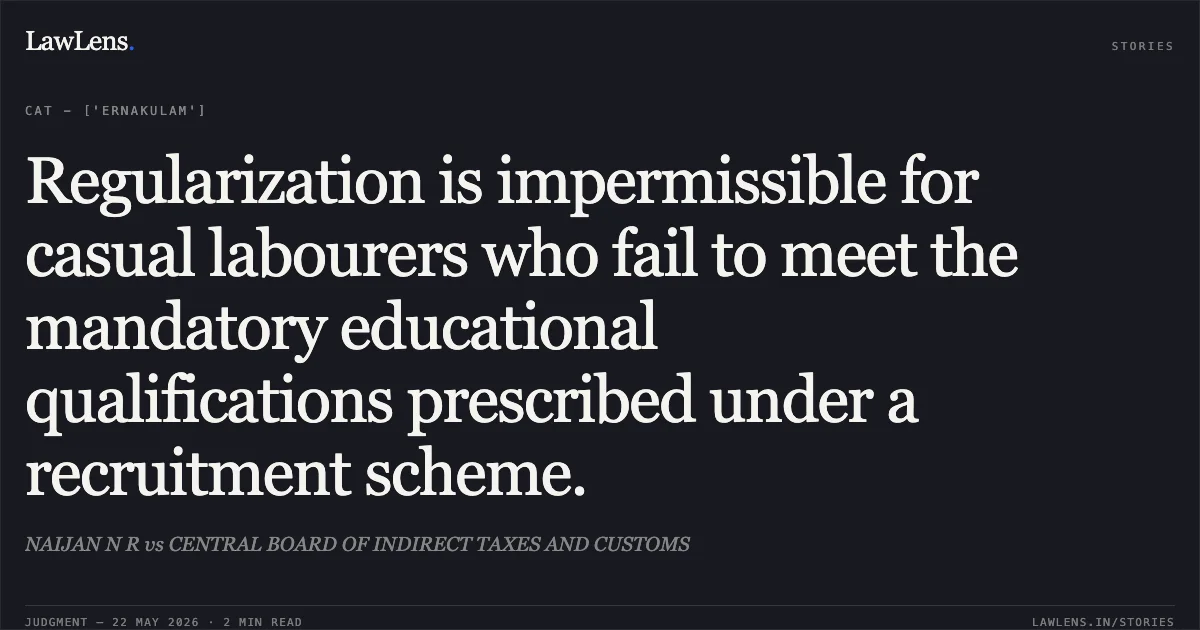
The Tribunal answered the issues in the negative, holding that the applicant has no legal right to be regularized or reinstated as MTS since he does not possess the requisite educational qualifications prescribed by the Scheme and Recruitment Rules.
The court found no illegality in Annexures A8 and A9. The Original Application was dismissed, and the interim order protecting the applicant's work was vacated.
Source reference: para. 19Acts & Sections Cited
1 provisions across 1 statute referred to in this judgment. Linked provisions open on LawLens.
Central Civil Services (Classification, Control & Appeal) Rules, 19651
Original Court PDF
NAIJAN N RvsCENTRAL BOARD OF INDIRECT TAXES AND CUSTOMS
Click to open original judgment
Original judgment, available to read, download and summarize on LawLens.in