01Facts
The petitioner, a registered trade union, represented 122 daily-rated mazdoors (“DRMs”) engaged by the Forest Administration on diverse dates from 1990 onwards.
¶ 1, 20Following prolonged litigation, the authorities issued an order dated 21 May 2015 appointing the DRMs on an ad hoc basis with pay-band and grade-pay benefits.
¶ 27Subsequently, by the impugned regularisation order—recorded in the judgment as dated 12 July 2021—their services were regularised with effect from 21 May 2015, and their prior ad hoc service was regularised.
¶ 2, 34The Union contended that regularisation and consequential benefits should operate from the date of initial engagement, relying on the Labour Tribunal’s award dated 13 July 2005 and subsequent proceedings.
¶ 3–7The respondents argued that the Tribunal had left the date of regularisation to the Administration, that the workmen had accepted the award, and that the writ petition was barred by delay and laches.
¶ 8–13The Court rejected the objection of delay, noting the Union’s continued litigation, contempt proceedings, and filing of the writ petition shortly after disposal of the contempt application.
¶ 14–18, 3202Issues
i.Whether the 122 DRMs were entitled to regularisation and consequential service benefits from their initial date of engagement rather than from 21 May 2015.
¶ 3–7, 20–24ii.Whether, in the absence of evidence establishing the precise initial dates of engagement, 10 April 1996 could be adopted as the effective date of regularisation.
¶ 25, 29–33iii.Whether the writ petition was liable to be dismissed on the ground of delay and laches.
¶ 11, 14–18, 3203Law Applied
The Court relied on the Labour Tribunal’s award dated 13 July 2005, which directed payment of daily wages from the workmen’s respective dates of initial engagement and left the implementation of regularisation to the employer.
¶ 21, 24–25It also considered the Office Memorandum dated 11 December 2006 issued pursuant to Secretary, State of Karnataka v. Umadevi (3), (2006) 4 SCC 1, concerning regularisation of qualified workers appointed irregularly against sanctioned posts.
¶ 21The governing principle applied was that, once regularisation was granted, the Administration was required to determine the effective date by reference to the workmen’s established period of service and could not arbitrarily disregard earlier service by treating a later ad hoc appointment as the commencement of service.
¶ 23–24, 30–31Where the exact date of initial engagement was unavailable, the date supported by the Administration’s own records could be adopted.
¶ 29–3104Reasoning
The Court held that the Administration had itself acknowledged that all 122 DRMs had been engaged before 10 April 1996, thereby establishing a reliable outer date for their service, even though the precise dates of individual engagement had not been proved before the Tribunal.
¶ 25, 29Since the Tribunal had directed payment from the respective dates of initial engagement and the Administration ultimately regularised the workmen, it could not restrict the benefit to the later date of ad hoc appointment without assigning any reason.
¶ 23–24In the absence of direct evidence identifying each workman’s exact initial date, the Court adopted 10 April 1996—the date supported by the available official record—as the effective date for regularisation and consequential benefits.
¶ 30–31The plea of delay was rejected because the Union had continuously pursued the matter through successive proceedings and had approached the Court promptly after the contempt proceedings concluded.
¶ 3205Holding
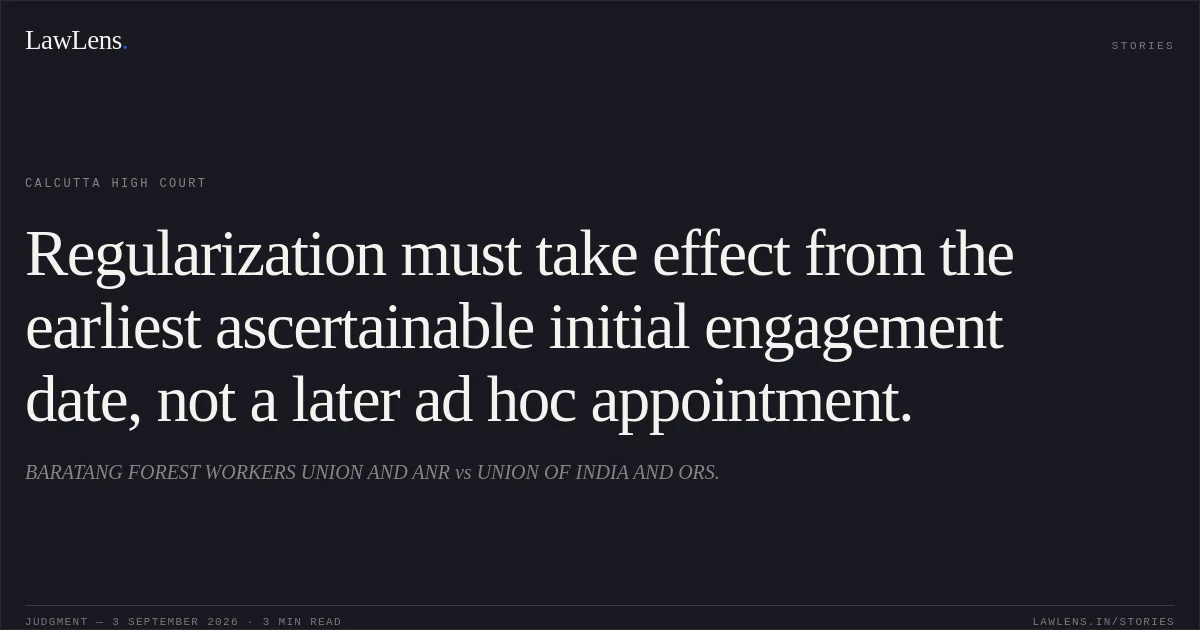
The Court allowed the writ petition and held that the date of regularisation and all consequential benefits for the 122 DRMs shall be 10 April 1996, in place of 21 May 2015.
¶ 33–34The relevant portion of the regularisation order was set aside, and the respondents were directed to update their records, recalculate the financial implications, and implement the directions within sixty days of communication of the judgment.
¶ 34–36No order as to costs was made.
¶ 37Original Court PDF
BARATANG FOREST WORKERS UNION AND ANRvsUNION OF INDIA AND ORS.
Click to open original judgment
Original judgment, available to read, download and summarize on LawLens.in