Facts
The petitioner, appointed as Assistant Development Officer (Chemical) in 1976, became an employee of BIADA after the merger of the Industrial Area Development Authorities in 2003. His services were terminated in 2005 on the ground that his initial appointment was illegal; the termination was set aside by the High Court in C.W.J.C. No. 6364 of 2005, with a direction to reinstate him with consequential benefits.
Source reference: p.3After his reinstatement in June 2007, disciplinary proceedings were initiated against him and he was compulsorily retired on 25 July 2007. That order was quashed in C.W.J.C. No. 11526 of 2007 on 5 May 2009, with a direction to consider back wages in accordance with Novartis India Ltd. v. State of West Bengal.
Source reference: pp.4–5The petitioner was subsequently suspended, and the disciplinary proceeding culminated in an order imposing censure and denying salary for the suspension period, except subsistence allowance; the period of compulsory retirement was directed to count for continuity and gratuity.
Source reference: p.6On appeal, the Chairman, BIADA set aside the punishment order on 14 June 2011.
Source reference: pp.6–7, 12The petitioner thereafter sought back wages for the period of compulsory retirement and the differential salary for the suspension period. BIADA rejected the claim for back wages by Memo No. 2850 dated 7 May 2013, without deciding the claim relating to salary during suspension.
Source reference: p.7Issues
Whether the petitioner was entitled to back wages for the period during which his compulsory retirement operated after the retirement order was quashed, particularly in light of the direction to consider the claim under Novartis India Ltd.?
Source reference: pp.5, 7–10Whether BIADA could deny salary for the period of suspension after the appellate authority had set aside the disciplinary punishment order?
Source reference: pp.6–9, 12–15Whether the Board of Governors’ review of the appellate order validly justified rejection of the petitioner’s claim for back wages under Clause 2.8.5 of Part II of the 2007 BIADA Regulations?
Source reference: pp.10–13Law Applied
The Court applied the principle that back wages following reinstatement are not invariably automatic and must be determined in accordance with the circumstances of the case, including the employee’s gainful employment, as indicated in Novartis India Ltd. v. State of West Bengal, (2009) 3 SCC 124.
Source reference: pp.5, 7–10It also considered Rule 13(3) of the Bihar Government Servant (Classification, Control and Appeal) Rules, 2005, which provides for full salary and allowances where an order of discharge, dismissal or compulsory retirement is set aside for non-compliance with the Rules, although the Court’s ultimate decision on back wages rested on judicial parity.
Source reference: pp.2–3Clause 2.8.5 of Part II of the 2007 BIADA Regulations was treated as conferring review power on the Board of Directors/Governors.
Source reference: pp.10–13The Court further applied the principle of judicial parity and consistency with the binding outcome in the similarly situated case of Ram Pravesh Singh v. Managing Director, BIADA.
Source reference: pp.12–14Reasoning
The Court held that the petitioner’s claim for back wages could not be granted because the claim of a similarly situated employee, Ram Pravesh Singh, had already been rejected by the High Court and the dismissal had been affirmed in Letters Patent Appeal.
Source reference: pp.12–14Although the petitioner argued that BIADA had wrongly placed the burden on him to prove that he was not gainfully employed, the Court considered itself bound by judicial parity and institutional consistency, and therefore declined to reopen the question of back wages.
Source reference: p.14In contrast, the order denying salary during suspension had been expressly set aside by the appellate authority on 14 June 2011.
Source reference: pp.6, 12The Board’s subsequent review dealt only with back wages and did not determine the petitioner’s entitlement to salary for the suspension period or the effect of the censure order. Consequently, no subsisting order validly denying salary for suspension remained, apart from the subsistence allowance already paid.
Source reference: p.14Holding
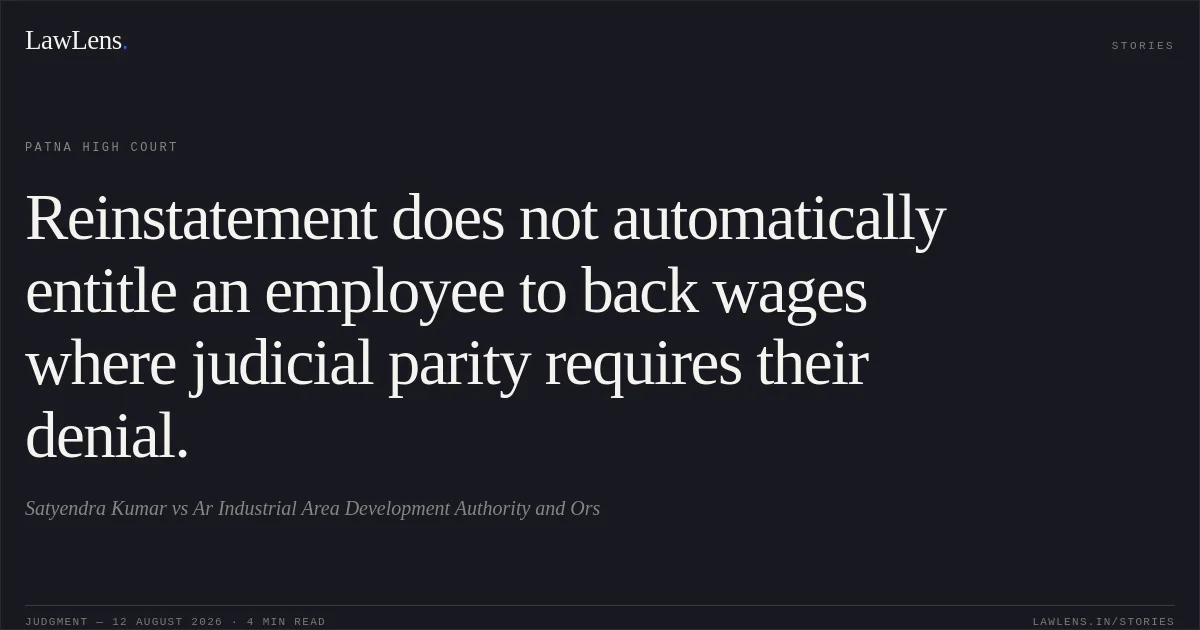
The writ petition was partly allowed and disposed of. The Court declined to interfere with BIADA’s rejection of the petitioner’s claim for back wages for the period of compulsory retirement, applying judicial parity with Ram Pravesh Singh.
However, it held that the petitioner was entitled to receive salary for the period of suspension, after deducting the subsistence allowance already paid to him, since the order denying such salary had been set aside by the appellate authority and had not been validly reinstated or reconsidered.
Source reference: p.14BIADA was directed to pay the amount within three months from receipt or production of the order.
Source reference: pp.14–15Pending applications, if any, were also disposed of.
Source reference: p.15Original Court PDF
Satyendra KumarvsAr Industrial Area Development Authority and Ors
Click to open original judgment
Original judgment, available to read, download and summarize on LawLens.in