Facts
The respondents instituted J.S.C.C. Suit No. 25 of 2016 before the Additional District and Sessions Judge, Court No. 2, Moradabad, seeking eviction of the petitioners and recovery of rent arrears.
Source reference: para. 3Their claim of ownership and landlordship was based on sale deeds dated 3 January 1992 and 7 January 1992.
Source reference: para. 3The petitioners denied the landlord–tenant relationship, asserted that the premises were Wakf property and that they were tenants under the Wakf/Managing Committee, and challenged the validity of the sale deeds.
Source reference: paras. 4–5They also contended that the dispute fell within the jurisdiction of the Wakf Tribunal under Sections 83 and 85 of the Wakf Act, 1995, and not the Court of Small Causes.
Source reference: para. 5After seven issues had been framed, the petitioners sought formulation of sixteen additional issues, but their applications were rejected on 9 October 2025.
Source reference: paras. 6–7They subsequently sought stay of the suit under Section 10 read with Section 151 CPC because Second Appeal No. 306 of 2018, concerning the validity of the same sale deeds, was pending before the High Court.
Source reference: paras. 8–10That application was rejected on 7 March 2026.
Source reference: paras. 8–10The petitioners challenged both orders under Article 227 of the Constitution.
Source reference: para. 11Issues
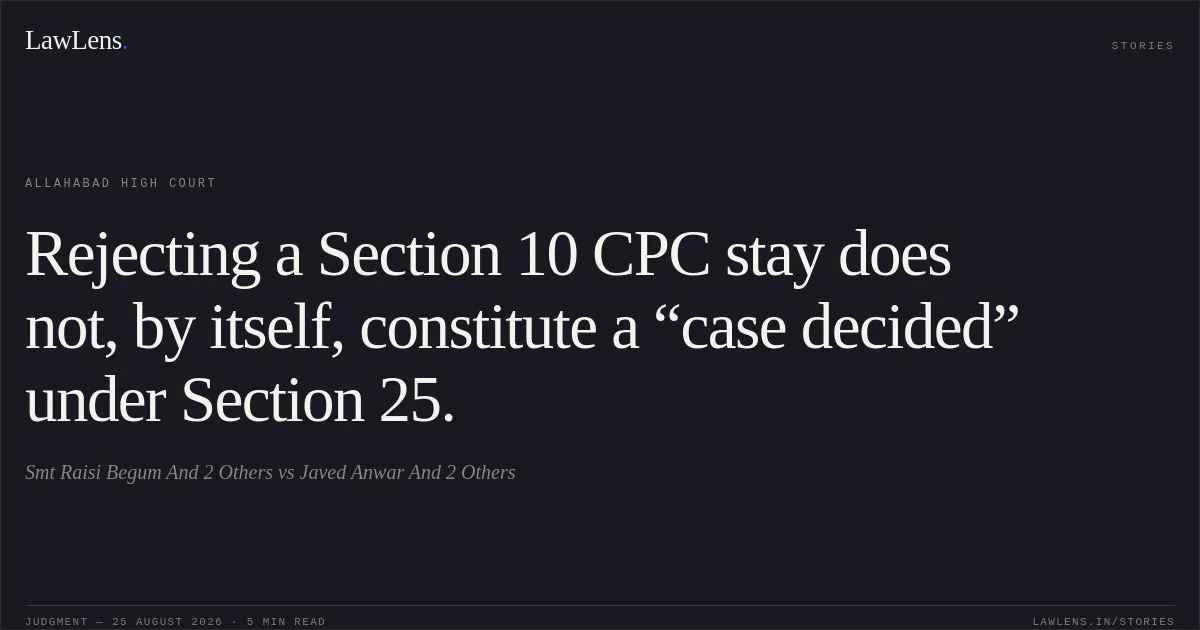
1. Whether the order dated 7 March 2026 rejecting the application under Section 10 read with Section 151 CPC constituted a “case decided” under Section 25 of the Provincial Small Cause Courts Act, 1887, and consequently affected the maintainability of the Article 227 petition?
Source reference: para. 32(i)2. Whether Section 17 of the Provincial Small Cause Courts Act read with Order L Rule 1 CPC excludes only the formal settlement of issues under Order XIV CPC, while retaining the Small Cause Court’s obligation to identify and determine the material points in controversy?
Source reference: para. 32(ii)3. Whether the trial court was justified in refusing to formally frame additional issues concerning the alleged Wakf character of the property, the jurisdiction of the Court of Small Causes, the landlord–tenant relationship, and the validity and effect of the sale deeds?
Source reference: para. 32(iii)4. Whether the pendency of Second Appeal No. 306 of 2018 warranted a stay of the J.S.C.C. suit under Section 10 CPC or in exercise of the inherent power under Section 151 CPC?
Source reference: para. 32(iv)Law Applied
Section 25 of the Provincial Small Cause Courts Act, 1887 permits revision only against a “case decided” by a Court of Small Causes; not every interlocutory or procedural order qualifies.
Source reference: paras. 33–35Section 17 of the Act and Order L Rule 1 CPC exclude the formal settlement of issues under Order XIV CPC in Small Cause Court proceedings, but do not dispense with the duty to identify and adjudicate the material controversies.
Source reference: paras. 38–42Under Order XX Rule 4(1) CPC, a Small Cause Court judgment must state the points for determination and the decision on those points.
Source reference: para. 42Section 10 CPC mandates stay only where the matter directly and substantially in issue in the later suit is also directly and substantially in issue in a previously instituted proceeding; a mere factual or legal overlap is insufficient.
Source reference: paras. 90–95The Court relied on Ramrichpal Singh v. Dayanand Sarup, AIR 1955 All 309, holding that an order under Section 10 CPC may, in an appropriate statutory context, constitute a “case decided,” but distinguished its application under Section 25 of the Provincial Small Cause Courts Act.
Source reference: paras. 36–37, 59It also relied on Ramesh Chandra Sahu v. Subhash Chandra, AIR 1988 All 246, and Prakash Chandra v. Y.C.P. John, 1993 (2) ARC 495, for the principle that ordinary procedural orders in Small Cause Court proceedings are not necessarily revisable.
Source reference: paras. 44–46Further reliance was placed on Raju Kashyap v. Smt. Archana Jain, 2026:AHC:164125, and Rameshwar Dayal v. Banda (Dead) through LRs, (1993) 1 SCC 531, for the distinction between formal issue-framing and the obligation to determine the real points in controversy.
Source reference: para. 71Reasoning
The Court held that rejection of the Section 10 application merely permitted the J.S.C.C. suit to proceed and did not finally determine title, the Wakf character of the property, the landlord–tenant relationship, rent liability, default, or entitlement to eviction.
Source reference: paras. 47–62It therefore did not constitute a “case decided” under Section 25, and the Article 227 petition was not barred on that ground.
Source reference: paras. 47–62On the issue applications, the Court held that the petitioners had no absolute right to have all sixteen proposed matters formally framed as separate issues because Order L Rule 1 excludes the formal Order XIV procedure.
Source reference: paras. 68–77, 82–86However, the trial court remained bound to identify and decide every material controversy arising from the pleadings, including—if material—the Wakf plea, the asserted tenancy under the Wakf or Managing Committee, the landlord–tenant relationship, and the Court’s jurisdiction.
Source reference: paras. 68–77, 82–86The rejection of the additional-issue applications was therefore upheld, subject to the clarification that no material defence could be omitted merely because it was not separately numbered as an issue.
Source reference: paras. 83–87Regarding stay, the Court found that the second appeal concerned the validity and cancellation of the sale deeds, whereas the J.S.C.C. suit concerned eviction, arrears of rent, and the asserted landlord–tenant relationship.
Source reference: paras. 88–95Although the proceedings had a factual and legal connection, identity of the matter directly and substantially in issue was not established.
Source reference: paras. 88–95The second appeal had not been admitted and no interim stay had been granted; mere apprehension of inconsistent findings could not substitute for the statutory requirements of Section 10 or justify an indefinite stay under Section 151 CPC.
Source reference: paras. 96–106Holding
The Article 227 petition was dismissed.
The Court held that the order dated 7 March 2026 rejecting the application under Section 10 read with Section 151 CPC was not a “case decided” under Section 25 of the Provincial Small Cause Courts Act, and the petition was maintainable on that count.
Source reference: paras. 58–64The rejection of the applications for formally framing sixteen additional issues was upheld, but the trial court was directed to identify and adjudicate all material points arising from the pleadings in its judgment, regardless of whether they were separately numbered as issues.
Source reference: paras. 84–87The refusal to stay the J.S.C.C. proceedings was also upheld because Section 10 CPC was not attracted and no exceptional basis for invoking Section 151 CPC was shown.
Source reference: paras. 102–108The trial court was directed to proceed in accordance with law and endeavour to dispose of the suit expeditiously, without prejudice to either party’s substantive rights and contentions.
Source reference: paras. 109–110Acts & Sections Cited
9 provisions across 5 statutes referred to in this judgment. Linked provisions open on LawLens.
Code of Civil Procedure, 19083
Provincial Small Cause Courts Act, 18872
Wakf Act, 19952
U.P. Muslim Wakf Act, 19601
Transfer of Property Act, 18821
Original Court PDF
Smt Raisi Begum And 2 OthersvsJaved Anwar And 2 Others
Click to open original judgment
Original judgment, available to read, download and summarize on LawLens.in
![Courts will not interfere with transfers absent mala fides or violation of statutory rules.. M Ramya vs EMPLOYEES STATE INSURANCE CORPORATION (ESIC). CAT - ['Chennai']. LawLens](/stories/thumbnails/courts-will-not-interfere-with-transfers-absent-mala-fides-or-violation-of-statutory-rules-a6845e9ca6f548fca284c51c8351957f.webp)
![Courts cannot direct one-time recruitment age relaxation absent authority in the governing rules or advertisement.. UT OF PUDUCHERRY vs M ANDAL. CAT - ['Chennai']. LawLens](/stories/thumbnails/courts-cannot-direct-one-time-recruitment-age-relaxation-absent-authority-in-the-governing-895d78fde47143e2a8ed0207c4b6a44f.webp)
![A review cannot correct an allegedly erroneous decision absent an error apparent on the record.. Ajit Kumar Jha vs RAILWAY BOARD. CAT - ['Delhi']. LawLens](/stories/thumbnails/a-review-cannot-correct-an-allegedly-erroneous-decision-absent-an-error-apparent-on-the-re-8ac952fd4eba470c92f7da20af72a220.webp)