Facts
DVC challenged a majority arbitral award rejecting its objection to HRD Builders’ standing to pursue claims under a contract originally made with M/s H.R. Builders, a sole proprietorship.
Source reference: para. 3–18, 20–25HRD Builders relied on a business transfer agreement executed after arbitration had been invoked and the Tribunal constituted.
Source reference: para. 3–18, 20–25DVC’s application challenging maintainability was filed under Section 23 read with Section 19 of the Arbitration and Conciliation Act, 1996, but was treated by the Tribunal as raising a jurisdictional question.
Source reference: para. 3–18, 20–25The majority held the arbitration maintainable and directed that the claims proceed on the merits.
Source reference: para. 3–18, 20–25DVC then filed a Section 34 petition; HRD Builders objected that the challenge was premature because the award rejected, rather than accepted, a jurisdictional plea.
Source reference: para. 3–18, 20–25Issues
1. Whether the maintainability of a Section 34 challenge is determined by the procedural label of the application before the Tribunal or by the substance and effect of the Tribunal’s decision
Source reference: para. 312. Whether the majority award rejecting DVC’s jurisdictional objection was a pure jurisdictional ruling, challengeable only with the final award under Sections 16(5)–(6), or an interim award immediately challengeable under Section 34
Source reference: para. 31, 45–46Law Applied
Section 16(1) of the Arbitration and Conciliation Act, 1996 empowers a tribunal to rule on its jurisdiction, including objections concerning the existence or validity of the arbitration agreement; where a jurisdictional plea is rejected, Sections 16(5)–(6) require the tribunal to continue the proceedings, with the objection challengeable under Section 34 after the final award, while Section 37(2)(a) permits an immediate appeal when the tribunal accepts the plea and terminates the proceedings
Source reference: para. 32–33Under MCM Worldwide Pvt. Ltd. v. Construction Industry Development Council, rejection of a Section 16 jurisdictional plea is not independently challengeable under Section 34; Indian Farmers Fertilizer Cooperative Ltd. v. Bhadra Products concerns a distinct decision finally disposing of a substantive issue or claim, which may qualify as an interim award under Section 2(1)(c)
Source reference: para. 33–34Zillion Infraprojects Pvt. Ltd. v. Bridge and Roof Co. India Ltd. likewise distinguishes a pure jurisdictional ruling from a decision that finally disposes of substantive claims; Deep Industries Ltd. v. ONGC and Uttarakhand Purva Sainik Kalyan Nigam Ltd. v. Northern Coalfields Ltd. concern the former category
Source reference: para. 35–36The Court distinguished Palmview Investments Overseas Ltd. v. Ravi Arya, which concerned the authority of a signatory acting for an admitted party, rather than whether a non-signatory could invoke the arbitration agreement
Source reference: para. 40–41Reasoning
The Court looked to the substance of DVC’s application, rather than its Section 23/19 label: it sought a ruling that the Tribunal lacked competence to hear HRD Builders’ claims, raising the existence or validity of the arbitration agreement as against HRD Builders
Source reference: para. 39, 43The majority award did not decide or extinguish any of the twelve substantive claims; it only held that the Tribunal could proceed to determine them. The ruling therefore remained jurisdictional and did not become an interim award merely because the Tribunal would not revisit the issue or because the decision concerned the claimant’s standing
Source reference: para. 38–39, 45Unlike Zillion, no claim had been finally disposed of; unlike Palmview, the issue was not a curable question of authority to sign pleadings on behalf of an admitted party
Source reference: para. 36, 41DVC’s arguments about assignment, the arbitration clause, and alleged fraud went to the merits of its jurisdictional objection and could be raised with a challenge to the final award
Source reference: para. 42, 44Holding
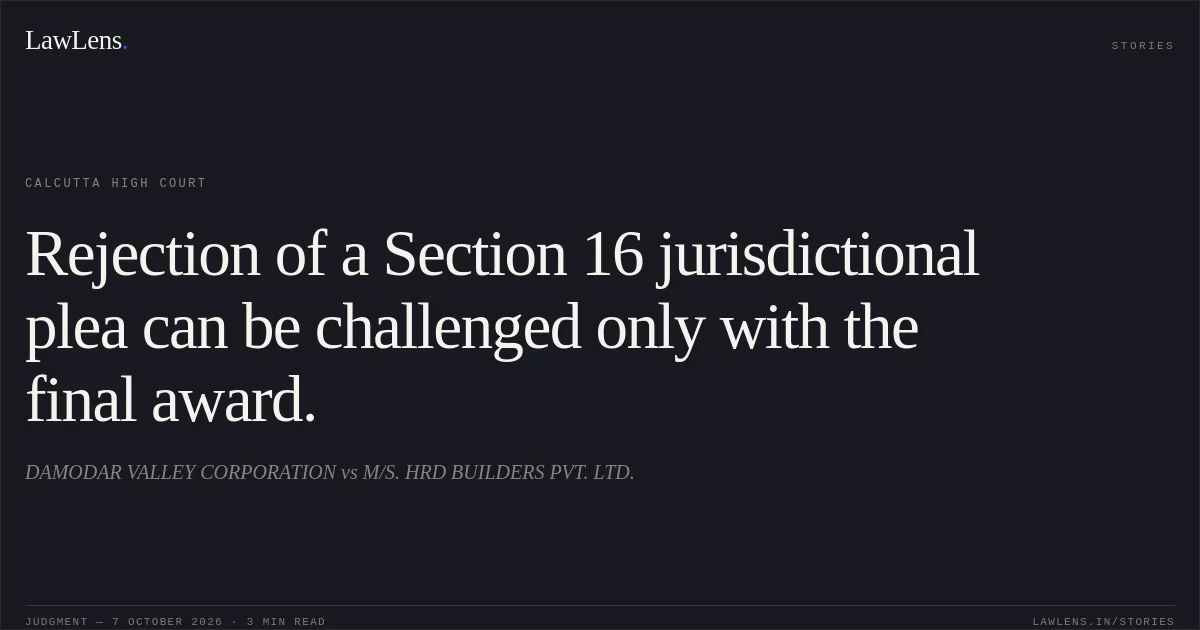
The Court held that the majority award was a pure jurisdictional ruling under Section 16(5), not an interim award independently challengeable under Section 34.
DVC’s petition was therefore premature and dismissed.
Source reference: para. 19, 45–47DVC was left at liberty, if aggrieved by the final award, to challenge that award and the impugned jurisdictional ruling together in a composite Section 34 application; the Court expressed no view on the merits of DVC’s objection or the underlying claims
Source reference: para. 19, 45–47Acts & Sections Cited
12 provisions across 3 statutes referred to in this judgment. Each provision opens on LawLens.
Arbitration and Conciliation Act, 1996
Code of Civil Procedure, 19081
Specific Relief Act, 19631
Original Court PDF
DAMODAR VALLEY CORPORATIONvsM/S. HRD BUILDERS PVT. LTD.
Click to open original judgment
Original judgment, available to read, download and summarize on LawLens.in