Facts
The appellant/claimant filed an appeal under Section 173 of the Motor Vehicles Act, 1988, challenging the order dated 12.12.2018 passed by the Claims Tribunal, which rejected his application for compensation
Source reference: para. 1The appellant alleged he suffered grievous injuries due to the rash and negligent driving of a vehicle driven by Respondent No. 1, owned by Respondent No. 2, and insured by Respondent No. 3
Source reference: para. 2 & 5The claimant (Witness No. 1) and an eye-witness (Witness No. 2) testified to the accident, and an FIR (Ex.P/02) was registered against the driver under Sections 279 and 337 of the IPC
Source reference: para. 5Despite this evidence, the Tribunal dismissed the claim, leading to this appeal
Source reference: para. 2Issues
1. Whether the Claims Tribunal was justified in rejecting the claim petition by disbelieving the testimony of the claimant and the eye-witness
Source reference: para. 2 & 52. Whether the Insurance Company can be exonerated from liability on the grounds of an invalid driving license without leading evidence to prove such a breach
Source reference: para. 7Law Applied
The Court applied the statutory provisions of the Motor Vehicles Act, 1988, specifically regarding the assessment of rash and negligent driving and the liability of insurers.
Source reference: no citationIt relied on the established precedents for the computation of compensation: National Insurance Company Ltd. v. Pranay Sethi (2017) regarding future prospects and standardizing heads
Source reference: p. 3Sarla Verma & Ors. v. Delhi Transport Corporation & Ors. (2009) regarding multipliers and income assessment
Source reference: p. 3Magma General Insurance Co. Ltd. v. Nanu Ram @ Chuhru Ram & Ors. (2018) regarding conventional heads
Source reference: p. 4Furthermore, the court applied the principle that the burden of proving a breach of policy conditions (such as lack of a valid license) lies strictly upon the insurer
Source reference: para. 7Reasoning
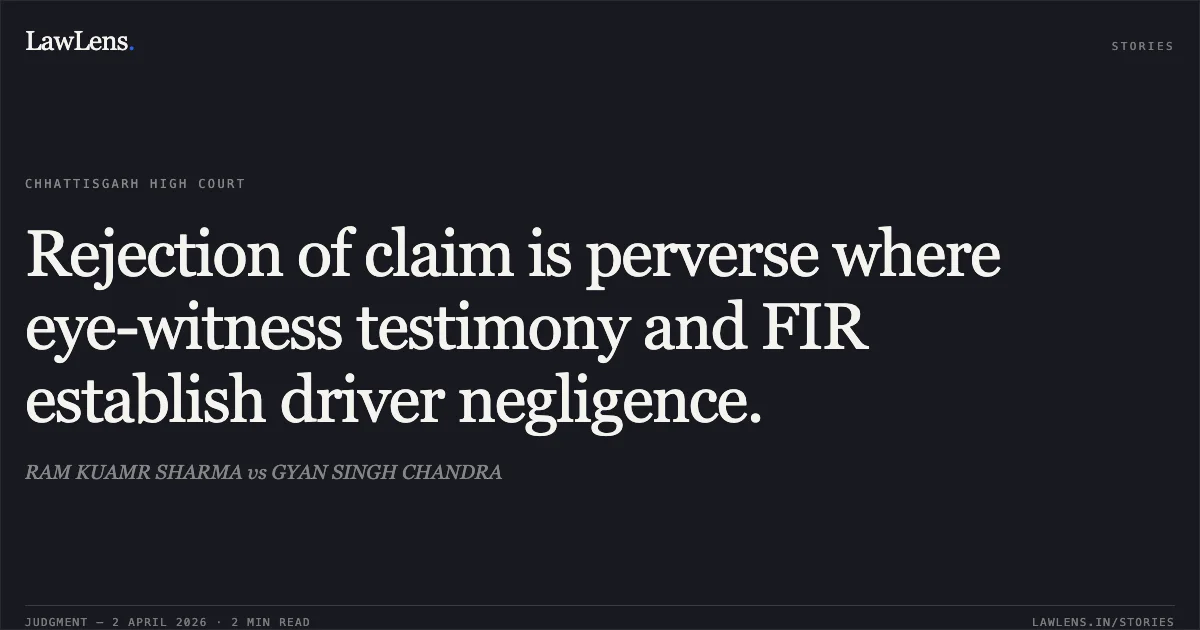
The Court found the Tribunal’s rejection of the claim to be perverse and contrary to the record
Source reference: para. 5It noted that the appellant and an eye-witness provided consistent accounts of the accident that remained unshaken during cross-examination
Source reference: para. 5The involvement of the offending vehicle was further corroborated by the FIR and the subsequent charge-sheet against Respondent No. 1
Source reference: para. 5Regarding the insurer's defense that the driver lacked a valid license, the Court observed that the insurance company failed to lead any evidence to substantiate this claim; consequently, the plea was rejected
Source reference: para. 7The Court then performed a fresh computation of compensation based on minimum wages (Rs. 6,206/- PM), medical expenses supported by exhibits, and conventional heads like pain, suffering, and special diet
Source reference: para. 6Holding
The High Court set aside the Tribunal’s order dated 12.12.2018 and allowed the appeal
The Court held that the appellant is entitled to a total compensation of Rs. 1,03,231/- with interest at 6% per annum from the date of filing the claim
Source reference: para. 8Respondent No. 3 (Insurance Company) was held liable to pay the amount and was directed to deposit the sum with the Tribunal within 45 days
Source reference: para. 8The Tribunal was directed to pass orders for the apportionment and disbursement of the awarded amount
Source reference: para. 8Acts & Sections Cited
3 provisions across 2 statutes referred to in this judgment. Each provision opens on LawLens.
Motor Vehicles Act, 19881
Indian Penal Code, 18602
Original Court PDF
RAM KUAMR SHARMAvsGYAN SINGH CHANDRA
Click to open original judgment
Original judgment, available to read, download and summarize on LawLens.in