Facts
The parties entered into Memorandums of Understanding (MoU) in 2006 and 2008. After the appellant filed a recovery suit, the respondent successfully moved an application under Section 8 of the Arbitration and Conciliation Act, 1996, referring the matter to arbitration
Source reference: para. 4During arbitral proceedings, the respondent filed an application under Section 16 of the Act, challenging the Arbitrator's jurisdiction on the grounds that the claims were barred by limitation. The Arbitrator rejected this plea on 19.05.2023
Source reference: para. 6The respondent challenged this rejection under Section 34 before the District Judge, who dismissed it on merits. Subsequently, the Delhi High Court, in an appeal under Section 37, reversed the District Judge's order and allowed the respondent’s plea on merits
Source reference: para. 7The appellant challenged this before the Supreme Court, contending that an order rejecting a Section 16 plea is not immediately challengeable
Source reference: para. 6Issues
1. Whether an order passed by an arbitral tribunal under Section 16(2) of the Arbitration Act, 1996, rejecting a plea of lack of jurisdiction, can be challenged under Section 34 of the Act prior to the passing of the final arbitral award.
Source reference: para. 92. Whether the High Court erred in entertaining an appeal under Section 37 against a Section 34 order that originated from a rejection of a jurisdictional plea under Section 16.
Source reference: para. 17Law Applied
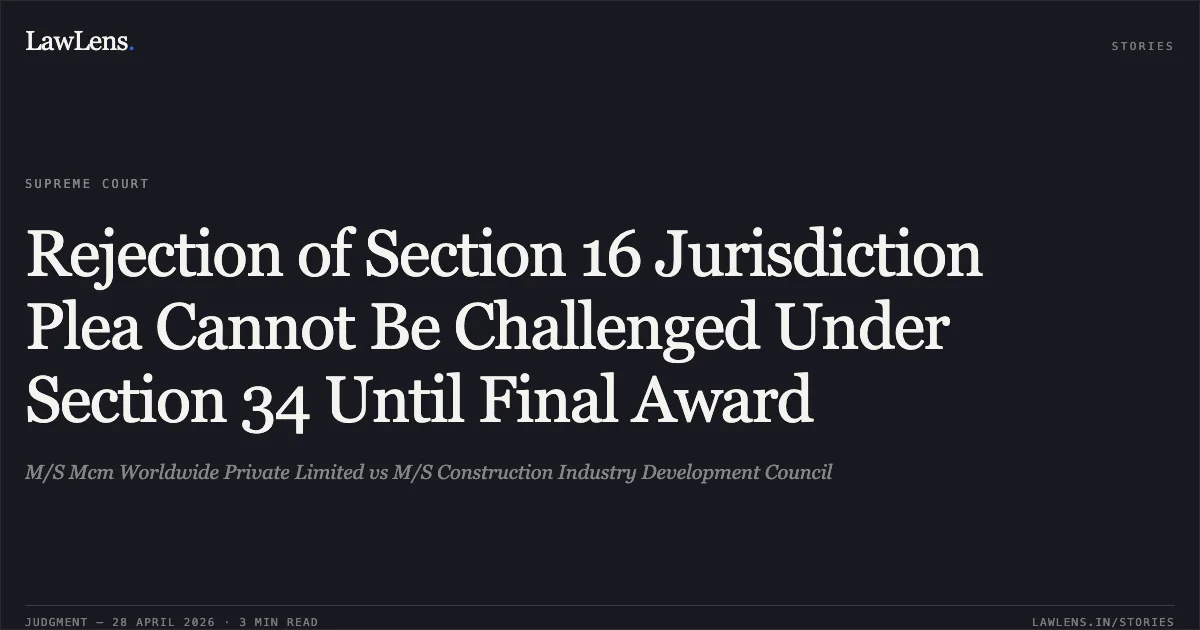
The Court primarily applied Section 16 of the Arbitration and Conciliation Act, 1996, specifically Sections 16(5) and 16(6), which mandate that if a plea of lack of jurisdiction is rejected, the tribunal shall continue proceedings and the aggrieved party may challenge the order only after the final award is made via Section 34
Source reference: para. 8The Court also referenced Section 37(2), noting that an appeal lies only when the arbitrator upholds a plea of lack of jurisdiction
Source reference: para. 8Precedent in Indian Farmers Fertilizer Cooperative Limited v. Bhadra Products (2018), distinguishing between a "preliminary issue" resulting in an interim award and a "jurisdictional plea" under Section 16
Source reference: paras. 10-12Reasoning
If limitation is decided as a preliminary issue independently of a jurisdictional challenge, it may constitute an "interim award" challengeable under Section 34. However, when limitation is raised specifically as a plea of lack of jurisdiction under Section 16(2), the "drill" of Sections 16(5) and 16(6) must be followed
Source reference: paras. 12-13These sections explicitly state that upon rejection of such a plea, the arbitrator must proceed to a final award, and the jurisdictional challenge can only be raised thereafter
Source reference: para. 14The Court found that both the District Judge and the High Court misinterpreted Bhadra Products, failing to realize that treating a Section 16 rejection as an interim award would render Section 37(2) superfluous and lead to the "piecemeal" litigation the Act seeks to avoid
Source reference: paras. 15-16Holding
The Supreme Court set aside the High Court’s judgment, holding that the respondent’s Section 34 application was fundamentally non-maintainable as the Arbitrator had rejected the Section 16 plea
The Court held that the respondent must wait until the final award is passed to challenge the validity of the order dated 19.05.2023. The appeal was allowed, directing that the arbitral proceedings should continue, with the right of the respondent to challenge the jurisdictional ruling preserved for the post-award stage under Section 34
Source reference: para. 17Acts & Sections Cited
6 provisions across 1 statute referred to in this judgment. Each provision opens on LawLens.
Arbitration and Conciliation Act, 19966
Original Court PDF
M/S Mcm Worldwide Private LimitedvsM/S Construction Industry Development Council
Click to open original judgment
Original judgment, available to read, download and summarize on LawLens.in