Facts
On September 27, 1987, at approximately 9:45 P.M., the deceased (Ram Kunwar) was returning from a religious recital when he was intercepted by the four accused—Mahesh, Naresh, Virpal, and Balistor—near Khairati's house.
Source reference: para. 2Witnesses (PW-1 and PW-2) observed the accused surround the deceased; Mahesh, Naresh, and Virpal fired guns while Balistor held a country-made pistol to intimidate witnesses.
Source reference: para. 2, 18The accused then dragged the body away using a rope.
Source reference: para. 21A headless torso was recovered six days later from a sugarcane field and identified by the deceased's clothing and shoes.
Source reference: para. 4, 19The Trial Court convicted the appellants under Sections 302, 302/34, 201, and 324/34 IPC.
Source reference: para. 12The appellants challenged this on grounds of delayed FIR, witness interest, and lack of motive.
Source reference: para. 15Issues
1. Whether the four-hour delay in lodging the FIR and the related nature of the eyewitnesses vitiated the prosecution's case.
Source reference: para. 15, 172. Whether the medical evidence from the post-mortem report adequately corroborated the ocular testimony of the eyewitnesses.
Source reference: para. 383. Whether the prosecution successfully established motive and the common intention of the accused under Section 34 IPC.
Source reference: para. 35, 37Law Applied
The Court applied Section 302 of the IPC for murder, Section 201 for causing disappearance of evidence, and Section 324/34 for voluntarily causing hurt by dangerous weapons with common intention.
Source reference: para. 1, 12The Court relied on the principle from State of Rajasthan v. Smt. Kalki (1981) that "related" is not synonymous with "interested," and the testimony of natural witnesses cannot be discarded solely due to kinship.
Source reference: para. 31The Court applied Sucha Singh v. State of Punjab (2003) regarding the natural instinct of self-preservation, noting that witnesses' failure to intervene when the accused are armed with deadly weapons does not discredit their testimony.
Source reference: para. 34Reasoning
The Court found the four-hour delay in the FIR reasonable given the "horrifying and cruel manner" of the crime committed at night.
Source reference: para. 17Regarding the credibility of PW-1 and PW-2, the Court held that being family members made them natural witnesses who would have no reason to shield the real culprit while falsely implicating innocent persons.
Source reference: para. 29, 31The medical evidence (Post-Mortem Report Exhibit Ka-19) showed eight injuries, including four gunshot wounds on vital parts, directly corroborating the ocular testimony of the witnesses.
Source reference: para. 38The motive was clearly established: the deceased was involved in a prior case regarding the elopement of the accused Mahesh’s sister.
Source reference: para. 19, 35, 37The headless state of the body and the recovery of the deceased's shoes and clothes sufficiently proved the charge under Section 201 IPC.
Source reference: para. 4, 27Holding
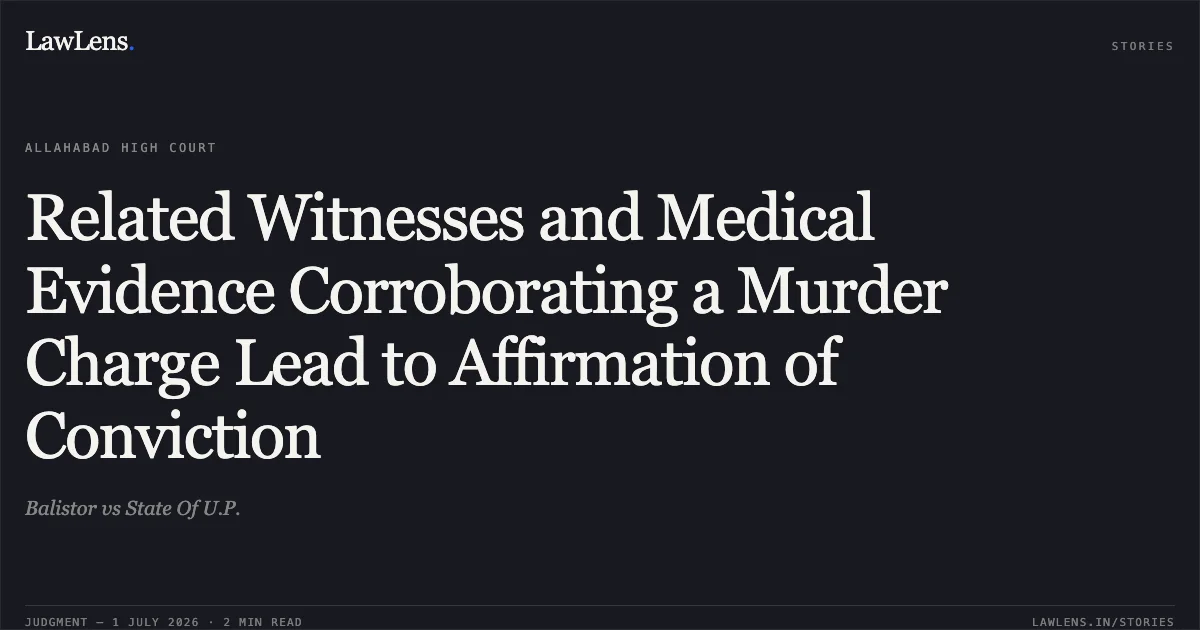
The Court held that the prosecution proved the guilt of the appellants beyond reasonable doubt through consistent ocular evidence corroborated by medical findings and a clear motive.
The High Court dismissed the appeals and affirmed the conviction and life imprisonment sentences passed by the Trial Court, ordering the appellants to surrender within fifteen days.
Source reference: para. 40, 41Acts & Sections Cited
9 provisions across 2 statutes referred to in this judgment. Each provision opens on LawLens.
Indian Penal Code, 18608
Code of Criminal Procedure, 19731
Original Court PDF
BalistorvsState Of U.P.
Click to open original judgment
Original judgment, available to read, download and summarize on LawLens.in