Facts
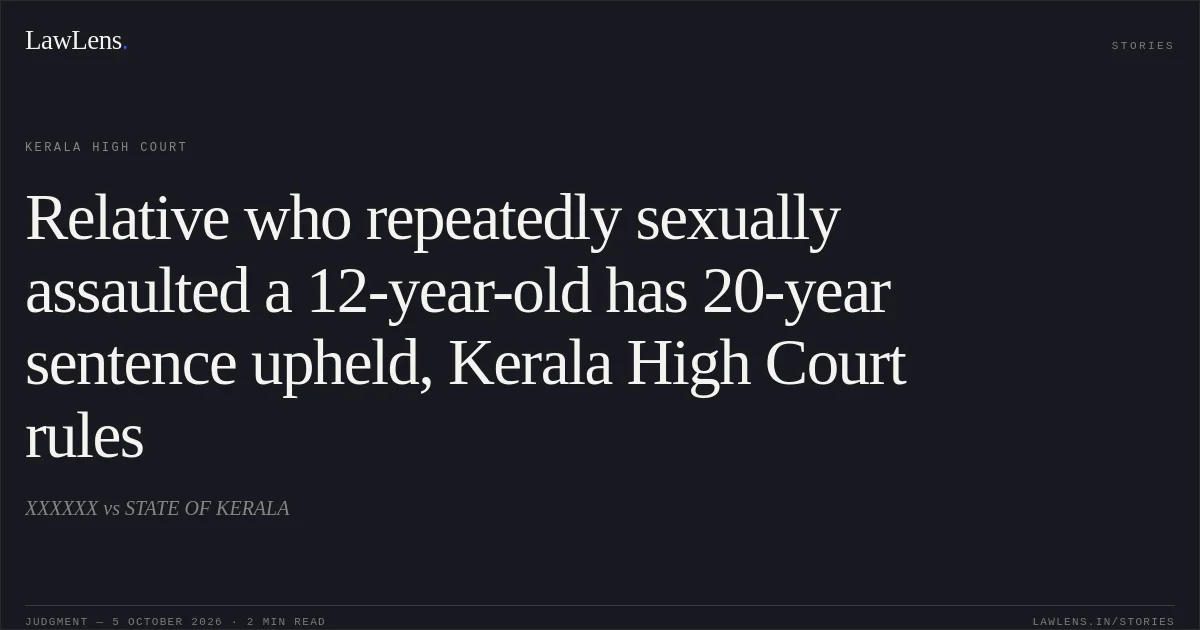
The appellant was convicted by the Special Court for offences arising from repeated sexual assaults on the 12-year-old victim, including penetrative assaults in November 2021 and further incidents in December 2021.
Source reference: p. 2–5, 10–20The prosecution relied principally on the victim’s testimony, supported by medical evidence and testimony from family members and other witnesses.
Source reference: p. 2–5, 10–20The Special Court imposed concurrent sentences, including 20 years’ rigorous imprisonment for specified aggravated penetrative sexual assault offences.
Source reference: p. 4–5The appellant challenged the conviction and sentence under Section 415(2) of the Bharatiya Nagarik Suraksha Sanhita, 2023, contending that material omissions and variations in the victim’s statements undermined her credibility.
Source reference: p. 2, 6–7Issues
Whether the victim’s testimony, despite alleged omissions and variations in her prior statements, was reliable and sufficient to sustain the convictions.
Source reference: p. 6–9, 22–26Whether the evidence justified the findings of guilt for the IPC and POCSO Act offences affirmed by the Special Court.
Source reference: p. 8–9, 26Whether the convictions or sentences warranted appellate interference.
Source reference: p. 26–27Law Applied
The Court considered the charged offences under Sections 450, 363, 376(2)(n), 376(2)(f) and 376(3) of the Indian Penal Code, and the corresponding offences under Sections 4(2) read with 3(b) and 3(d), 6(1) read with 5(l) and 5(n), and 10 read with 9(l) of the POCSO Act, as well as Section 8 read with Section 7 of that Act.
Source reference: p. 2–5, 26It applied the principle that the victim’s testimony in a sexual-offence case may alone sustain a conviction if it is of sterling quality; corroboration may support, but is not an indispensable condition for, reliance on such testimony.
Source reference: p. 24–25It also noted that Section 42 of the POCSO Act governed the treatment of corresponding IPC and POCSO offences, and that the minimum statutory sentences could not be reduced.
Source reference: p. 4–5, 26–27The Court distinguished Royson v. State of Kerala, holding that its concern with suppression of material facts in an informant’s first information statement did not apply because the victim was not the informant here.
Source reference: p. 7, 25–26Reasoning
The Court found the victim’s account of repeated assaults consistent with her Section 164 CrPC statement and supported by the medical evidence, including the doctor’s finding of old hymenal tears and an opinion suggestive of penetrative sexual assault.
Source reference: p. 22–25It treated the parents’ evidence as hearsay, based on what the victim had told them, and held that their failure to recount every detail in the first information statement or police statements did not undermine her direct testimony.
Source reference: p. 10–12, 24–25Finding the victim’s evidence credible and of sterling quality, and rejecting the appellant’s reliance on Royson, the Court upheld the Special Court’s findings of guilt.
Source reference: p. 25–26It further held that the imposed 20-year terms were statutory minimum sentences and therefore not reducible.
Source reference: p. 26–27Holding
The High Court answered the principal issues against the appellant, held that the evidence supported the convictions, and found no basis to interfere with the sentences.
The appeal was dismissed, the conviction and sentence were confirmed, and the Registry was directed to forward the judgment to the Jail Superintendent and the Special Court for information and compliance.
Source reference: p. 27Acts & Sections Cited
18 provisions across 4 statutes referred to in this judgment. Each provision opens on LawLens.
Bharatiya Nagarik Suraksha Sanhita, 20231
Indian Penal Code, 18604
Protection of Children from Sexual Offences Act, 2012
Code of Criminal Procedure, 19734
Original Court PDF
XXXXXXvsSTATE OF KERALA
Click to open original judgment
Original judgment, available to read, download and summarize on LawLens.in