Facts
The prosecution alleged that on 18.05.2012, due to prior enmity involving a family dispute and customary divorce, A1-A4 (appellants) and A5-A7 (acquitted) intercepted the deceased Kannan (D1) and Periyasamy (D2) near a TASMAC shop in Thadikombu. A5-A7 allegedly threw chilli powder, and A1-A4 attacked the deceased with knives and aruvals
Source reference: p.5-6PW1 (mother) and PW2 (father) claimed to be eyewitnesses
Source reference: p.6D1 was brought dead to the hospital; D2 survived for five days, during which a dying declaration (Ex.P16) was recorded by a Judicial Magistrate
Source reference: p.7The Trial Court convicted A1-A4 for murder (Section 302 IPC) while acquitting A5-A7
Source reference: p.4, 15The appellants challenged this conviction on grounds of unreliable eyewitness testimony and defective investigation.
Source reference: no citationIssues
1. Whether the testimonies of PW1 and PW2 are reliable enough to sustain a conviction
Source reference: p.202. Whether the dying declaration of D2 can be solely relied upon when it named recently acquitted co-accused
Source reference: p.28-293. Whether the lapses in investigation by the Investigating Officer (PW16) vitiate the prosecution’s case
Source reference: p.31-32Law Applied
The Court applied Section 302 (Murder) and Section 148 (Rioting with deadly weapons) of the IPC
Source reference: p.4It relied on Section 32 of the Indian Evidence Act regarding the relevancy of dying declarations
Source reference: p.28Procedurally, it considered Section 161(3) Cr.P.C. regarding the importance of recording witness statements
Source reference: p.24-25The Court cited the precedent of State of Gujarat v. Kishanbhai (2014) 5 SCC 108 to address the consequences of defective investigation
Source reference: p.32It maintained the principle that while a conviction can be based on a dying declaration alone, if the declaration is partially disbelieved or lacks reliability, it requires independent corroboration
Source reference: p.28Reasoning
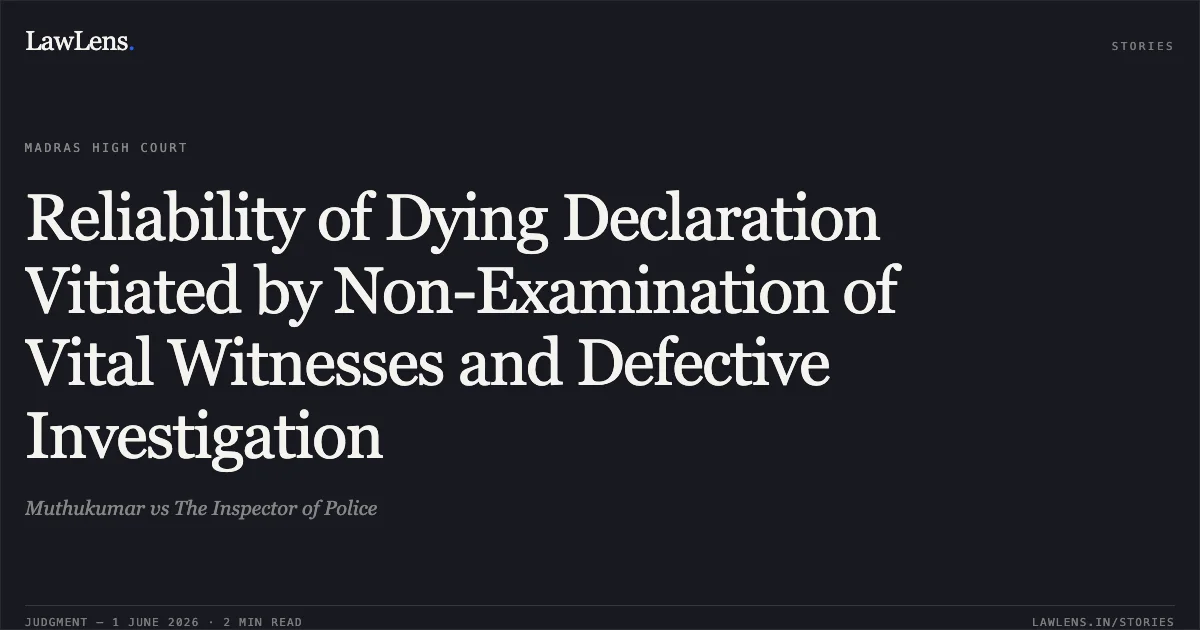
The Court found the eyewitness accounts of PW1 and PW2 highly suspect due to material contradictions regarding their arrival time at the scene and the distance from which they witnessed the event
Source reference: p.21-22There was a significant, unexplained discrepancy in the timing of the incident between the Accident Register (3:15 p.m.) and the prosecution's narrative
Source reference: p.22-23The Court noted a "slipshod" investigation by PW16, who failed to examine vital witnesses like the share auto driver, the ambulance drivers, and individuals (Murugesan and Rathinavel) who transported D2 to the hospital
Source reference: p.24-25Crucially, while the Trial Court acquitted A5-A7 despite them being named in D2's dying declaration, the High Court held that a dying declaration cannot be "dissected" to convict some while acquitting others named therein without further corroboration
Source reference: p.29Furthermore, physical evidence like the amputated portion of D2's arm was not recorded in the observation mahazar, suggesting the IO did not actually visit the scene
Source reference: p.31Holding
The Court held that the prosecution failed to prove the case beyond reasonable doubt due to unreliable eyewitnesses, a lack of corroboration for the dying declaration, and gross investigative failures
The Court set aside the conviction and sentences of A1, A2, A3, and A4, ordering their immediate release
Source reference: p.33Additionally, the Court expressed "anguish" at the "bizarre" investigation and directed departmental action against the Investigating Officer, PW16. High Court allowed the appeals
Source reference: p.32-33Acts & Sections Cited
10 provisions across 2 statutes referred to in this judgment. Each provision opens on LawLens.
Indian Penal Code, 18605
Code of Criminal Procedure, 19735
Original Court PDF
MuthukumarvsThe Inspector of Police
Click to open original judgment
Original judgment, available to read, download and summarize on LawLens.in