Facts
The appellant was convicted by the Sessions Judge, Bhopal, on August 21, 2012, for murder (Section 302 IPC), concealing evidence (Section 201 IPC), and possession of an illegal weapon (Section 25(1-B) Arms Act)
Source reference: para. 1On October 31, 2010, the appellant was seen by complainant Dinesh Pal (PW-3) at Hawkers Corner, Bhopal, approaching the deceased (Mannu) with an arm around his neck
Source reference: para. 3Following a brief altercation, the appellant produced a knife and inflicted multiple fatal stabs upon the deceased
Source reference: para. 3The appellant fled the scene, and the deceased was declared dead upon arrival at the hospital
Source reference: para. 3The appellant challenged the conviction on the grounds that the incident was a "sudden altercation" without intent, the FSL report for the weapon was inconclusive regarding human blood, and witness testimonies were unreliable
Source reference: para. 4Issues
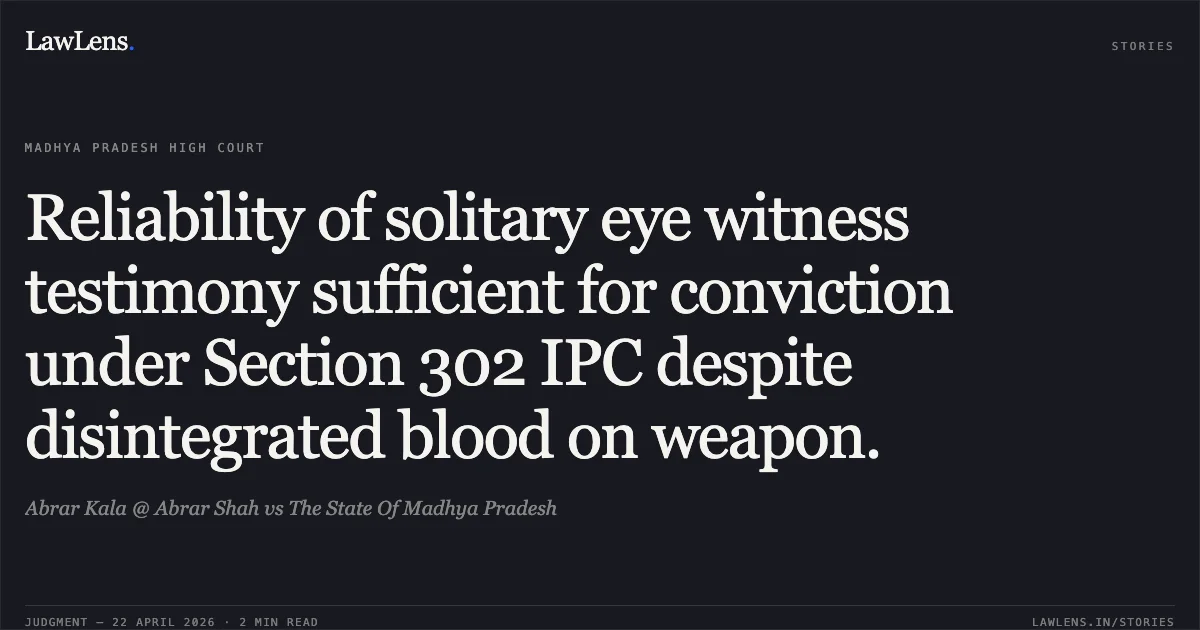
1. Whether a conviction under Section 302 IPC can be sustained based on the testimony of a solitary reliable eye witness despite a negative FSL report for human blood on the weapon.
Source reference: para. 10-132. Whether the act of the appellant qualifies under Exception 4 of Section 300 IPC (sudden fight/altercation) to warrant a reduction of the charge to Section 304 IPC.
Source reference: para. 4-5Law Applied
Section 302 of the IPC regarding murder
Source reference: para. 1Section 134 of the Indian Evidence Act, 1872, which stipulates that no particular number of witnesses is required for the proof of any fact, emphasizing that "evidence has to be weighed and not counted"
Source reference: para. 11-12Vadi Velu Thevar and another v. State of Madras (1957), which established that a court can record a conviction based on the testimony of a single "wholly reliable" witness
Source reference: para. 11-12Amar Singh v. State (NCT of Delhi) (2020) to affirm that corroboration is unnecessary if the sole eye witness is credible
Source reference: para. 13Reasoning
The Court rejected the appellant's argument of a "sudden altercation," noting that the medical evidence (Ex.P/1) revealed seven distinct injuries, including a 15cm deep penetrating wound that ruptured the lung and heart
Source reference: para. 5Such brutality indicated a "well-thought-out strategy" rather than a single blow in the heat of passion
Source reference: para. 5Regarding the FSL report (Ex.P/26), the Court held that while human blood could not be specifically detected due to disintegration, the presence of blood on the recovered knife and the medical query report (Ex.P/28) confirming the weapon could cause such injuries supported the prosecution
Source reference: para. 5-10Most pivotally, the Court found the testimony of Dinesh Pal (PW-3) to be "wholly reliable" and "unrebutted," as he clearly described the appellant pushing the deceased before stabbing him without any prior scuffle
Source reference: para. 9Under Section 134 of the Evidence Act, the Court determined that the quality of this solitary testimony was sufficient to sustain the conviction
Source reference: para. 12-13Holding
The consistency of the eye witness account outweighed the technical limitations of the FSL report
The Court dismissed the appeal and upheld the judgment of the Sessions Court, confirming the sentence of life imprisonment under Section 302 IPC, three years under Section 201 IPC, and two years under Section 25(1-B) of the Arms Act
Source reference: para. 1, 14Acts & Sections Cited
4 provisions across 2 statutes referred to in this judgment. Each provision opens on LawLens.
Indian Penal Code, 18603
Arms Act, 19591
Original Court PDF
Abrar Kala @ Abrar ShahvsThe State Of Madhya Pradesh
Click to open original judgment
Original judgment, available to read, download and summarize on LawLens.in


