Facts
The Appellant was convicted by the Trial Court for aggravated sexual assault under Section 10 of the PoCSO Act and multiple IPC sections (354, 354A, 354B, 506) involving a six-year-old victim
Source reference: p. 1-2The prosecution alleged that on August 19, 2022, the Appellant took the victim into his residence/shop (khokha), removed her undergarments, and rubbed his private parts against hers while threatening her
Source reference: p. 2, 9The victim’s mother (PW2) discovered the incident two days later while bathing the child, who complained of pain
Source reference: p. 8-9The Appellant contended that he was falsely implicated due to a property dispute with the victim's grandfather
Source reference: p. 4, 13-14The Trial Court sentenced him to 7 years of rigorous imprisonment
Source reference: p. 5Issues
1. Whether the Trial Court's judgment suffered from any infirmity regarding the appreciation of evidence and the improbability of the crime scene
Source reference: p. 7, 152. Whether the non-examination of child witnesses 'P' and 'A' and the two-day delay in filing the FIR were fatal to the prosecution's case
Source reference: p. 6, 17, 213. Whether the sentence of 7 years was excessive given the age of the accused and the nature of the offence
Source reference: p. 7, 24Law Applied
The court applied Section 9(m) of the PoCSO Act, defining aggravated sexual assault as sexual assault on a child under twelve, and Section 10 for its punishment (5 to 7 years)
Source reference: p. 23-24It relied on Section 42 of the PoCSO Act and Section 71 of the IPC regarding the principle that an act punishable under multiple laws should not result in double jeopardy/cumulative punishment for the same act
Source reference: p. 22The court cited Moidu K. v. State of Kerala regarding the effect of non-compliance with Section 232 Cr.P.C.
Source reference: p. 4The court cited Ganesan v. State regarding the sufficiency of a sole victim's testimony
Source reference: p. 19Reasoning
The Court rejected the defense that the crime was improbable in a populated area, noting the victim's consistent testimony that the assault occurred in a private room behind the shop
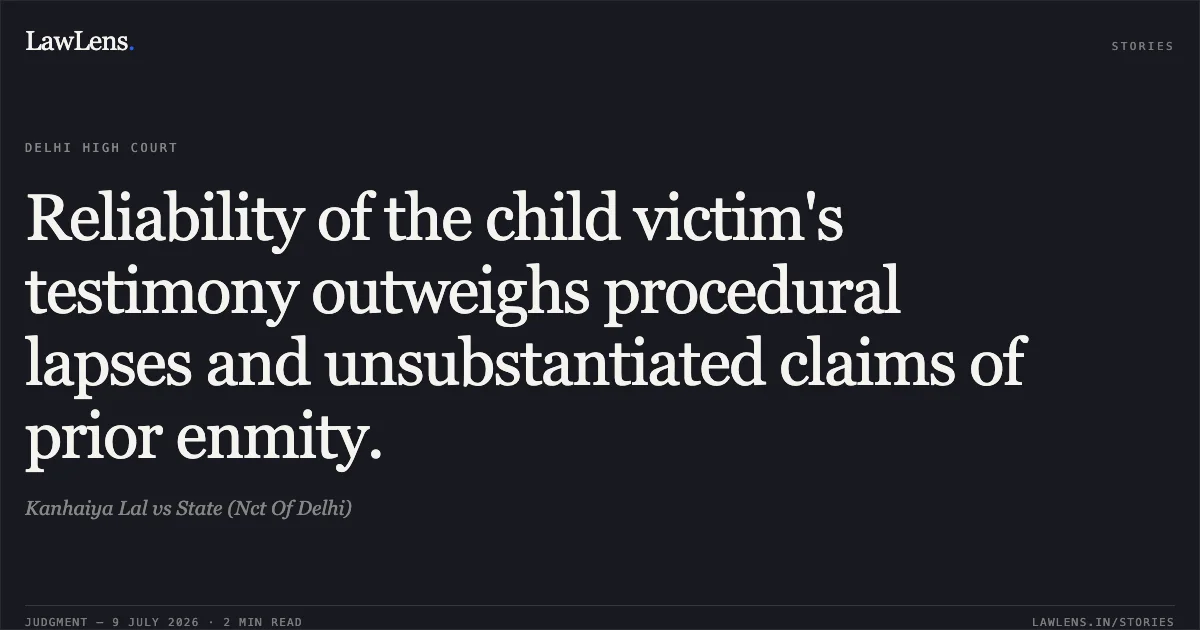
Source reference: p. 15-16The Court held that the non-examination of witnesses 'P' and 'A'—nieces of the accused—was not a lacuna because a victim's credible testimony as per Ganesan v. State is sufficient for conviction
Source reference: p. 18-19The alleged prior enmity regarding an MCD complaint was dismissed as the defense provided no documentary evidence or independent witnesses to substantiate it
Source reference: p. 20The two-day delay in the FIR was deemed satisfactorily explained by the mother’s discovery of the child’s pain during bathing and the child's initial delayed disclosure due to fear
Source reference: p. 21-22However, the High Court noted the Trial Court erred in law by not sentencing under Section 354 IPC, but since the State did not appeal this, the Court limited its scope to the PoCSO sentence
Source reference: p. 23Holding
The Court upheld the conviction for all offences but partially allowed the appeal regarding the quantum of sentence
It held that while the guilt was established, a reduction in sentence from 7 years to the statutory minimum of 5 years under Section 10 of the PoCSO Act would serve the ends of justice, considering the facts and the appellant's age (62)
Source reference: p. 24The conviction and sentence under Section 506 IPC were confirmed, to run concurrently with the modified 5-year sentence
Source reference: p. 25Acts & Sections Cited
18 provisions across 4 statutes referred to in this judgment. Each provision opens on LawLens.
Bharatiya Nagarik Suraksha Sanhita, 20232
Protection of Children from Sexual Offences Act, 20125
Indian Penal Code, 18606
Code of Criminal Procedure, 19735
Original Court PDF
Kanhaiya LalvsState (Nct Of Delhi)
Click to open original judgment
Original judgment, available to read, download and summarize on LawLens.in