Facts
The criminal law was set in motion via an Ejahar filed on March 21, 2010, by Muchiram Biswas (PW1) alleging that his son, Sibashi Biswas (PW5), was severely injured and his daughter-in-law, Bisaka Biswas, was killed by the accused persons, including the appellant
Source reference: p.2The incident occurred at approximately 9:00 PM following a dispute regarding landed property
Source reference: p.2The prosecution presented ten witnesses, including PW5, an injured eyewitness who testified that the accused attacked the deceased and himself with daggers
Source reference: p.3Medical evidence confirmed the deceased suffered five fatal injuries from sharp pointed objects
Source reference: p.3while PW5 sustained contusions and lacerations attributed to blunt weapons
Source reference: p.4The trial court, vide judgment dated May 3, 2019, acquitted the co-accused but convicted the appellant under Section 302 of the IPC, sentencing him to rigorous imprisonment for life
Source reference: p.1-2, 5Issues
1. Whether the inconsistencies between the ocular testimony of the injured eyewitness and the medical reports (regarding the nature of weapons used) are sufficient to create reasonable doubt
Source reference: p.6, 122. Whether the non-examination of child witnesses present at the scene and the discrepancy regarding the time of the deceased's last meal vitiate the prosecution's case
Source reference: p.5, 113. Whether the testimony of a single injured eyewitness is sufficient for conviction under Section 302 IPC
Source reference: p.12-13Law Applied
The court primarily applied Section 302 of the IPC regarding the punishment for murder
Source reference: p.2It relied on Section 134 of the Evidence Act, which emphasizes the quality over the quantity of evidence
Source reference: p.13The court cited Kamta Yadav v. State of Bihar, establishing that the testimony of an injured eyewitness carries significant weight as their presence at the scene is inherently probable
Source reference: p.8-9It further applied Shamsher Singh @ Shera v. State of Haryana to rule that ocular evidence is not discarded merely due to minor inconsistencies with medical evidence if the witness is otherwise credible
Source reference: p.9-10Finally, it invoked Prithipal Singh v. State of Punjab, affirming that conviction can be based on the testimony of a single reliable witness
Source reference: p.13Reasoning
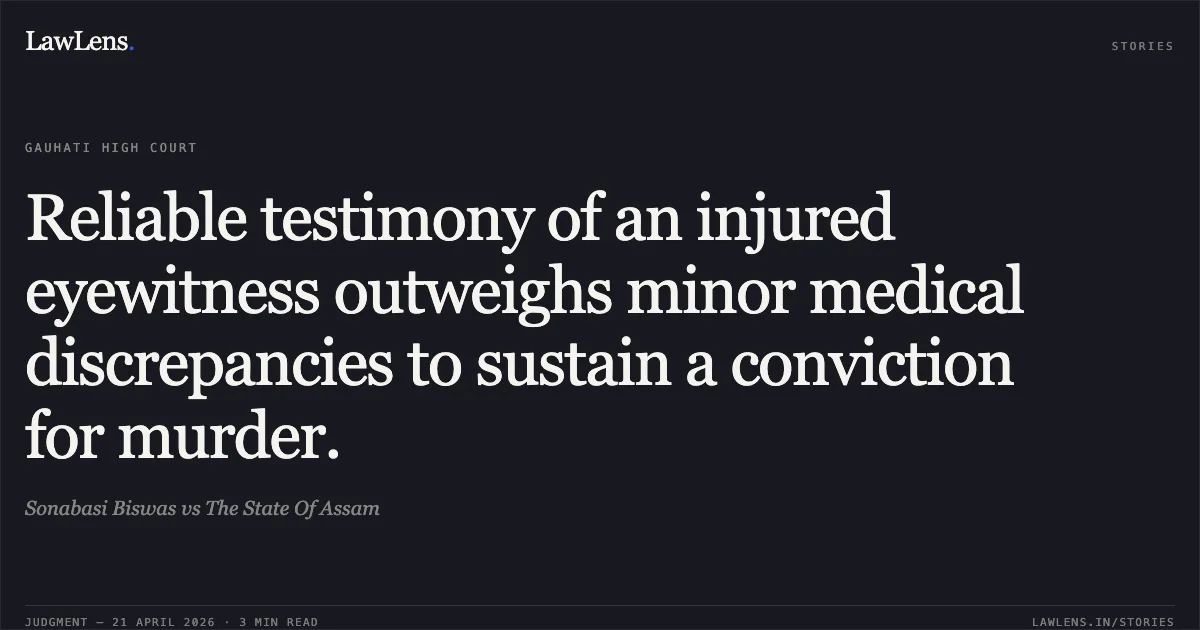
The court found the testimony of PW5 (injured eyewitness) to be highly credible, noting that his status as an injured victim placed his testimony on a "higher footing"
Source reference: p.7, 14Regarding the medical discrepancy—where PW5 alleged daggers were used but his injuries were blunt—the court reasoned that daggers possess blunt sides and such minor variations are expected in night-time attacks involving multiple assailants
Source reference: p.12The court dismissed the argument regarding the "food in stomach" timing, noting the doctor's opinion was hypothetical and rural dinner timings often vary
Source reference: p.11-12It further observed that the informant (PW1) was the father of both the accused and the victim, making it highly improbable that he would falsely implicate his own son
Source reference: p.14The non-examination of child witnesses was held not to be fatal because the testimony of the surviving victim (PW5) was cogent and trustworthy
Source reference: p.12Holding
The High Court dismissed the appeal and upheld the judgment and order of conviction passed by the Sessions Judge, Darrang
The court held that the prosecution successfully proved the charge under Section 302 IPC beyond a reasonable doubt, affirming the sentence of life imprisonment and the fine of Rs. 10,000
Source reference: p.1, 14The court concluded that the quality of the injured eyewitness's testimony outweighed minor procedural or medical inconsistencies
Source reference: p.13-14Acts & Sections Cited
7 provisions across 2 statutes referred to in this judgment. Each provision opens on LawLens.
Code of Criminal Procedure, 19733
Indian Penal Code, 18604
Original Court PDF
Sonabasi BiswasvsThe State Of Assam
Click to open original judgment
Original judgment, available to read, download and summarize on LawLens.in