Facts
The complainant, Smt. Rooprani, filed a written report alleging that on March 28, 2005, while her husband was away, she heard the cries of her 9-year-old daughter behind their house.
Source reference: para. 2Upon rushing to the spot with her nephew, she witnessed the appellant, Rajendra, attempting a "wrongful act" by removing the victim’s undergarments.
Source reference: para. 2Due to social stigma and the husband's absence, the FIR was lodged on March 30, 2005, a delay of two days.
Source reference: para. 3, 25Medical examination of the victim revealed a torn hymen with inflammation and oozing, and radiological tests determined her age to be below 12 years.
Source reference: para. 5, 8The Trial Court convicted the appellant under Section 376 of the IPC, sentencing him to life imprisonment.
Source reference: para. 1Issues
1. Whether the delay of two days in lodging the FIR was satisfactorily explained or fatal to the prosecution case?
Source reference: para. 22-252. Whether the testimony of a child witness (P.W.1) is reliable and can form the sole basis for conviction?
Source reference: para. 28-323. Whether minor contradictions between ocular and medical evidence render the prosecution story unreliable?
Source reference: para. 48-50Law Applied
Section 376 of the IPC regarding punishment for rape.
Source reference: para. 1Section 118 of the Indian Evidence Act, 1872, regarding the competency of witnesses.
Source reference: para. 29Principle from Vidyadharan v. State of Kerala and Tulshidas Kanolkar v. State of Goa that delay in sexual assault FIRs in tradition-bound societies is natural and not a ground to discard evidence if explained.
Source reference: para. 22, 24Principle from State of M.P. v. Balveer Singh (2025) establishing that a child's testimony is admissible if they understand the questions and that corroboration is a rule of prudence, not law.
Source reference: para. 30-31Doctrine that medical evidence is corroborative and cannot override clear ocular testimony (State of U.P. v. Naresh).
Source reference: para. 36, 49Reasoning
The Court found the two-day delay in the FIR adequately explained by the mother’s desire to wait for her husband’s return and the inherent social stigma associated with rape in rural India.
Source reference: para. 25-26Regarding the child witness (P.W.1), the Court noted that the Trial Judge conducted a preliminary examination to satisfy the court of her mental capacity.
Source reference: para. 32Her testimony was found consistent, spontaneous, and free from tutoring, despite minor discrepancies in peripheral details like topographical layout.
Source reference: para. 35The Court held that "minor variations" in the testimony of rustic witnesses are expected and do not affect the "core" of the case.
Source reference: para. 45-46The hostile nature of P.W.6 (the nephew) was disregarded as the victim’s testimony was found credible and corroborated by the medical report, which confirmed vaginal injuries consistent with sexual assault.
Source reference: para. 49-50Holding
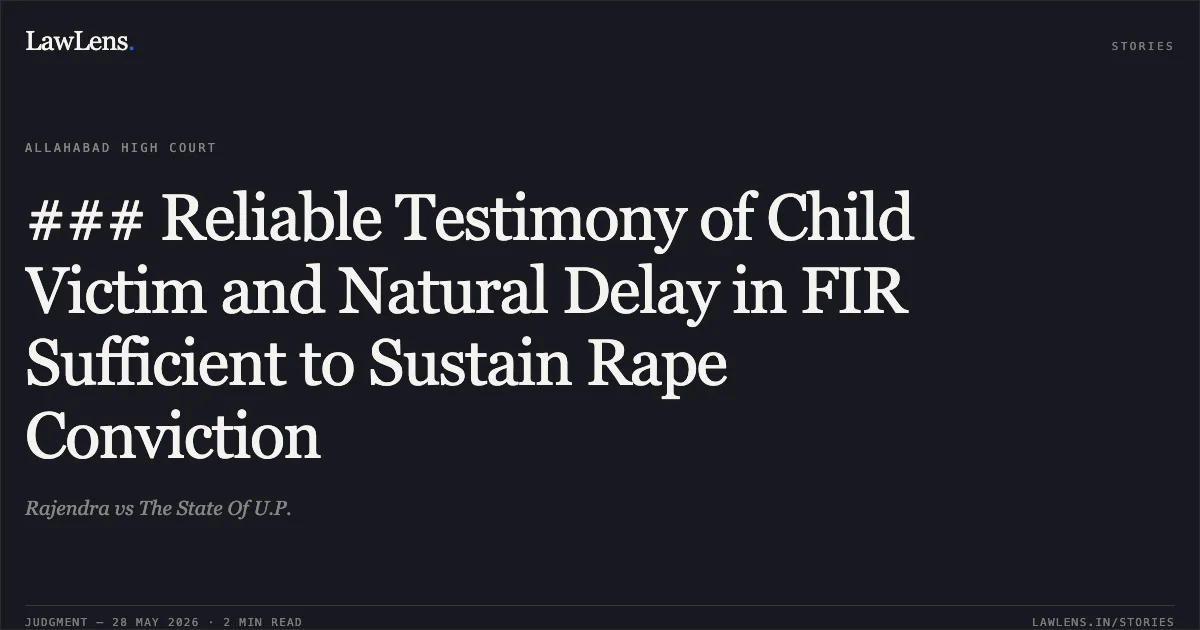
The Court answered the issues in the affirmative for the prosecution, holding that the victim's testimony was "cogent, consistent, and reliable".
The appeal was dismissed, the conviction under Section 376 IPC was upheld, and the sentence of life imprisonment was maintained.
Source reference: para. 53Acts & Sections Cited
6 provisions across 2 statutes referred to in this judgment. Each provision opens on LawLens.
Code of Criminal Procedure, 19734
Indian Penal Code, 18602
Original Court PDF
RajendravsThe State Of U.P.
Click to open original judgment
Original judgment, available to read, download and summarize on LawLens.in