Facts
The Petitioners, three students related as siblings and cousins, applied for tribe validity certificates claiming to belong to the ‘Dhoba’ Scheduled Tribe (Entry No. 18).
Source reference: para. 2-3They submitted pre-constitutional documents from 1930 and 1945 recording "Dhoba".
Source reference: para. 4However, the Respondent Scrutiny Committee invalidated their claims via an order dated 18/10/2022, primarily relying on four adverse entries (1911–1980) discovered by the Vigilance Cell which recorded the caste as "Dhobi".
Source reference: para. 11-12The Petitioners disputed the relationship with the individuals in the oldest adverse entries and denied interpolations in their submitted records.
Source reference: para. 15Issues
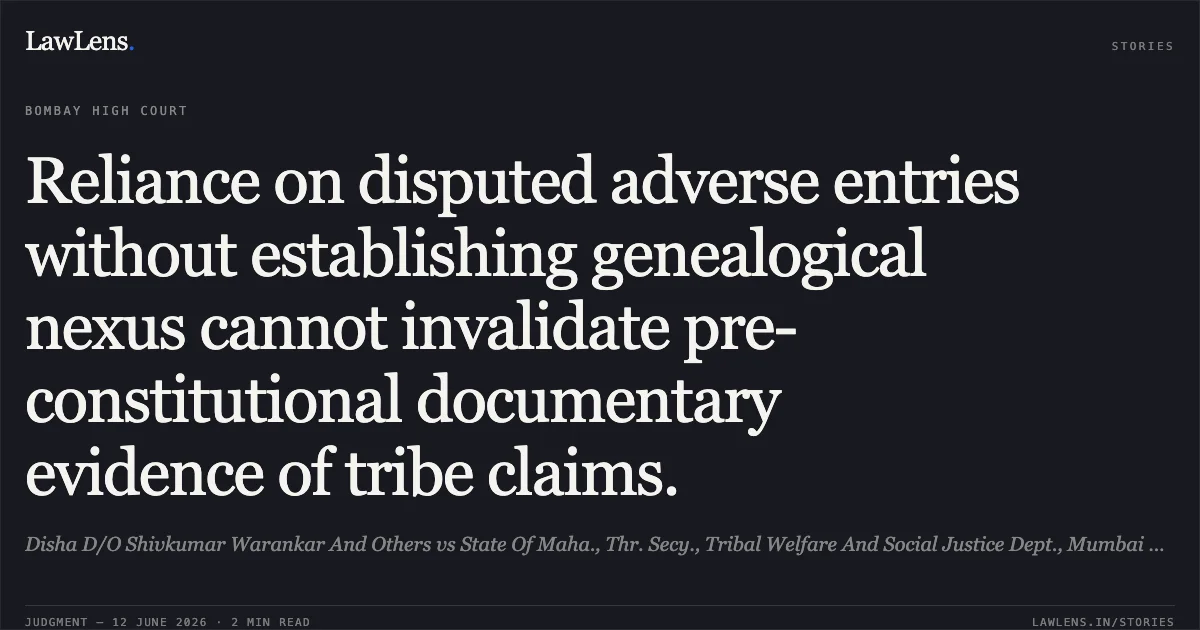
1. Whether the Scrutiny Committee was justified in relying on adverse "Dhobi" entries to invalidate the tribe claim without establishing a nexus between the persons in those records and the Petitioners' genealogy.
Source reference: para. 17-182. Whether the findings of "interpolation" in the Petitioners' documents were sustainable in the absence of cogent evidence or expert opinion.
Source reference: para. 203. Whether the failure of the affinity test can be the sole basis for invalidating a tribe claim when documentary evidence is available.
Source reference: para. 22Law Applied
The court applied the Maharashtra Scheduled Castes, Scheduled Tribes, De-notified Tribes (Vimukta Jatis), Nomadic Tribes, Other Backward Classes and Special Backward Category (Regulation of Issuance and Verification of) Caste Certificate Act, 2000, particularly Section 8 regarding the burden of proof.
Source reference: para. 9, 23It relied on Anand v. Committee for Scrutiny and Verification of Tribe Claims [(2012) 1 SCC 113], establishing that the affinity test is not a "litmus test" and pre-constitutional documents have highest probative value.
Source reference: para. 8, 22Furthermore, Sayanna v. State of Maharashtra [(2009) 10 SCC 268] was applied, requiring expert opinion/cogent material to allege interpolation rather than mere suspicion.
Source reference: para. 8, 20Reasoning
The Court found that the Committee failed to demonstrate a genealogical link between the Petitioners and the adverse "Dhobi" entries of 1911 and 1927, which the Petitioners had specifically denied.
Source reference: para. 17-18The Court observed that since the Petitioners’ genealogy was undisputed, the Committee could not import "stranger" entries to invalidate claims.
Source reference: para. 16, 18Regarding the alleged interpolations from "Dhobi" to "Dhoba" in the 1930 and 1980 records, the Court perused the original records and concluded they appeared genuine, noting that the Committee had provided no expert evidence to prove tampering as required by Sayanna.
Source reference: para. 20-21The Court held that socio-cultural affinity is not determinative when consistent documentary evidence exists; thus, the Committee’s reliance on the Vigilance Cell’s affinity report was misplaced.
Source reference: para. 22-23Holding
The Court allowed the Writ Petition and quashed the Scrutiny Committee's order dated 18/10/2022.
It held that the Petitioners successfully established their "Dhoba" Scheduled Tribe status and directed the Respondent No. 2 Committee to issue tribe validity certificates to all three Petitioners within six weeks.
Source reference: para. 23(iii)Acts & Sections Cited
1 provisions across 1 statute referred to in this judgment. Each provision opens on LawLens.
Maharashtra Scheduled Castes, Scheduled Tribes, De-notified Tribes (Vimukta Jatis), Nomadic Tribes, Other Backward Classes and Special Backward Category (Regulation of Issuance and Verification of) Caste Certificate Act, 2000.1
Original Court PDF
Disha D/O Shivkumar Warankar And OthersvsState Of Maha., Thr. Secy., Tribal Welfare And Social Justice Dept., Mumbai And Anr.
Click to open original judgment
Original judgment, available to read, download and summarize on LawLens.in


