Facts
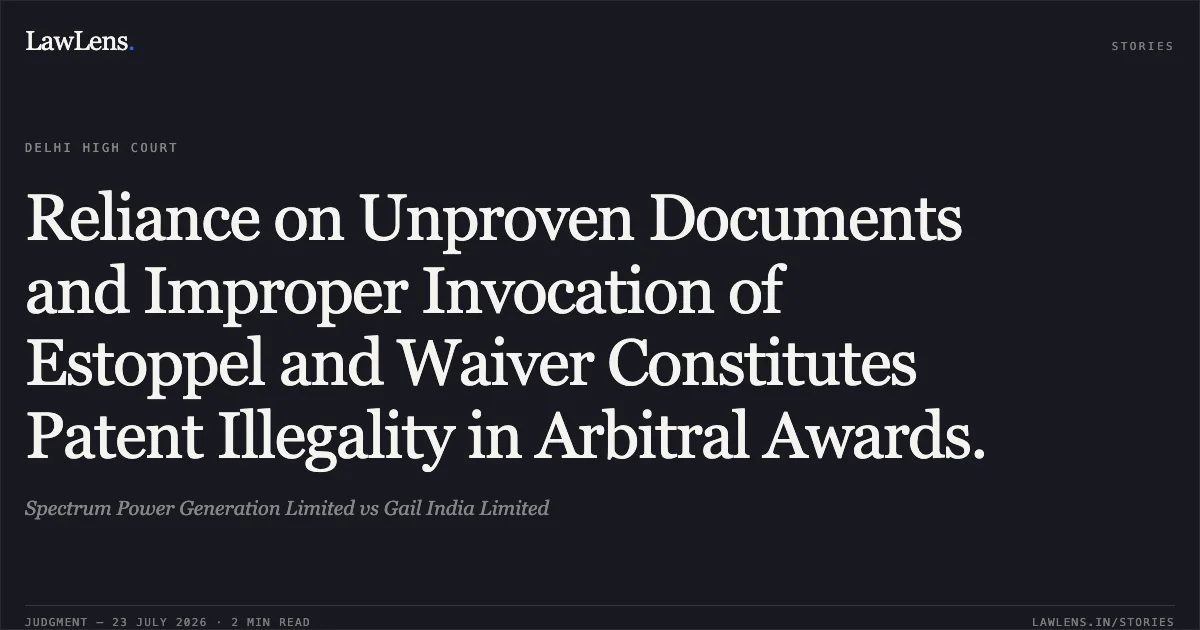
The Petitioner, a power generation company, entered into a Gas Sale Agreement (GSA) dated 18.12.2015 with the Respondent for natural gas supply.
Source reference: para 2Post-GST implementation, the Respondent raised invoices for reimbursement of GST on gas transmission charges.
Source reference: para 2The Petitioner paid these for three years but later initiated arbitration seeking a refund, contending that the sale was governed by the AP VAT Act and no GST was leviable on internal transmissions.
Source reference: para 2.1The Arbitral Tribunal rejected the claim, holding that the Petitioner waived its rights by not challenging invoices within 14 days (Clause 12.6) and that the Respondent had deposited the collected GST with authorities.
Source reference: para 2.2The Petitioner challenged this award under Section 34 of the Arbitration and Conciliation Act, 1996.
Source reference: para 1Issues
1. Whether the burden of GST on transmission charges could be contractually passed to the Petitioner and whether the Tribunal's interpretation of the GSA was plausible.
Source reference: para 8/92. Whether the Respondent proved the actual deposit of the tax with GST authorities through admissible evidence.
Source reference: para 8/143. Whether the Petitioner was precluded from claiming a refund based on the principles of estoppel and waiver.
Source reference: para 8/21Law Applied
Interpretation of contracts is the exclusive domain of the Tribunal unless the view is one no fair-minded person would take under Section 34 of the Arbitration and Conciliation Act, 1996.
Source reference: para 12.1, Prakash Atlanta (JV) v. NHAIThe principle that admitting unproven documents is a violation of natural justice and legal misconduct.
Source reference: para 15, Bi-Water Penstocks Ltd. v. Municipal Corporation of Gr. BombayWaiver requires "intentional relinquishment of a known right" and the onus of proof lies on the party pleading waiver.
Source reference: para 23.1, Provash Chandra Dalui v. Biswanath Banerjee; para 25, Kalpraj Dharamshi v. Kotak Investment Advisors Ltd.The doctrine of Estoppel requires a five-pronged test, including a representation and a subsequent change in position by the promisee.
Source reference: para 26.1, Motilal Padampat Sugar Mills Co. Ltd. v. State of U.P.Reasoning
The High Court upheld the Tribunal's interpretation of the GSA regarding the Petitioner's liability for tax reimbursement as a "plausible view".
Source reference: para 11The court found the Tribunal's factual finding that GST was actually deposited to be "perverse" because the Tribunal relied on tax receipts without ever deciding on their admissibility after the Petitioner objected to them.
Source reference: para 14, 19The court noted that four random receipts do not prove payment for the specific gas supplied to the Petitioner.
Source reference: para 16Regarding waiver, the court held the Tribunal erred in assuming the parties were ad idem; there was no evidence that the Petitioner consciously abandoned its right to object.
Source reference: para 22, 25On estoppel, the court found the Respondent failed to show it altered its position based on the Petitioner's payments, as the Respondent's liability to the tax authorities existed independently of the Petitioner's reimbursement.
Source reference: para 27The court noted that Clause 12.6 (requiring payment before dispute) creates a situation where payment is necessary to avoid disruption of supply, and thus payment alone cannot be the sole factor to debar a claim.
Source reference: para 29-31Holding
The Court allowed the petition and set aside the arbitral award.
The finding of tax deposit was based on inadmissible/unproven evidence.
Source reference: para 18, 20The invocation of "estoppel" and "waiver" was patently illegal as the fundamental legal requirements for these doctrines were not met.
Source reference: para 25, 27Clause 12.6 of the GSA does not act as an absolute bar to claims when payments are made to ensure uninterrupted gas supply.
Source reference: para 29Acts & Sections Cited
3 provisions across 2 statutes referred to in this judgment. Each provision opens on LawLens.
Arbitration and Conciliation Act, 19962
Central Goods and Services Tax Act, 20171
Original Court PDF
Spectrum Power Generation LimitedvsGail India Limited
Click to open original judgment
Original judgment, available to read, download and summarize on LawLens.in