Facts
The petitioner, a contractual Sub-Engineer under the MGNREGA scheme, sought review of the High Court’s order dismissing his writ petition against the non-extension of his contractual engagement.
Source reference: para. 1–3He argued that the decision was based on misconduct allegations and was stigmatic, and that similarly situated Sub-Engineers had obtained relief in separate proceedings.
Source reference: para. 1–3The State opposed review, contending that the petitioner had no vested right to renewal and had shown no apparent error.
Source reference: para. 4The Court examined the petitioner’s appellate order alongside appellate orders concerning other Sub-Engineers, noting their differing factual findings and grounds.
Source reference: para. 6–7, 18Issues
1. Whether the dismissal of the petitioner’s writ petition disclosed an error apparent on the face of the record warranting review under Order XLVII Rule 1 CPC
Source reference: para. 1, 8–12, 172. Whether relief granted to other Sub-Engineers in separate proceedings entitled the petitioner to the same relief in review
Source reference: para. 183. Whether K. Raghupathi v. State of U.P. required review of the dismissal order in the petitioner’s case
Source reference: para. 15–16Law Applied
Section 114 and Order XLVII Rule 1 CPC permit review on discovery of new and important evidence unavailable despite due diligence, an error apparent on the face of the record, or another sufficient reason.
Source reference: para. 10–12Under Kamlesh Verma v. Mayawati, review is not an appeal in disguise; an error must be patent and self-evident, rather than one requiring reappraisal or extended reasoning.
Source reference: para. 8State of West Bengal v. Kamal Sengupta similarly holds that an apparent error must be prima facie visible and that an erroneous view of law is not, by itself, a ground for review.
Source reference: para. 9Parsion Devi v. Sumitri Devi and Col. Avatar Singh Sekhon v. Union of India confine review to material, manifest errors that undermine the decision or cause a miscarriage of justice.
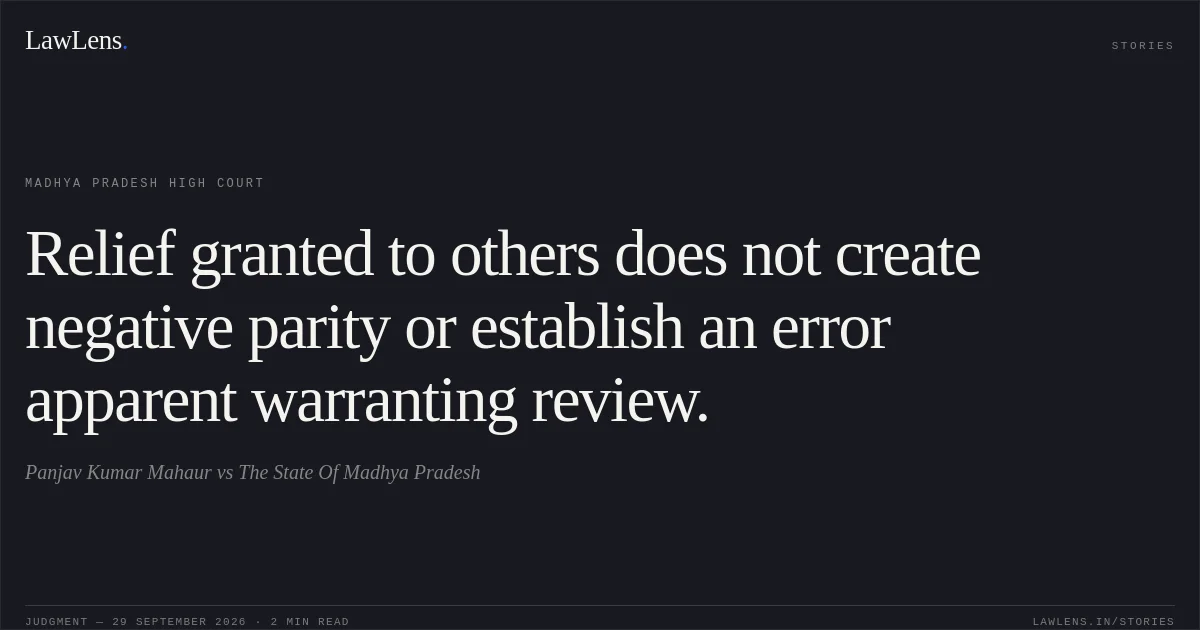
Source reference: para. 13–14Article 14 does not permit a claim to “negative parity” based on an allegedly erroneous benefit granted in another case, as stated in Basawaraj v. Special Land Acquisition Officer and State of Odisha v. Anup Kumar Senapati.
Source reference: para. 18The Court treated K. Raghupathi v. State of U.P. as fact-specific.
Source reference: para. 15–16Reasoning
The Court found that the petitioner’s arguments about the alleged stigmatic basis for non-extension, his APR gradings, and the treatment of other Sub-Engineers did not establish a patent error in the dismissal order; they invited reconsideration of the merits, which is beyond review jurisdiction.
Source reference: para. 3, 17, 19The appellate orders concerning other Sub-Engineers arose from their individual facts and findings and could not be mechanically applied to the petitioner, nor could they create a right to equal treatment if the relief granted was not otherwise legally due.
Source reference: para. 18K. Raghupathi did not alter that conclusion because its result depended on the circumstances of that case.
Source reference: para. 15–16Holding
The Court held that no error apparent on the face of the record or other basis for review had been established.
It dismissed the review petition as devoid of merit.
Source reference: para. 17, 19–20Acts & Sections Cited
1 provisions across 1 statute referred to in this judgment. Each provision opens on LawLens.
Code of Civil Procedure, 19081
Original Court PDF
Panjav Kumar MahaurvsThe State Of Madhya Pradesh
Click to open original judgment
Original judgment, available to read, download and summarize on LawLens.in