Facts
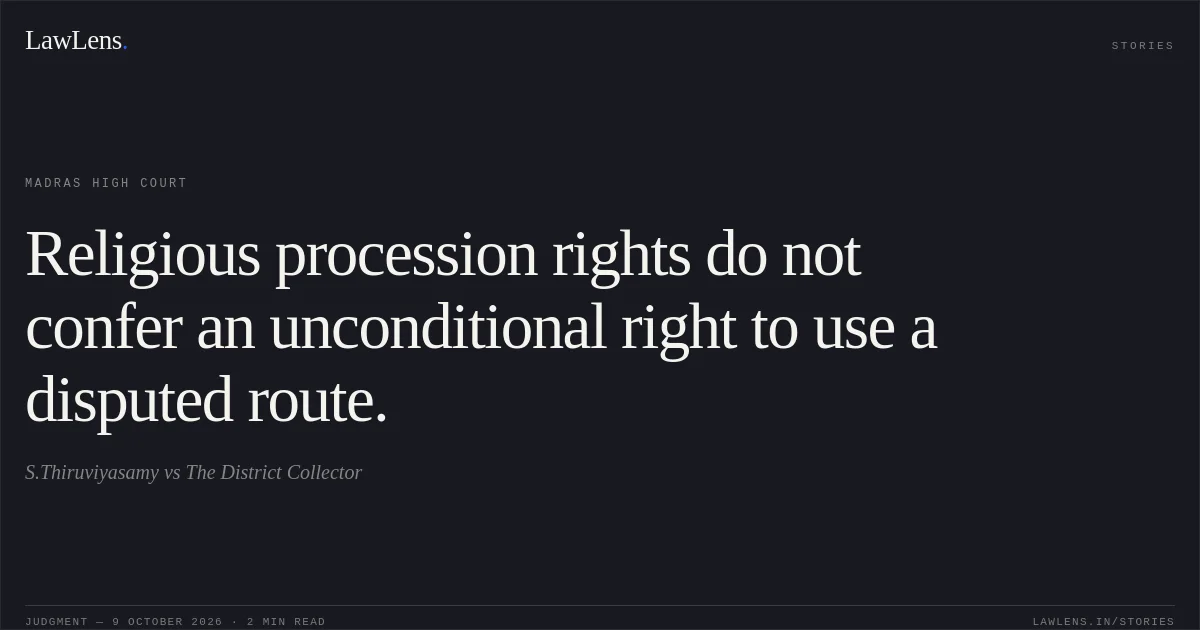
The petitioner sought a mandamus directing the authorities to ensure that the annual chariot procession of Punitha Jebamalai Matha passed along its claimed traditional route through Aranmanaikkarai, including specified survey numbers, on 10 October 2026.
Source reference: pp. 1–2, paras. 1–2He asserted that the procession had followed that route after the church was established, despite objections raised in 2010.
Source reference: p. 3, para. 2The seventh respondent relied on a peace-committee arrangement prescribing an alternative route, which he said the petitioner had accepted.
Source reference: p. 4, para. 4The official respondents also referred to a 2014 law-and-order incident and argued that departing from the arrangement could renew the dispute.
Source reference: p. 4, para. 5Issues
Whether the petitioner was entitled to a mandamus requiring the authorities to permit the procession along the specific disputed route, notwithstanding the earlier peace-committee arrangement.
Source reference: p. 5, para. 7Whether apprehended public-order concerns and the prior arrangement justified declining that specific relief.
Source reference: pp. 6–7, paras. 8–11Law Applied
Article 25 of the Constitution protects the right freely to profess and practise religion, subject to public order, morality, health, and the other provisions of Part III; the presence of another religious community or its place of worship along a route is not, by itself, a sufficient reason to deny a religious procession.
Source reference: p. 5, para. 7Relying on Ramasamy Udayar v. District Collector, 2021 SCC OnLine Mad 1779, the Court stated that authorities should regulate processions where necessary rather than prohibit them solely because of communal objections.
Source reference: p. 6, para. 7The Court also considered the principle, attributed in the judgment to the Bharat Mukti Morcha decision, that a restriction on assembly or procession must be founded on a reasonable apprehension of threat to public peace or public order, rather than a general concern about law and order.
Source reference: pp. 4–5, para. 5; p. 7, para. 11The right to insist on a particular route is not unconditional where a prior arrangement governs the procession; the arrangement and its circumstances must be considered.
Source reference: p. 6, paras. 8–10Reasoning
The Court accepted that a procession could not be denied merely because another religious community lived in the locality or had a place of worship there.
Source reference: p. 6, para. 7However, the relief sought was a positive direction to use a particular disputed route, not merely protection for conducting the festival.
Source reference: no citationThe materials indicated that objections had led to a peace-committee meeting and an arrangement concerning the route.
Source reference: p. 6, paras. 8–9Although the 2014 criminal case alone was insufficient to prohibit the procession, the prior dispute supported the need to respect a lawful arrangement aimed at preserving public peace unless grounds existed to reconsider it.
Source reference: p. 7, para. 10The Court therefore found that the general principle in Ramasamy Udayar did not establish an entitlement to the specific route sought.
Source reference: p. 7, para. 12Holding
The Court dismissed the writ petition and declined to issue a mandamus permitting the procession along the disputed route.
The dismissal concerned the specific route relief sought; the judgment did not hold that the religious festival itself could be prohibited.
Source reference: no citationOriginal Court PDF
S.ThiruviyasamyvsThe District Collector
Click to open original judgment
Original judgment, available to read, download and summarize on LawLens.in