Facts
The petitioner society owned land in Khasra Nos. 185/1, 185/5, 185/6, and 185/7
Source reference: para 2The Jabalpur Development Authority (JDA) initiated acquisition of this land under Section 50 of the Nagar Tatha Gram Nivesh Adhiniyam, 1973
Source reference: para 7On 05.12.1995, both parties entered into an agreement where the JDA agreed to relinquish the acquisition of the petitioner’s land in exchange for the petitioner constructing the 'MR-4' road and colony infrastructure at its own cost
Source reference: para 2, 7After performing the construction, the petitioner sought monetary compensation or 20% developed land under a 1996 government circular
Source reference: para 2, 9The High Court previously remitted the matter for reconsideration, but the respondents rejected the claim via order dated 27.04.2026, stating the work was done per the agreement
Source reference: para 2, 3The petitioner challenged this rejection, citing Article 300A
Source reference: para 3Issues
1. Whether the petitioner is entitled to compensation for the land utilized for road construction despite the existence of a specific relinquishment agreement
Source reference: para 3, 72. Whether the principle of "unjust enrichment" applies where a landowner seeks compensation after receiving the benefit of non-acquisition of their property
Source reference: para 11Law Applied
The court primarily applied the concept of quid pro quo within the framework of contractual obligations under the Nagar Tatha Gram Nivesh Adhiniyam, 1973
Source reference: para 7-8constitutional protection of property under Article 300A
Source reference: para 3The court heavily applied the principle of "Unjust Enrichment" as defined by the Supreme Court in Indian Council For Enviro-Legal Action v. Union of India, which prevents a party from unjustly enriching themselves at the expense of another against the principles of equity and good conscience
Source reference: para 10-11The court also distinguished Vidya Devi v. State of Himachal Pradesh regarding the right to compensation for acquired property
Source reference: para 12Reasoning
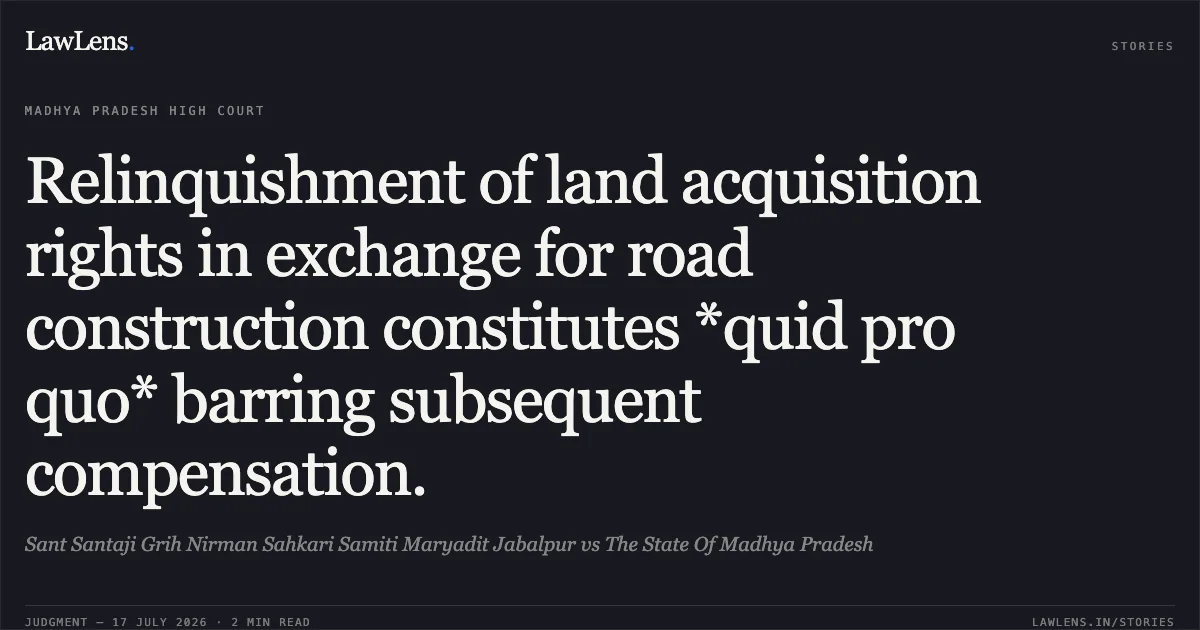
The Court reasoned that the 1995 agreement was not a standard development contract but a reciprocal arrangement based on quid pro quo
Source reference: para 8The JDA performed its part by exempting the petitioner’s land from Scheme No. 16, thereby allowing the petitioner to retain ownership of land that was otherwise being acquired
Source reference: para 8In return, the petitioner assumed the cost of constructing the MR-4 road, which was explicitly designated to remain JDA property
Source reference: para 7The Court found that the petitioner could not rely on the 1996 circular for 20% developed land because that circular was not part of the specific, independent instrument executed under "exceptional circumstances" to expedite public works
Source reference: para 9Applying the doctrine of unjust enrichment, the Court held that since the petitioner had already received the massive benefit of having its land released from acquisition, demanding additional monetary compensation for the road area would constitute an inequitable double benefit
Source reference: para 11Holding
The Court answered the issues in the negative, holding that the petitioner is not entitled to compensation.
The Court concluded that the agreement was binding and that the petitioner had already been "benefited" by the non-acquisition of its property. The petition was dismissed, and the parties were ordered to bear their own costs.
Source reference: para 11, 13The final holding affirms that a landowner who enters a voluntary agreement to construct public infrastructure in exchange for the release of land from acquisition cannot subsequently claim compensation for the area utilized for that infrastructure
Source reference: para 8, 11Acts & Sections Cited
1 provisions across 1 statute referred to in this judgment. Each provision opens on LawLens.
Gram Nyayalayas Act, 20081
Original Court PDF
Sant Santaji Grih Nirman Sahkari Samiti Maryadit JabalpurvsThe State Of Madhya Pradesh
Click to open original judgment
Original judgment, available to read, download and summarize on LawLens.in