Facts
The appellant was the complainant in proceedings under Section 138 of the Negotiable Instruments Act, 1881 (“NI Act”), and the respondent was the accused.
Source reference: p.1, para. 2The Trial Court had proceeded with the trial, during which the accused was examined as DW-1. His defence was that he had issued a signed blank cheque as security for a loan of ₹10 lakhs, whereas the cheque was presented for ₹30 lakhs; he also contended that the complainant was not present at Bengaluru on the dates relevant to the alleged transaction.
Source reference: p.3, para. 6The Trial Court observed that the accused could have produced call data records to establish the complainant’s absence.
Source reference: p.3–4, para. 6Neither before the Trial Court nor before the First Appellate Court did the accused allege prejudice.
Source reference: p.4, para. 7In revision, however, the High Court remanded the matter for a fresh trial from the stage of defence evidence, relying on M/s Mandvi Cooperative Bank Ltd. v. Nimesh B. Thakore, (2010) 3 SCC 83.
Source reference: p.1–2, paras. 2, 4Issues
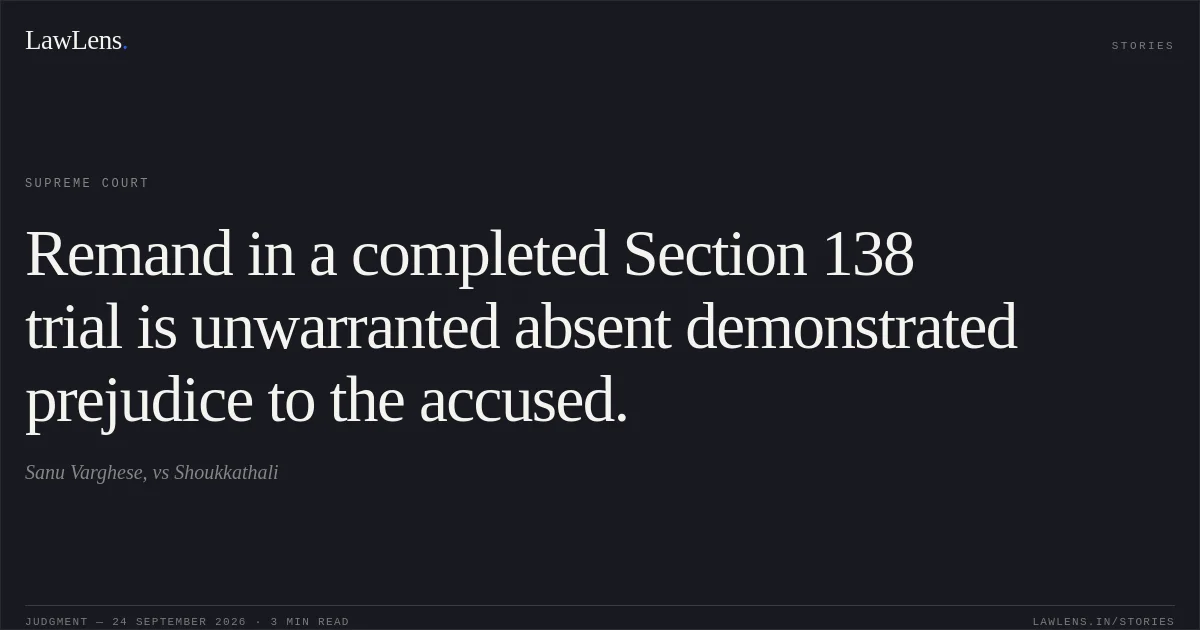
Whether the High Court was justified in remanding the complaint under Section 138 of the NI Act for a fresh trial from the stage of defence evidence, despite the absence of any plea or demonstrated prejudice to the accused.
Source reference: p.2, para. 4; p.4, paras. 7–8Whether the decision in M/s Mandvi Cooperative Bank Ltd. v. Nimesh B. Thakore required such a remand in the circumstances of the case.
Source reference: p.1–3, paras. 2, 4–5Law Applied
Section 145(1) of the NI Act permits the complainant’s examination-in-chief to be given by affidavit, which may be read in evidence subject to just exceptions. Under Section 145(2), the Court may summon the person giving evidence on affidavit for examination regarding the facts stated therein; where either the prosecution or the accused applies for such examination, the person must be called and examined.
Source reference: p.2, para. 4M/s Mandvi Cooperative Bank Ltd. v. Nimesh B. Thakore, (2010) 3 SCC 83, further distinguishes the complainant’s evidence from the accused’s defence evidence and holds that the accused cannot be permitted to give evidence on affidavit, since the defence may involve evidence beyond documentary material.
Source reference: p.2–3, para. 5These principles must, however, be applied in a criminal case with reference to actual prejudice caused to the accused in the completed trial.
Source reference: p.3, para. 6Once the cheque signature is admitted, the statutory presumption under the NI Act operates unless rebutted.
Source reference: p.4, para. 7Reasoning
The Supreme Court held that Mandvi Cooperative Bank did not automatically require a remand.
Source reference: p.3–4, para. 6Although the accused had advanced a defence concerning a security cheque, the alleged excess amount, and the complainant’s absence, he neither produced substantive evidence of the complainant’s unavailability nor demonstrated that the trial procedure caused him prejudice.
Source reference: p.3–4, para. 6He could have obtained the complainant’s call data records, but did not do so.
Source reference: p.3–4, para. 6The accused also failed to raise prejudice before the Trial Court or the First Appellate Court, and the admitted signature attracted the statutory presumption, which remained unrebutted.
Source reference: p.4, para. 7The High Court therefore erred in accepting the procedural objection raised for the first time in revision and in ordering a fresh trial solely on that basis.
Source reference: p.4, para. 8Holding
The appeal was allowed and the High Court’s remand order was set aside.
The criminal revision was restored to the High Court for consideration on its remaining merits.
Source reference: p.4, para. 9The Supreme Court directed that only the evidence initially led at trial should be considered; if the Trial Court had subsequently examined the accused in person after the remand, that subsequent evidence was to be excluded.
Source reference: p.4–5, para. 9Pending applications, if any, were rejected.
Source reference: p.5, para. 11Acts & Sections Cited
2 provisions across 1 statute referred to in this judgment. Each provision opens on LawLens.
Negotiable Instruments Act, 18812
Original Court PDF
Sanu Varghese,vsShoukkathali
Click to open original judgment
Original judgment, available to read, download and summarize on LawLens.in