Facts
The petitioner, a Constable posted at a police camp in a sensitive naxalite-affected area, remained unauthorizedly absent from duty for 213 consecutive days (from 13.06.2018 to 12.01.2019)
Source reference: para 4, 17He claimed the absence was due to family bereavement, his own ill health, and his wife’s pregnancy, but he failed to intimate his superiors during this period
Source reference: para 4, 8A departmental enquiry was initiated under the Chhattisgarh Police Regulations, where the petitioner was served a charge-sheet and provided opportunities to defend himself
Source reference: para 5, 19The Enquiry Officer found the charges proved, leading the Disciplinary Authority to order his removal from service on 04.10.2019
Source reference: para 6, 20The petitioner’s service record revealed a history of "habitual absence," including five minor and two major penalties previously imposed for similar misconduct
Source reference: para 14, 18The Appellate Authority and the Director General of Police (in a mercy petition) subsequently affirmed the removal
Source reference: para 21, 24Issues
1. Whether the departmental inquiry was conducted in violation of the principles of natural justice and statutory procedure
Source reference: para 8, 242. Whether the punishment of removal from service was shockingly disproportionate to the gravity of the proven misconduct
Source reference: para 9, 423. Whether the High Court, in the exercise of its supervisory jurisdiction under Article 226, can reappreciate evidence or substitute the punishment imposed by the disciplinary authority
Source reference: para 15, 34Law Applied
The court primarily applied Rule 24 of the Chhattisgarh Civil Services (Leave) Rules, 1977, which stipulates that willful absence from duty renders a government servant liable to disciplinary action
Source reference: para 28, 29It relied on State of A.P. v. S. Sree Rama Rao, establishing that the High Court is not an appellate authority over departmental inquiries and is only concerned with the decision-making process
Source reference: para 33, 34The court further cited Union of India v. P. Gunasekaran, which prohibits the reappreciation of evidence under Article 226 unless the findings are perverse or based on no evidence
Source reference: para 34Regarding proportionality, the court followed State of Karnataka v. N. Gangaraj, holding that interference with the quantum of punishment is only permissible if it "shocks the conscience" of the court
Source reference: para 15, 42Reasoning
The court found that the departmental inquiry strictly adhered to procedural safeguards under Rule 14 of the Rules of 1966 and Article 311(2) of the Constitution
Source reference: para 37The record demonstrated that the petitioner was served with a charge-sheet and given ample opportunity to cross-examine witnesses and lead defense evidence, which he largely failed to utilize
Source reference: para 19, 38The court rejected the petitioner's defense of "compelling circumstances," noting he provided no contemporaneous intimation or supporting medical documentation during the inquiry
Source reference: para 26Crucially, the court emphasized that in a disciplined force deployed in a naxalite-affected area, 213 days of unauthorized absence is a grave misconduct that undermines institutional integrity
Source reference: para 36, 39By connecting the law to the facts, the court determined that the petitioner’s "habitual" nature of absence justified the disciplinary authority’s conclusion that he was unfit for retention in service
Source reference: para 39, 41Holding
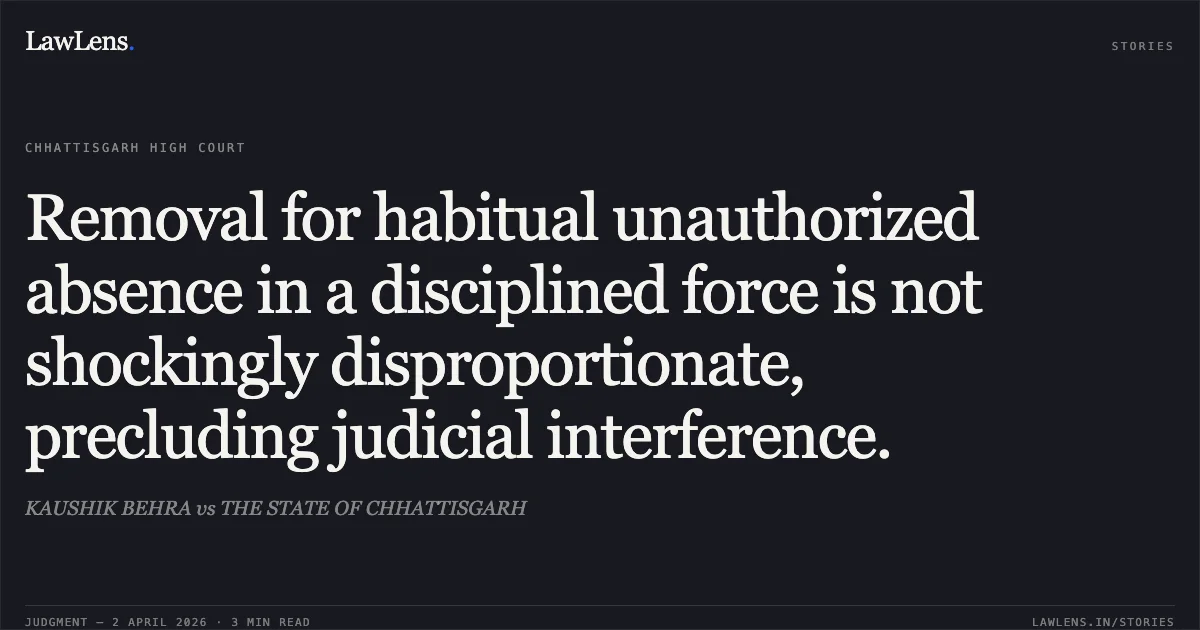
The Court answered the issues in the negative, holding that the inquiry was procedurally sound and the punishment was not disproportionate given the petitioner's sensitive posting and poor past service record
The Court held that it cannot act as a court of appeal to reassess findings of fact supported by "some evidence"
Source reference: para 40, 44Consequently, the High Court dismissed the writ petition, upholding the orders of removal dated 04.10.2019, the appellate order dated 30.09.2020, and the rejection of the mercy petition dated 29.09.2021
Source reference: para 45, 46Acts & Sections Cited
1 provisions across 1 statute referred to in this judgment. Each provision opens on LawLens.
Prevention of Corruption Act, 19881
Original Court PDF
KAUSHIK BEHRAvsTHE STATE OF CHHATTISGARH
Click to open original judgment
Original judgment, available to read, download and summarize on LawLens.in