Facts
The applicant was appointed as a Hospital Attendant on compassionate grounds in 2011
Source reference: p. 3On 06.07.2018, he left his place of posting at Ledo without prior authorization, citing his sister's sudden illness and his brother's tuberculosis as reasons for returning to his hometown
Source reference: p. 3The respondents issued a Charge Memorandum on 16.10.2019 under Rule 9 of the RS(D&A) Rules, 1968, alleging unauthorized absence from 06.07.2018 until the date of the charge sheet
Source reference: p. 3An ex parte inquiry was conducted after notices were sent via registered post, published in newspapers, and pasted on the applicant's door
Source reference: p. 7-8Following the inquiry report, the Disciplinary Authority passed an order on 25.08.2020 removing the applicant from service, noting his history as a habitual absentee with multiple prior minor penalties
Source reference: p. 5-7The applicant’s appeal was rejected on 16.09.2020
Source reference: p. 6Issues
1. Whether the applicant's unauthorized absence for a period of 15 months was willful or justified by the medical condition of his family members
Source reference: p. 102. Whether the disciplinary proceedings and the subsequent penalty of removal from service were disproportionate or violated the principles of natural justice
Source reference: p. 5-6, 11Law Applied
Rule 9 of the Railway Servants (Discipline & Appeal) Rules, 1968, governing the procedure for imposing major penalties
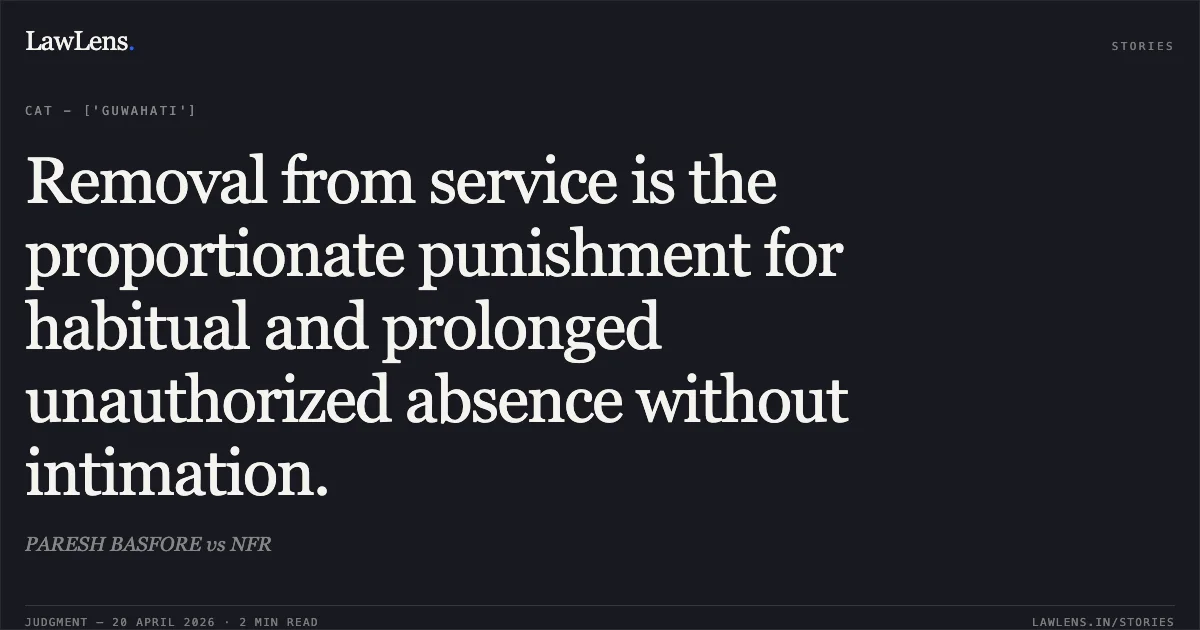
Source reference: p. 3, 8State of Rajasthan v. Mohamed Ayub Naz, which held that removal from service is a proportionate punishment for prolonged unauthorized absence without intimation, as such conduct constitutes gross indiscipline
Source reference: p. 9-10Krushnakant B. Parmar v. Union of India to argue that unauthorized absence must be "willful" to warrant dismissal
Source reference: p. 4-5Roop Singh Negi v. Punjab National Bank regarding the requirements of a valid inquiry
Source reference: p. 4-5Reasoning
The Tribunal found that the applicant admitted to being absent for 15 months without intimation
Source reference: p. 10Although the applicant claimed his sister’s illness necessitated his absence, the evidence showed his absence began in 2017, whereas the medical documents provided were dated 2018 and 2019, contradicting his defense
Source reference: p. 11The Tribunal noted that the respondents followed due process by serving notices through multiple channels, including newspaper publication, justifying the ex parte proceedings under Rule 9(23)
Source reference: p. 7-8Furthermore, the applicant’s service record revealed he was a habitual offender who had received several prior warnings and minor penalties for similar misconduct
Source reference: p. 7, 11The Tribunal reasoned that a government servant who fails to intimate their employer during a prolonged absence commits a serious dereliction of duty, and such behavior undermines workplace discipline
Source reference: p. 10-11Holding
The Tribunal dismissed the Original Application, holding that the applicant failed to prove his absence was not willful and was, in fact, a habitual absentee
The court concluded that the punishment of removal from service was proportionate and consistent with established legal precedents regarding prolonged unauthorized absence
Source reference: p. 10-11No interference with the impugned orders of the Disciplinary and Appellate Authorities was warranted
Source reference: p. 11All pending Miscellaneous Applications were closed with no order as to costs
Source reference: p. 12Acts & Sections Cited
1 provisions across 1 statute referred to in this judgment. Each provision opens on LawLens.
Indian Penal Code, 18601
Original Court PDF
PARESH BASFOREvsNFR
Click to open original judgment
Original judgment, available to read, download and summarize on LawLens.in