Facts
The landlord let two adjoining shops to the tenant under separate rent notes.
Source reference: no citationThe tenant removed the common wall between them, allegedly without the landlord’s prior written consent, and also made other alterations, including installing an RCC pillar, loft and new shutter.
Source reference: para. 3–4, 10, 16–17The tenant maintained that the wall was removed with the landlord’s permission when the second shop was let in 1994.
Source reference: para. 3–4, 10, 16–17The trial court decreed eviction on the ground that removal of the wall breached Section 13(1)(b) of the Gujarat Rents, Hotel and Lodging House Rates Control Act, 1947 (“Rent Act”); the appellate court affirmed the decree and also treated other works as permanent structures.
Source reference: para. 3–4, 10, 16–17The tenant’s revision challenged those findings and asserted that the suit was time-barred.
Source reference: para. 3–4, 10, 16–17Issues
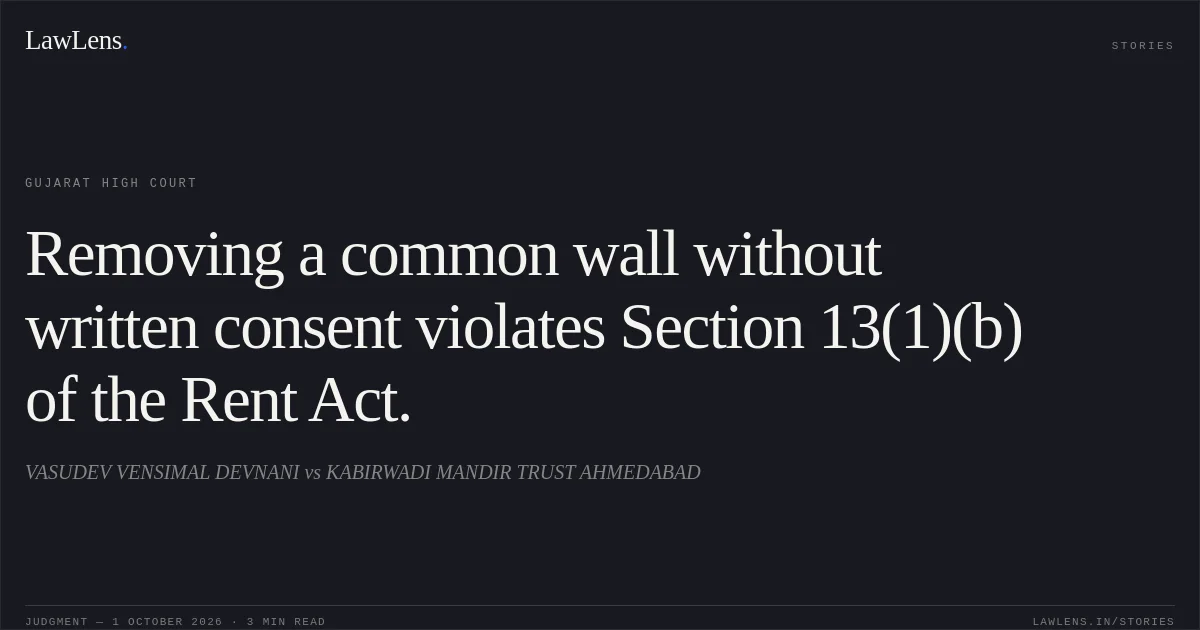
1. Whether removing the common wall between the two rented shops without the landlord’s written consent amounted to erecting a permanent structure under Section 13(1)(b) of the Rent Act
Source reference: para. 12–152. Whether the appellate court could revisit the trial court’s adverse finding concerning the RCC pillar, loft and shutter despite the landlord not filing a cross-objection or appeal
Source reference: para. 16.1–16.33. Whether the eviction suit was time-barred, given the tenant’s claim that the wall was removed in 1994
Source reference: para. 17–17.5Law Applied
Section 13(1)(b) of the Rent Act permits eviction where a tenant, without the landlord’s written consent, erects a permanent structure; its Explanation identifies specified works that are excluded from that expression.
Source reference: para. 13In assessing permanence, the court applied the tests stated in Gheewala Shankerlal Mafatlal v. Gheewala Chandrakantbhai Valjibhai, including the material and durability of the work, removability without serious damage, effect on the premises’ identity, the tenant’s intention and the absence of written consent.
Source reference: para. 14.2Under Order XLI Rule 22 CPC, a respondent may support a decree by challenging an adverse finding without a cross-objection, where no additional relief is sought.
Source reference: para. 16.2–16.3Article 66 of the Limitation Act, 1963, was applied as allowing 12 years from the alleged breach.
Source reference: para. 17.3Under Hindustan Petroleum Corporation Ltd. v. Dilbahar Singh, revisional review does not permit mere reappreciation of evidence, but may correct findings that are perverse, unsupported by evidence, or otherwise not according to law.
Source reference: para. 11Reasoning
The tenant did not dispute that removing the wall changed the identity of the premises, and no written consent was produced. Applying the Gheewala tests, the court held that the removal effectively made one shop out of two and would endure for the tenancy; it therefore constituted a permanent structure in breach of Section 13(1)(b).
Source reference: para. 14.1–15The appellate court could also reconsider the trial court’s finding on the other works because the landlord sought to support the eviction decree rather than obtain additional relief; the RCC pillar and loft, erected without written consent, were treated as permanent structures.
Source reference: para. 16.2–16.4The tenant’s expert evidence did not reliably establish removal in 1994. Even taking that evidence at face value, the court inferred removal around 1998; the 2009 suit was therefore within the 12-year period it applied under Article 66.
Source reference: para. 17.1–17.5The concurrent findings disclosed no basis for interference in revision.
Source reference: para. 11, 18Holding
The High Court rejected the revision application and confirmed the eviction decree, finding no jurisdictional error, perversity or gross irregularity in the decisions below.
Notice was discharged, interim relief vacated and no order as to costs made. After pronouncement, enforcement of the judgment was suspended for four weeks, subject to the tenant creating no third-party interest in the property.
Source reference: para. 20 and Further OrderActs & Sections Cited
5 provisions across 3 statutes referred to in this judgment. Each provision opens on LawLens.
Gujarat Rents, Hotel and Lodging House Rates Control Act, 19473
Transfer of Property Act, 18821
Limitation Act, 19631
Original Court PDF
VASUDEV VENSIMAL DEVNANIvsKABIRWADI MANDIR TRUST AHMEDABAD
Click to open original judgment
Original judgment, available to read, download and summarize on LawLens.in