Facts
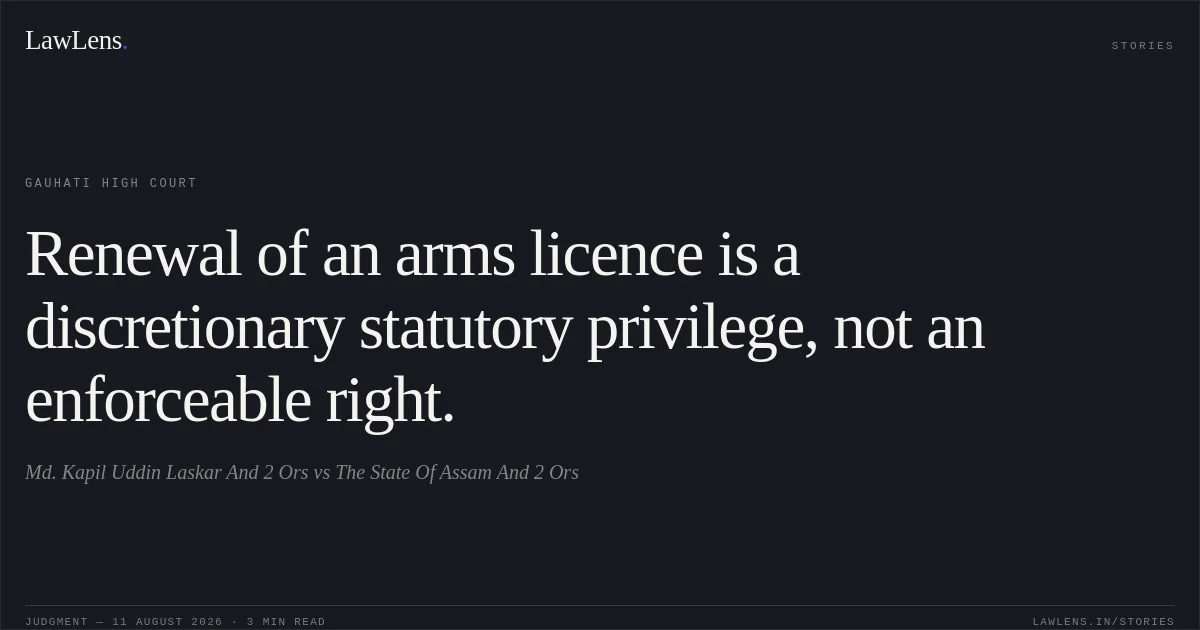
The three petitioners, residents of Hojai, Assam, challenged the inaction of the Deputy Commissioner, Hojai, in not renewing their firearm licences.
Source reference: para. 3; p. 3They claimed that they had previously been employed by private companies in Nagaland and other places outside Assam, where firearm licences were required in connection with their employment.
Source reference: para. 3; p. 3The State opposed the petition, contending that the Deputy Commissioner had considered the applications and found that the petitioners were not entitled to renewal.
Source reference: para. 5; pp. 3–4The records showed that the licences had been issued when the petitioners were allegedly below the statutory minimum age of 21 years under Section 9(1) of the Arms Act, 1959.
Source reference: para. 5; pp. 3–4The petitioners clarified that the Nagaland licences had originally been issued in the names of other persons and were subsequently transferred or issued in their names.
Source reference: para. 6; p. 4Issues
Whether the petitioners had an enforceable right to seek renewal of their firearm licences merely because such renewal was allegedly necessary for their employment.
Source reference: paras. 7–10; pp. 4–6Whether the Deputy Commissioner’s refusal or non-renewal of the firearm licences disclosed grounds warranting interference by the High Court under Article 226 of the Constitution.
Source reference: paras. 5, 9 and 11; pp. 3–6Whether the discrepancies concerning the petitioners’ ages, the original issuance of the licences, and the necessity for possessing firearms justified consideration of the renewal applications as a matter of statutory discretion.
Source reference: paras. 5–10; pp. 3–6Law Applied
The Court applied Section 9(1) of the Arms Act, 1959, which prohibits a person who has not completed 21 years from acquiring, possessing or carrying a firearm or ammunition.
Source reference: para. 5; p. 4It held that issuance or renewal of a firearm licence is not a fundamental right but a statutory privilege, dependent upon the satisfaction and discretion of the licensing authority.
Source reference: paras. 7, 9–10; pp. 4–6The authority may consider relevant factors, including public peace or safety, the applicant’s bona fide need, and the existence of a perceptible and genuine necessity for the firearm.
Source reference: paras. 7, 9–10; pp. 4–6The Court relied on the Supreme Court’s order in Rajendra Singh v. State of Uttar Pradesh, SLP No. 12831/2022, dated 13.02.2023, for the principle that the right to bear firearms is not a fundamental freedom under the Constitution of India.
Source reference: para. 10; pp. 5–6The decision in Nawab Hussain v. State of Punjab, CWP No. 3281/2025, was held not to assist the petitioners because the ultimate discretion remained with the competent licensing authority.
Source reference: paras. 4 and 9; pp. 3 and 5Reasoning
The Court rejected the petitioners’ contention that employment-related necessity, by itself, created an entitlement to renewal.
Source reference: paras. 7–10; pp. 4–6It treated firearm licensing as a discretionary statutory matter rather than a fundamental right and held that the petitioners had to establish a justified and demonstrable necessity for renewal.
Source reference: paras. 7–10; pp. 4–6The Deputy Commissioner’s affidavits disclosed reasons for refusing renewal, including doubts regarding the petitioners’ ages at the time of the original issuance of the licences, inconsistencies concerning the licences allegedly issued by Nagaland, and the absence of sufficient justification for continued possession of firearms.
Source reference: paras. 5–6 and 9; pp. 3–5Since the licensing authority had apparently applied its mind and exercised its discretion on relevant considerations, and since no manifest illegality or arbitrariness was established, the Court declined to substitute its own view for that of the authority.
Source reference: paras. 9 and 11; pp. 5–6Holding
The Court held that the petitioners had no legal or fundamental right to obtain renewal of their firearm licences and that employment-related necessity alone could not compel the licensing authority to renew them.
It further held that the reasons disclosed by the Deputy Commissioner, including the licensing discrepancies and doubts concerning compliance with the minimum-age requirement under Section 9(1) of the Arms Act, were sufficient to repel judicial interference.
Source reference: para. 11; p. 6The writ petition was accordingly dismissed, with no direction for renewal of the licences.
Source reference: para. 11; p. 6Acts & Sections Cited
1 provisions across 1 statute referred to in this judgment. Each provision opens on LawLens.
Arms Act, 19591
Original Court PDF
Md. Kapil Uddin Laskar And 2 OrsvsThe State Of Assam And 2 Ors
Click to open original judgment
Original judgment, available to read, download and summarize on LawLens.in