01Facts
The original plaintiffs (co-owners) filed an eviction suit against the applicant-tenant on grounds of unauthorized construction, subletting, change of user, bona fide requirement, and arrears of rent
pp. 2-3The Trial Court dismissed the suit in 2009, but the Appellate Bench reversed this decision in 2014, passing an eviction decree
p. 3The tenant challenged this decree via a Civil Revision Application under Section 115 CPC.
p. 3During the pendency of this revision, the applicant-tenant purchased a 50% ownership share in the suit premises from the legal heirs of the second plaintiff via a conveyance deed dated 22 April 2016
p. 3 · ¶ 6Consequently, the heirs of the second plaintiff (now Respondent No. 2) sought to withdraw the eviction proceedings, whereas the other co-owner (Respondent No. 1/3) insisted on proceeding with the eviction
p. 4, 1002Issues
i.1. Whether an eviction proceeding under the Rent Act can be maintained or continued against a tenant who has subsequently acquired a co-ownership interest in the suit premises
pp. 8-9 · ¶ 9.1-9.5ii.2. Whether the objection of one co-owner to the eviction proceedings terminates the litigation initiated jointly by co-owners
pp. 5-7 · ¶ 8-9iii.3. Whether a tenant who succeeds in reversing an eviction decree is entitled to a refund of market rent deposited in court during the pendency of the revision
pp. 11-14 · ¶ 18-2503Law Applied
Section 115 of the Code of Civil Procedure, 1908, regarding revisionary jurisdiction
p. 2While one co-owner can sue for eviction, such entitlement ends if another co-owner objects or if the entitlement of the body of co-owners to eject the tenant expires by act of parties or operation of law, as established in Mohinder Prasad Jain v. Manohar Lal Jain (2006) 2 SCC 724 and India Umbrella Mfg. Co. v. Bhagabandei Agarwalla (2004) 3 SCC 178
pp. 5-7The principle from Atmaram Properties v. Federal Motors (2005) 1 SCC 705 regarding the deposit of market rent as a condition for staying an eviction decree
p. 11, 14Provisions in the judgment · 2 · Linked ones open on LawLens
Code of Civil Procedure, 1908 Section 115Section 41
04Reasoning
The court reasoned that once a tenant acquires a co-ownership share in the tenanted premises, they occupy a dual capacity where their tenancy rights are enhanced by ownership rights
p. 9 · ¶ 9.4Applying the ratio in Mohinder Prasad Jain, the court held that although a suit by one co-owner is generally maintainable, the disagreement of another co-owner is a relevant fact that can terminate the proceedings
pp. 6-7 · ¶ 8-11The court identified three scenarios where eviction fails: (a) when a joint plaintiff-owner withdraws consent; (b) when a third-party purchaser of a co-owner's share refuses to proceed; and (c) when the tenant themselves purchases a co-ownership share
pp. 7-8 · ¶ 9.1In this case, since the tenant became a 50% owner and the other co-owner (successor to Plaintiff 2) expressly sought to withdraw the suit, the eviction proceedings could not legally continue
p. 9 · ¶ 9.5The court dismissed the respondents' reliance on P. Anjanappa v. A. P. Nanjundappa and Alka Shrirang Chavan v. Hemchandra Rajaram Bhonsale, noting they were factually distinguishable as they did not involve landlord-tenant mergers under the Rent Act
pp. 10-11 · ¶ 1305Holding
The court allowed the Civil Revision Application and set aside the Appellate Court’s eviction decree, confirming the Trial Court’s dismissal of the suit
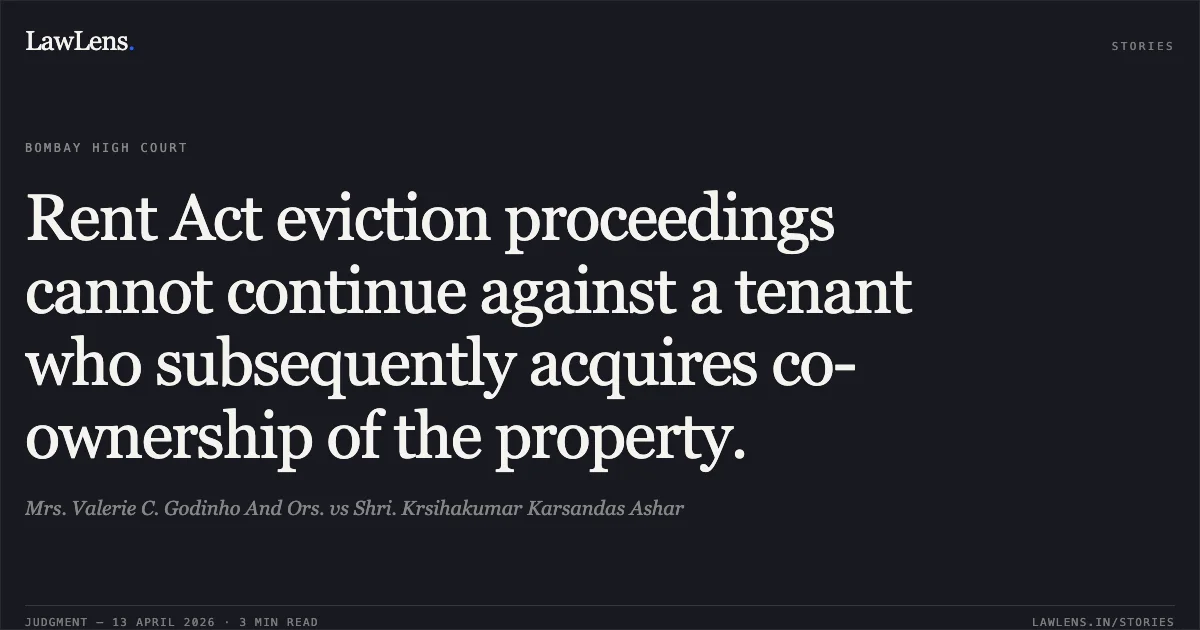
p. 11 · ¶ 15-16It held that a co-owner cannot continue eviction proceedings under the Rent Act against a tenant who has acquired a part-ownership in the property
p. 9 · ¶ 9.4The court directed the Registry to refund the entire amount deposited by the applicant (approximately Rs. 60,00,000/-) along with accrued interest, ruling that since the eviction decree was reversed, the applicant was entitled to the return of market rent deposited during the pendency of the revision
p. 14 · ¶ 24-25Original Court PDF
Mrs. Valerie C. Godinho And Ors.vsShri. Krsihakumar Karsandas Ashar
Click to open original judgment
Original judgment, available to read, download and summarize on LawLens.in