Facts
The petitioner-tenant challenged an eviction order under Section 14(1)(e) of the Delhi Rent Control Act, 1958, concerning one ground-floor room in property No. 71-D, Kamla Nagar, Delhi. The learned ARC passed the order after trial.
Source reference: pp. 1–3, paras. 1–8In revision under Section 25-B(8), the petitioner argued that the petition improperly split a tenancy covering two rooms; that another room became available to the landlord during the proceedings; that a commercial requirement could not support eviction; and that the landlord’s site plan was inaccurate.
Source reference: pp. 1–3, paras. 1–8The ARC had considered the other room’s availability and found that both rooms were required for the landlord’s office-cum-sitting space; it also rejected the site-plan objection because the tenant had filed no counter site plan.
Source reference: pp. 8–14, para. 24Issues
1. Whether the eviction petition was not maintainable because it sought eviction from only part of an allegedly indivisible tenancy.
Source reference: pp. 6–8, paras. 17–232. Whether the subsequent availability of another room negated the landlord’s bona fide requirement for the subject premises.
Source reference: pp. 14–18, paras. 25–323. Whether the commercial nature of the landlord’s requirement, or the alleged absence of necessary permissions, barred eviction under Section 14(1)(e).
Source reference: pp. 18–19, paras. 33–354. Whether the alleged inaccuracy of the landlord’s site plan disclosed an infirmity warranting revisional interference.
Source reference: pp. 19–20, paras. 36–385. Whether any of these grounds justified interference under the limited revisional jurisdiction in Section 25-B(8).
Source reference: pp. 3–6, paras. 10–16Law Applied
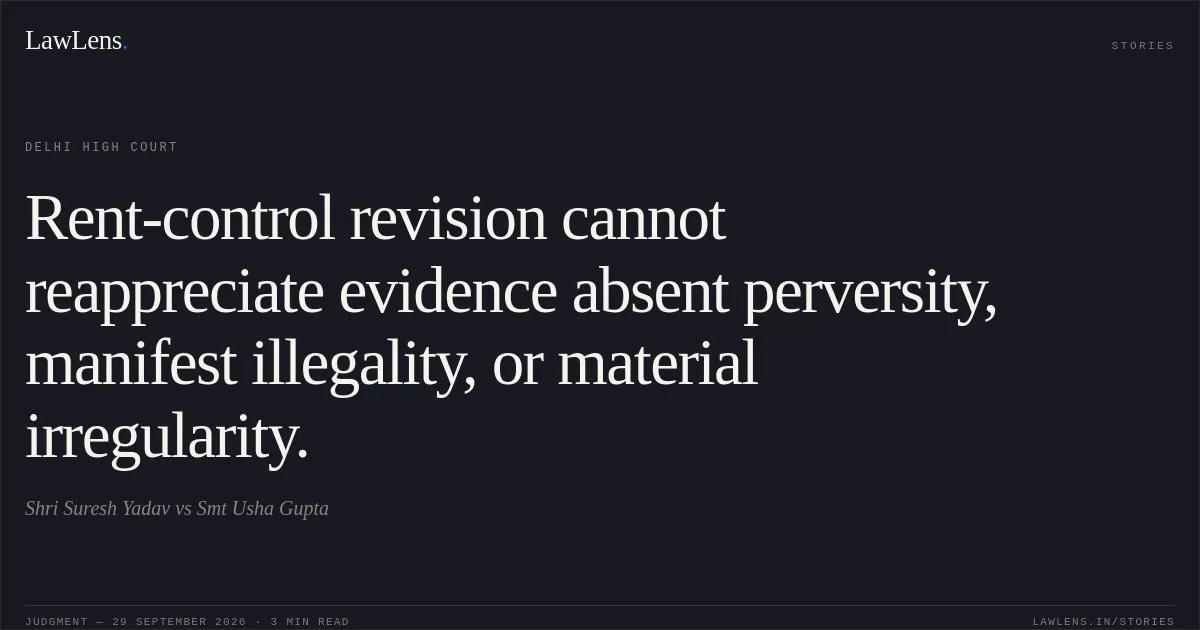
Section 25-B(8) of the Delhi Rent Control Act confers supervisory and revisional, not appellate, jurisdiction; the High Court does not reappraise evidence or substitute its view for the Rent Controller’s unless the decision-making process discloses, for example, a jurisdictional error, manifest illegality, material irregularity, perversity, or an error apparent on the record (Abid-Ul-Islam v. Inder Sain Dua; Sarla Ahuja v. United India Insurance Co. Ltd.; Hindustan Petroleum Corporation Ltd. v. Dilbahar Singh).
Source reference: pp. 3–6, paras. 10–15A single indivisible tenancy cannot ordinarily be split for partial eviction absent statutory authority, but that principle applies only when the tenancy is shown to be indivisible (Habibunnisa Begum v. G. Doraikannu Chettiar).
Source reference: pp. 7–8, paras. 20–22Relevant subsequent events may be considered in deciding whether a bona fide need continues, but their effect depends on the facts (Amarjit Singh v. Smt. Khatoon Quamarain).
Source reference: pp. 15–18, paras. 28–31The court also proceeded on the basis that Section 14(1)(e) may support eviction for a bona fide commercial requirement, and that an unsupported challenge to a site plan, without a counter site plan, does not by itself establish an infirmity.
Source reference: pp. 11–14, para. 24; pp. 18–20, paras. 33–38Reasoning
The splitting-of-tenancy objection had not been raised before the ARC, and the tenant’s written statement acknowledged that the tenancy concerning the subject room was distinct from the other room, which was under different ownership/landlordship. The record therefore did not establish an indivisible tenancy.
Source reference: pp. 6–8, paras. 17–23The ARC had considered the other room’s availability and found that it was insufficient on its own for the landlord’s stated office-cum-sitting-space requirement; the High Court found no perversity in that assessment and distinguished Amarjit Singh on its facts.
Source reference: pp. 14–18, paras. 25–32The commercial-purpose objection disclosed no error of law in the ARC’s application of Section 14(1)(e), while the site-plan objection remained unsupported by a counter plan or an explanation of how any discrepancy affected the adjudication.
Source reference: pp. 18–20, paras. 33–38Each ground, in substance, sought reconsideration of factual findings beyond the permissible revisional scope.
Source reference: pp. 20–21, paras. 39–40Holding
The High Court held that none of the petitioner’s grounds established a jurisdictional error, manifest illegality, material irregularity, perversity, or other basis for interference under Section 25-B(8).
It dismissed the revision petition as meritless and disposed of all pending applications.
Source reference: p. 21, paras. 41–43Acts & Sections Cited
3 provisions across 2 statutes referred to in this judgment. Each provision opens on LawLens.
delhi rent control act, 19582
Slum Areas (Improvement and Clearance) Act, 19561
Original Court PDF
Shri Suresh YadavvsSmt Usha Gupta
Click to open original judgment
Original judgment, available to read, download and summarize on LawLens.in