Facts
The plaintiff instituted H.R.P. Suit No. 1550 of 2001 before the Small Cause Court, Ahmedabad, alleging that the defendants were his tenants in Flat No. 54/647, Naranpura, let at a monthly rent of ₹1,500 under a notarised rent agreement dated 7 September 2001, and were attempting to transfer or sublet the premises in breach of the agreement.
Source reference: paras. 3, 11The defendants denied the landlord–tenant relationship and claimed that they were owners of the premises, asserting that the plaintiff had advanced ₹75,000 to defendant No. 2 and had procured their signatures on the rent agreement by coercion.
Source reference: para. 3.1The Trial Court held that the plaintiff was entitled to an injunction and permanently restrained the defendants from transferring, assigning, or granting possession of the premises to any third party.
Source reference: paras. 3.2–3.3The Appellate Bench confirmed the decree on 9 March 2009, holding that the plaintiff was the landlord under Section 5(3) of the Bombay Rent Act and that the Rent Court was not required to adjudicate title.
Source reference: paras. 3.4–3.5The defendants thereafter invoked the High Court’s revisional jurisdiction under Section 29(2) of the Act.
Source reference: paras. 1, 3.6Issues
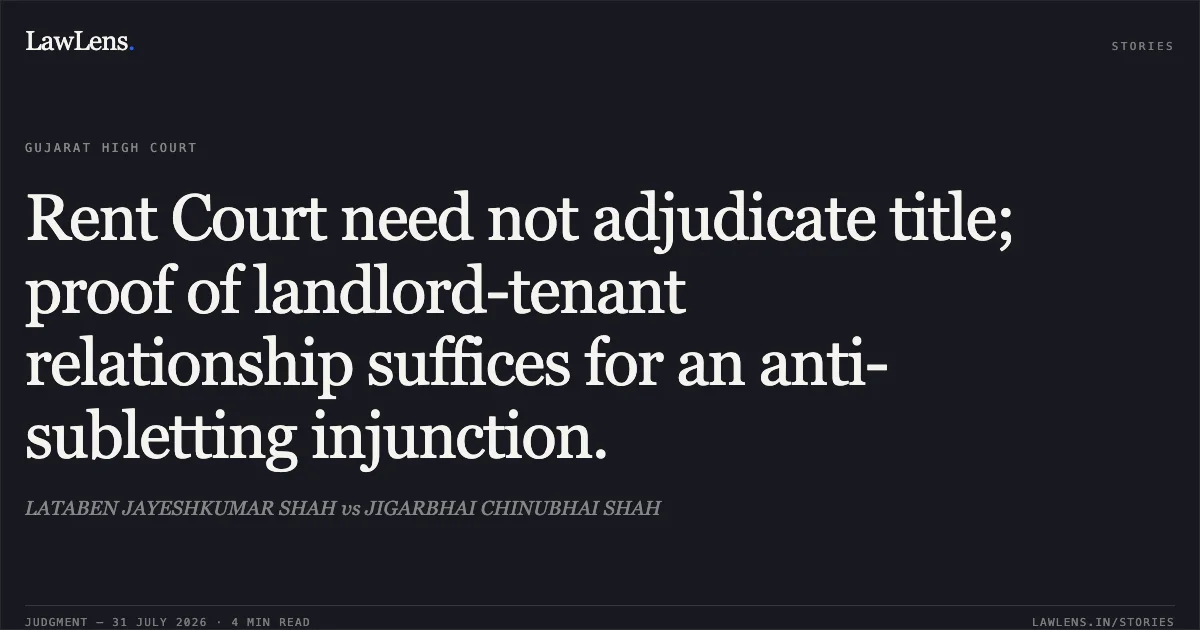
Whether the plaintiff was required to prove ownership or seek a declaration of title to maintain an injunction suit before the Rent Court, or whether proof of his status as landlord and of the defendants’ status as tenants was sufficient.
Source reference: paras. 14–16Whether the rent agreement dated 7 September 2001 established the landlord–tenant relationship despite the defendants’ denial, claim of ownership, and allegation of coercion.
Source reference: paras. 11–13, 16Whether the concurrent findings and decree of permanent injunction were perverse, grossly erroneous, or otherwise liable to interference under Section 29(2) of the Bombay Rent Act.
Source reference: para. 9Law Applied
Under Section 5(3) of the Bombay Rent Act, a “landlord” includes a person receiving or entitled to receive rent, while Section 5(11) defines a “tenant” as a person by whom or on whose account rent is payable.
Source reference: p. 13; para. 10Section 28 confers exclusive jurisdiction on the Rent Court over suits between landlords and tenants relating to premises governed by the Act, whereas Section 29A preserves the parties’ right to establish title before a competent Civil Court; consequently, the Rent Court need not finally determine title in deciding the landlord–tenant dispute.
Source reference: pp. 14–15; paras. 14–15Section 116 of the Indian Evidence Act, corresponding to Section 122 of the Bharatiya Sakshya Adhiniyam, 2023, embodies the rule that a tenant cannot deny the title of the landlord who inducted the tenant into possession.
Source reference: p. 23; para. 20.2In revisional jurisdiction under Section 29(2), interference with concurrent findings is warranted only where the findings are perverse, grossly erroneous, contrary to law, or affected by jurisdictional error, as recognised in Hindustan Petroleum Corporation Ltd. v. Dilbahar Singh, (2014) 9 SCC 78.
Source reference: para. 9The Court also relied on Suraj Lamp & Industries Pvt. Ltd. v. State of Haryana, (2012) 1 SCC 656, for the principle that immovable property cannot be transferred or purchased merely through a power-of-attorney transaction so as to establish ownership.
Source reference: para. 18.1Reasoning
The Court held that the plaintiff discharged his initial burden by producing the notarised rent agreement, which recorded the defendants’ obligation to pay ₹1,500 per month and acknowledged the plaintiff as owner/landlord; defendant No. 2 admitted his signature and acceptance of condition No. 5.
Source reference: paras. 11, 12.1, 16The defendants’ alternative case—that the transaction was a loan secured by a coerced rent agreement—was unsupported: they neither examined the alleged intermediary or notary nor produced reliable evidence of coercion, and no police complaint had been made.
Source reference: paras. 12–12.1Their claim of ownership also failed because they produced no title deed, did not examine the alleged predecessor-in-title, and the subsequently produced Housing Board certificate could not be considered without compliance with Order XLI Rule 27 CPC; in any event, it did not establish ownership.
Source reference: paras. 13, 17–18.1Since the proceedings concerned the parties’ status as landlord and tenants and the alleged prohibited transfer or subletting, the plaintiff was not required to obtain a declaration of title before seeking an injunction.
Source reference: paras. 14–16, 20.1, 21The defendants remained free to pursue an independent title claim before a competent Civil Court under Section 29A.
Source reference: paras. 14–16, 20.1, 21No perversity, gross legal error, or jurisdictional defect was found in the concurrent findings.
Source reference: paras. 19, 22Holding
The High Court answered the issues in favour of the plaintiff, holding that the rent agreement sufficiently established the landlord–tenant relationship for the purposes of the Rent Court and that the plaintiff was not required to prove title or seek a declaration of ownership in the present proceedings.
The defendants were estopped from disputing the plaintiff’s title after accepting the tenancy arrangement and could pursue any independent title claim only before a competent Civil Court.
Source reference: paras. 20.2–21The revision application was rejected, the Rule was discharged, the interim relief was vacated, and the judgments and decree of the Courts below permanently restraining the defendants from transferring, assigning, subletting, or granting possession of the suit premises to any third party were confirmed.
Source reference: para. 23Acts & Sections Cited
1 provisions across 1 statute referred to in this judgment. Each provision opens on LawLens.
Bharatiya Sakshya Adhiniyam, 20231
Original Court PDF
LATABEN JAYESHKUMAR SHAHvsJIGARBHAI CHINUBHAI SHAH
Click to open original judgment
Original judgment, available to read, download and summarize on LawLens.in