01Facts
The petitioners challenged an order made under Section 151 CPC requiring them to pay rent arrears at the admitted rate of ₹30,000 per month from September 2023 and to continue paying rent until possession was handed over.
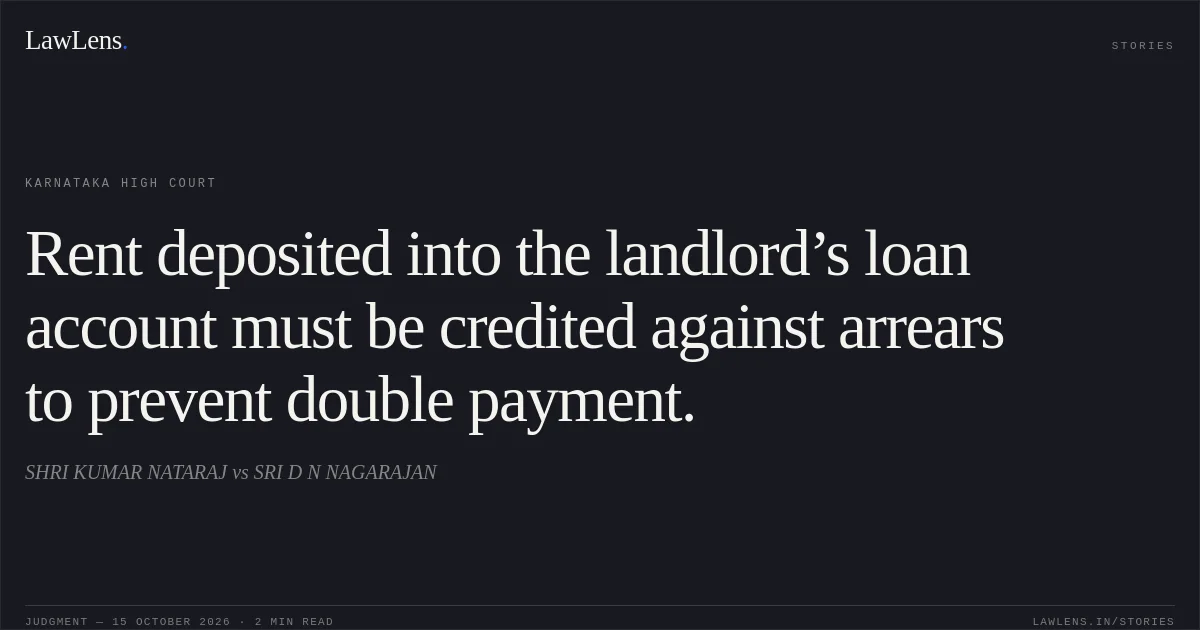
p. 2They contended that they had deposited ₹5,05,000 into the respondent’s loan account to protect their tenancy interests amid proceedings concerning the suit property, and that requiring payment again would amount to double payment.
pp. 3–4The respondent disputed that the DRT had directed those deposits and sought compliance with the Trial Court’s order.
p. 4The High Court found that the DRT order did not direct the petitioners to deposit rent into the loan account.
p. 502Issues
i.1. Whether the ₹5,05,000 deposited by the petitioners into the respondent’s loan account should be credited against the rent arrears ordered by the Trial Court.
pp. 4–6ii.2. Whether the Trial Court’s direction to pay arrears and continuing rent required modification, and, if so, on what terms.
pp. 6–803Law Applied
The petition invoked the High Court’s supervisory jurisdiction under Article 227 of the Constitution, challenging an order made under Section 151 CPC.
p. 2, 7The Court treated the petitioners’ admitted liability to pay rent of ₹30,000 per month as undisputed and assessed the amounts paid into the loan account against the arrears claimed.
pp. 4–6It also considered the DRT’s order of 19 September 2025, finding that it did not direct the petitioners to make those rent deposits.
p. 5No precedent was cited.
Provisions in the judgment · 1 · Linked ones open on LawLens
Code of Civil Procedure, 1908 Section 151
04Reasoning
The Court calculated rent for 37 months, from September 2023 to 2026, at ₹30,000 per month, totalling ₹11,10,000, and credited the ₹5,05,000 shown in the petitioners’ statement of account, leaving ₹6,05,000 outstanding.
pp. 5–6Although the DRT had not ordered the deposits, the Court considered the amounts already paid when determining the remaining arrears.
pp. 5–6It therefore modified the Trial Court’s order to permit payment of the balance in two instalments, while requiring regular monthly payments into the loan account until the respondent’s loan liability was discharged.
pp. 6–805Holding
The writ petition was disposed of, and the Trial Court’s order was modified.
pp. 7–8The petitioners were directed to deposit the arrears of ₹6,05,000 in two equal instalments by 30 October 2026 and 30 November 2026, respectively, and to continue paying monthly rent of ₹30,000 into the respondent’s loan account without default.
pp. 7–8Once the respondent’s loan liability was discharged, rent was to be paid directly to the respondent; the Trial Court’s remaining directions were left undisturbed.
pp. 7–8Original Court PDF
SHRI KUMAR NATARAJvsSRI D N NAGARAJAN
Click to open original judgment
Original judgment, available to read, download and summarize on LawLens.in