Facts
The dispute concerns Khata Nos. 75 and 133 in Bahorpur, Deoria
Source reference: p. 3In the basic year of consolidation, the land was recorded in the names of Satya Narain Giri and Surya Bhan Giri. Respondent No. 3 (Markandey) and his sons (Respondent Nos. 4 & 5) filed objections under Section 9-A(2) of the U.P.C.H. Act, claiming co-tenancy rights as descendants of Dalmardan Giri
Source reference: p. 3-4The petitioners contested this, alleging Markandey had renounced the world to become a chela (disciple) of Mahant Raghubir of Chirraiyya Math, thereby severing ties with the family
Source reference: p. 4Procedurally, the Consolidation Officer (CO) granted co-tenancy to Markandey in 1974; the Settlement Officer of Consolidation (SOC) reversed this in 1975; however, the Deputy Director of Consolidation (DDC) reinstated Markandey’s co-tenancy (granting a 1/4 share) in 1982
Source reference: p. 5-6Issues
1. Whether a member of the Giri family, upon becoming a chela of a Mahant and renouncing the worldly life (Girhast Ashram), retains the right to inherit or claim co-tenancy in joint family property.
Source reference: p. 7, 132. Whether the findings of the Civil Court in Suit No. 10 of 1910 regarding the legal "civil death" of a family member who becomes a Sanyasi operate as binding precedents for consolidation authorities.
Source reference: p. 13-14Law Applied
The Court applied Section 9-A(2) and Section 48 of the U.P. Consolidation of Holdings (U.P.C.H.) Act, 1953, regarding the adjudication of title and revisional powers
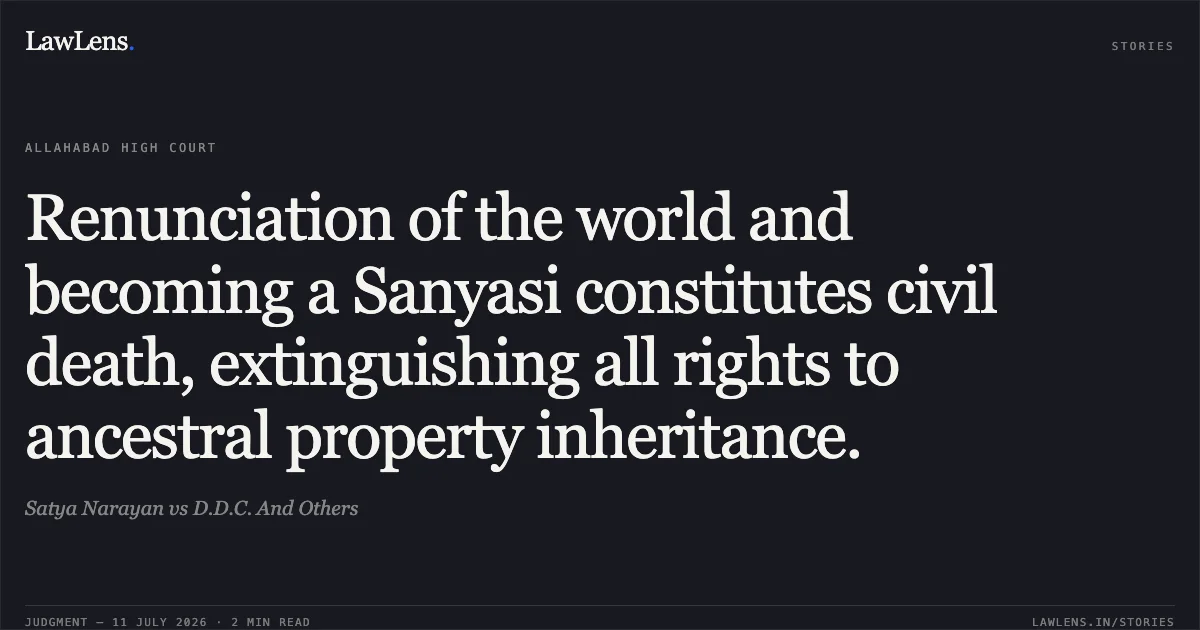
Source reference: p. 3, 5-6The Court relied heavily on the Hindu Law principle that renunciation of the world (Sanyasa) amounts to "civil death," causing the renouncer's property interests to vest in their heirs or remaining joint family members
Source reference: p. 13The Court further applied the doctrine of finality of judgments, citing a 1910 Civil Court decree and referred to precedents such as Shri Krishna Singh v. Mathura Ahir (1981) regarding the legal status of Sanyasis
Source reference: p. 8, 12-13Reasoning
The Court examined the genealogical records and the critical evidence of Markandey's transition to the Chirraiyya Math
Source reference: p. 10-11It highlighted the judgment in Suit No. 10 of 1910, where it was previously decreed that Markandey’s father, Raghubir, had ceased to be a member of the family upon becoming a Sanyasi
Source reference: p. 12-13The Court reasoned that since Markandey followed this religious path as a chela, the same principle of civil death applied, extinguishing his rights to ancestral property
Source reference: p. 13The Court observed that the SOC correctly appreciated the 1941 gift-deed and the 1934 will-deed which evidenced Markandey's lack of connection to the family property. Conversely, the DDC and CO erred by failing to give due weight to the legal consequences of renunciation and the binding 1910 decree
Source reference: p. 13-14Holding
The Court held that Markandey, having become a chela of the Math, lost his status as a co-parcener and could not claim co-tenancy
The court allowed Writ-B No. 11303 of 1982, quashing the DDC's order and restoring the SOC's order. Consequently, Writ-B No. 14250 of 1982 (filed by Markandey) was dismissed. Writ-B No. 1817 of 2024 was allowed, with a mandamus issued to restrain respondents from interfering with the petitioners' possession of the disputed land
Source reference: p. 14-15Acts & Sections Cited
3 provisions across 1 statute referred to in this judgment. Linked provisions open on LawLens.
U.P Consolidation of Holdings Act, 19533
Original Court PDF
Satya NarayanvsD.D.C. And Others
Click to open original judgment
Original judgment, available to read, download and summarize on LawLens.in